


In summary
| Type of deductible | Explanations and examples |
|---|---|
| Relative (or simple) deductible | The insured is compensated only if the loss exceeds the amount of the deductible. Example: deductible €150 → loss €100 → no reimbursement; loss €200 → full reimbursement. Present in legal protection contracts. |
| Absolute deductible | The deductible is always deducted, regardless of the amount of the loss. Example: €150 deductible → €100 loss → no reimbursement; €200 loss → €50 reimbursement. Common in auto and home insurance. |
| Proportional deductible | The deductible varies based on a percentage of the damage, with a minimum and a maximum. Example: 10% of the loss with a minimum €250 and a maximum €450. If the loss is €2,600 → €260 deductible; if loss is €2,200 → €250 deductible; if loss is €5,600 → €450 deductible. |
| Fixed deductible | Amount always the same, defined in the contract, regardless of the loss. Example: fixed €150 deductible → systematically deducted. Allows reducing the premium but increases the out-of-pocket portion. |
| Variable deductible | Amount that adapts to the cost of the loss (often in %). Example: 10% deductible on a €1,000 loss → €100 remaining to pay. More fair for small claims but can be costly for large damages. |
| Minimum and maximum deductible | Framework for the proportional deductible. Example: min €50, max €500 → you will never pay less than the minimum or more than the maximum, regardless of the claim value. |
In insurance, the concept of deductible plays a key role as it determines the portion of costs remaining at the insured’s expense in case of a claim. Too often overlooked, it directly influences the amount of compensation as well as the cost of the insurance premium. There are several forms of deductibles, each with its own specificities, advantages, and disadvantages. To better understand these differences and make an informed choice when subscribing to a contract, here is a summary table of the main types of insurance deductibles.
🎯 Why do insurers use deductibles?
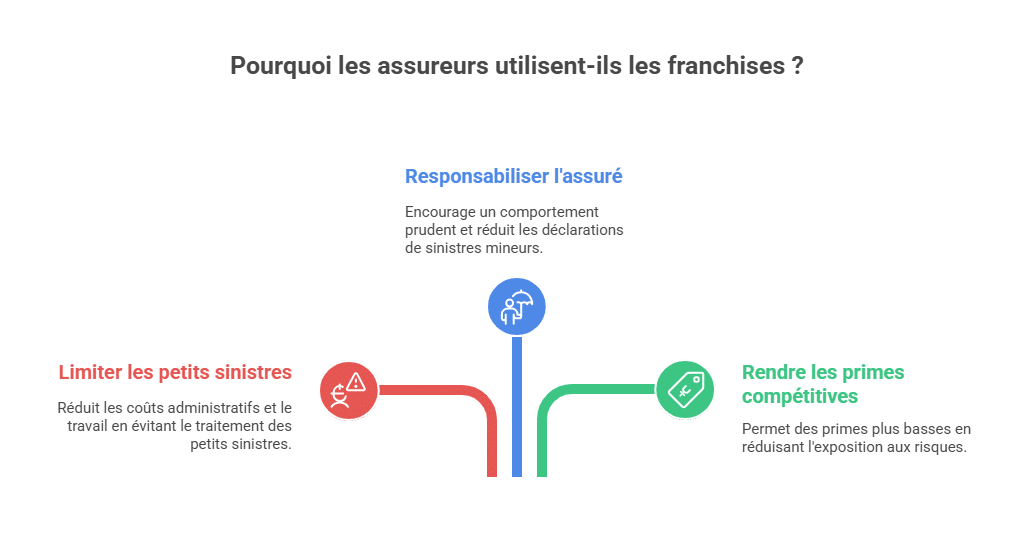
The presence of a deductible in an insurance contract is not insignificant. It serves several essential objectives for insurance companies:
-
Limit management of small claims : handling damage of a few dozen euros often costs more in administrative fees than the amount of reimbursement itself. The deductible helps avoid this workload and reduces internal costs.
-
Make the insured more responsible : by leaving part of the damage at the client’s expense, the insurer encourages cautious behavior and discourages the declaration of minor claims.
-
Make premiums more competitive : thanks to deductibles, insurers reduce their exposure to frequent risks and can offer more attractive premiums. This helps balance the relationship between the price paid by the insured and the level of coverage offered.
Relative (or simple) deductible
The relative deductible, sometimes called simple deductible, is an insurance mechanism based on a clear principle: you are compensated only if the amount of the claim exceeds the deductible specified in the contract. Otherwise, you receive nothing from your insurer.
Concretely, this deductible acts as a trigger threshold. It does not operate proportionally or deductively but in a “all or nothing” manner.
👉 Detailed example :
-
If your contract provides a relative deductible of €150 and your claim is assessed at €120, you will receive no compensation from the insurer.
-
If your claim amounts to exactly €150, the deductible still applies, and you will not be reimbursed.
-
However, if your claim reaches €200, the insurer will cover the entire amount, without deducting the deductible.
To remember :
-
The relative deductible blocks reimbursement below or up to the deductible, but is fully waived once the damage exceeds it.
-
Unlike the absolute deductible, it does not reduce compensation in cases of higher claims: you then receive the full damage amount.
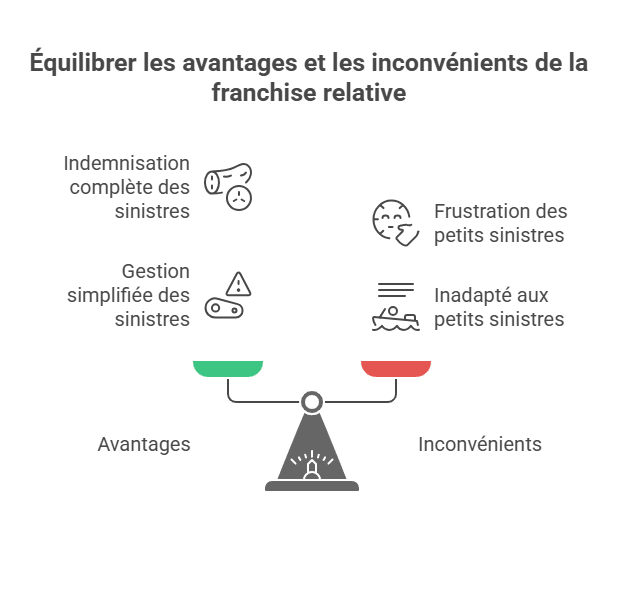
✅ Advantages of the relative deductible
-
The insured is fully compensated if the damage exceeds the deductible.
-
Allows filtering small claims, which prevents the insurer from managing minor cases.
-
Promotes a win-win relationship: the insured does not lose anything on major claims, and the insurer limits management costs on small ones.
❌ Disadvantages of the relative deductible
-
It can be perceived as frustrating for policyholders if claims are frequent but low in amount.
-
It does not suit policies covering ordinary and low-cost damages, as the insured may feel like “paying for nothing”.
📌 Areas of application
The relative deductible is typically found in legal protection contracts, where it helps avoid managing minor disputes while guaranteeing full coverage for larger cases. It may also appear in some health or specialized insurance policies, depending on the insurer.
Absolute deductible :
The absolute deductible is the most common form of deductible in insurance contracts, especially in auto and home insurance. It operates systematically: the amount of the deductible is always deducted from the compensation, regardless of the severity of the claim.
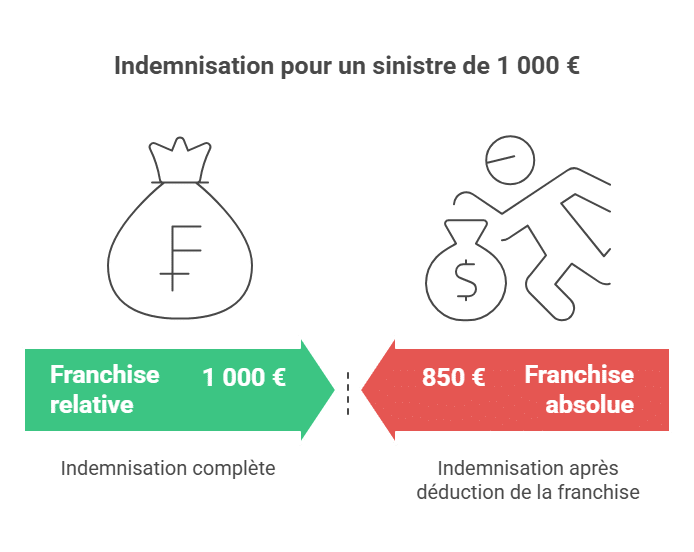
Concretely, the insured is only compensated if the amount of damage exceeds the deductible. And even then, they only receive the difference between the claim amount and the contractual deductible.
👉 Detailed example :
-
If the deductible is set at €150 and the claim is €100, you will receive no compensation because the damage is below the deductible.
-
If the claim reaches €200, the insurer will reimburse only €50 (200 – 150).
-
For a €1,000 claim, you will be compensated up to €850 (1,000 – 150).
To remember : with the absolute deductible, the deduction applies in all cases where the claim exceeds the deductible. The insured must therefore always bear part of the costs.
✅ Advantages of the absolute deductible
-
Predictability : the amount of the deductible is clear and known in advance, facilitating claim management.
-
Reduced insurance premium : the higher the deductible, the often lower the premium.
-
Risk sharing : it makes the insured responsible by leaving them part of the claim cost.
❌ Disadvantages of the absolute deductible
-
The insured is never fully compensated, even for very large claims.
-
It can be burdensome for small claims, where final compensation may seem insignificant.
-
It can be perceived as disadvantageous compared to the relative deductible, because the insured must always participate financially.
📌 Areas of application
The absolute deductible is widespread in most auto insurance contracts (glazing breakage, accident, theft, fire) and in home insurance (fire, water damage, burglary). It is favored by insurers because it helps reduce the number of small claims and for systematically sharing the cost of claims with the insured.
Proportional deductible :
The proportional deductible is a specific form that varies according to the amount of damage suffered. Unlike fixed or absolute deductibles, it does not correspond to a predetermined amount but to a percentage applied to the amount of the claim.
To prevent abuses or extreme situations, this deductible is always limited by two bounds:
-
a minimum deductible (floor amount below which the deductible cannot go),
-
and a maximum deductible (ceiling beyond which the deductible cannot increase).
👉 Detailed example (10% deductible with min €250 and max €450):
-
If the damage is €2,600, the deductible equals €260 (10%). Since this amount falls within the minimum and maximum, it is retained as is.
-
If the damage is €2,200, the 10% corresponds to €220, but since this is less than the minimum, the applied deductible will be €250.
-
If the damage is €5,600, the 10% correspond to €560, but since this exceeds the set ceiling, the deductible will be limited to €450.
To remember : the proportional deductible is flexible since it adjusts to the size of the claim, but it also ensures some fairness through the system of minimum and maximum.
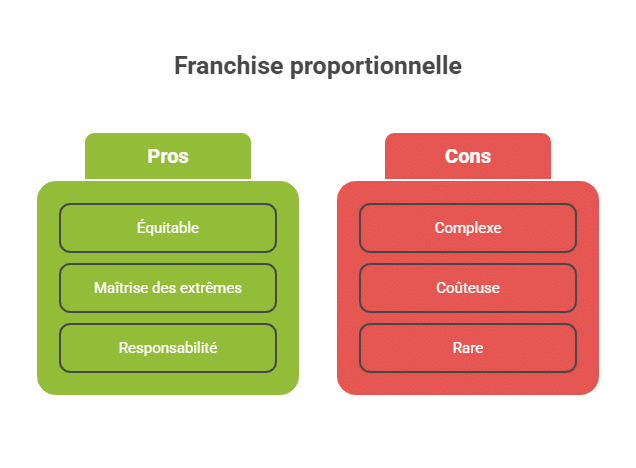
✅ Advantages of the proportional deductible
-
It is fair: the larger the claim, the more the insured’s participation is proportional.
-
The minimum and maximum system helps control extremes and avoid excessive or too little charges.
-
It encourages responsibility because the insured always participates, but proportionally.
❌ Disadvantages of the proportional deductible
-
It can be complex to understand for the insured, especially with minimum and maximum notions.
-
It can be costly for medium to large claims because the deductible amount can rise quickly.
-
Rarely offered in standard policies, it remains less common than the absolute deductible.
📌 Areas of application
The proportional deductible is mainly found in some specialized policies, for example in professional insurance or for specific risks (transport, fleet insurance, industrial risks). It is less common in home or auto insurance policies aimed at individuals.
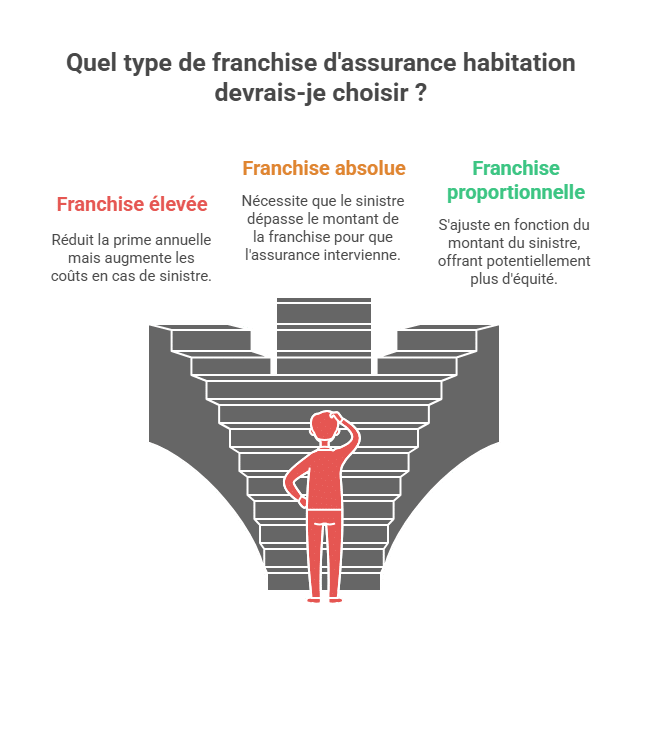
The specificities of home insurance deductibles: choices and implications
When choosing home insurance, one of the fundamental aspects to consider is the type of deductible applicable. Selecting an appropriate deductible level for your home insurance can significantly influence your annual premium as well as the compensation amount in case of a claim. For example, a high deductible might lower your premium, but it also means you will have to pay a larger part of the costs in case of damage occurring in your home. This is an important calculation for homeowners and tenants who must weigh the risk against the potential cost.
Impact of different deductibles on claims management
Before proceeding, you need to understand how each type of deductible influences claim management. With an absolute deductible, for example, the loss must exceed the deductible amount for the insurance to intervene, which can be a barrier for frequent small damages. Conversely, a proportional deductible adjusts based on the claim amount, which can be fairer, but requires a careful review of the contract terms to avoid unpleasant surprises. Therefore, choose your deductible according to your specific needs and risk tolerance to optimize your coverage and peace of mind against daily life hazards.
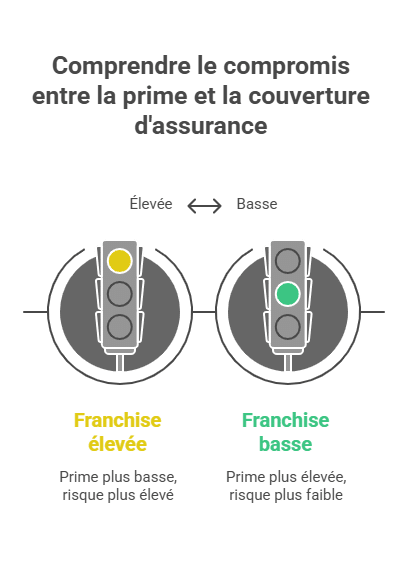
Comparison: high deductible vs low deductible
It is common to hesitate between a high deductible and a low deductible. Each of these options offers advantages and disadvantages:
-
A high deductible allows for reduced insurance premiums. It is attractive for policyholders who expect to have few claims. However, if a loss occurs, the out-of-pocket share can be very significant.
-
A low deductible provides better protection in case of claim, as the insurer’s coverage is higher. Conversely, the premium will generally be higher.
👉 Including a comparison table :
| Type of deductible | Advantages | Disadvantages |
|---|---|---|
| High | Reduced insurance premium 💰 | Heavier burden in case of a claim ⚠️ |
| Low | Better coverage ✅ | Higher annual premium 📈 |
The right choice depends on the profile of the insured, their risk tolerance, and their available budget.


FAQs about deductibles in insurance
What is a fixed deductible?
The fixed deductible is a fixed amount of money that remains at your expense in case of a claim covered by your insurance. It represents a portion of the costs you must bear when using your policy’s coverages. The fixed deductible is specified in your insurance contract and remains the same regardless of the amount of costs incurred. It can be expressed as a percentage or as a fixed amount depending on the guarantees chosen. For example, if you have a car insurance policy with a fixed deductible of €150 for damages caused to a third party, you will have to pay the €150 plus the insurance premium you paid.
What is a fixed deductible, and how is it defined?
The fixed deductible is a sum of money that remains at your expense in case of a claim covered by your insurance. It accounts for part of the costs you must handle when using your policy’s coverages. The fixed deductible is defined in your insurance contract and stays constant regardless of the amount of costs involved.
It can be expressed as a percentage or a fixed amount depending on the guarantees subscribed to. For example, if you have car insurance with a €150 fixed deductible for damages to a third party, you will pay the €150 plus the premium. The fixed deductible is typically used to reduce the insurance premium cost. By accepting to cover part of the costs in case of claim, you can obtain a lower premium. However, it is important to understand the terms of the fixed deductible before subscribing to an insurance contract to know what remains at your expense in case of a claim.
What are the advantages and disadvantages of the fixed deductible?
Advantages :
- The insurance premium is generally lower when a fixed deductible is provided in the contract.
- The fixed deductible can be a suitable solution for people with a low risk of using their insurance coverages.
Disadvantages :
- In case of a claim, you will have to pay the fixed deductible in addition to the premium. If the costs are high, this can represent a significant amount for you.
- The fixed deductible remains the same regardless of the amount of costs involved, which can be advantageous in some cases but disadvantageous if costs are very high.
- If you subscribe to insurance with a fixed deductible, you must carefully respect the conditions of the deductible to avoid financial penalties in case of a claim.
Can the fixed deductible amount be negotiated with your insurer?
It is possible to negotiate the fixed deductible amount with your insurer, but it depends on their policy and flexibility. Some insurance companies are more accommodating than others regarding negotiations of the fixed deductible, while others are less willing to modify it.
Here are some factors that can influence the possibility of negotiating the fixed deductible:
- Your risk profile: If you have a good driver record or live in a low-risk area, the insurer may be more inclined to negotiate the deductible amount.
- The nature of your insurance contract: Some insurances are more complex, making negotiation more difficult. For example, negotiating the fixed deductible of auto insurance is easier than that of life insurance, which involves many guarantees and variables.
- Your loyalty level: Being a loyal customer can make the insurer more willing to negotiate the deductible amount.
What is a variable deductible, and how does it work?
A variable deductible is an amount that remains at your expense in case of a claim covered by your insurance but varies according to the costs incurred. Unlike the fixed deductible, which is set in advance and remains the same regardless of costs, the variable deductible is proportional to the expenses.
This is how a variable deductible can work :
- If you have car insurance with a 10% deductible for damages caused to a third party, you will pay 10% of the costs plus the premium. For example, if costs amount to €1,000, you will pay €100 (10%).
- If you have home insurance with a €50 deductible for a claim, you will pay €50 plus the premium, regardless of the costs involved. If the costs are higher than €50, you will pay the €50 plus a part of the additional costs.
The variable deductible can be advantageous if costs are low because it prevents paying an excessively high deductible. However, it can become costly for large claims because you will pay part of the additional expenses beyond the deductible, on top of the premium. It is important to understand the terms of a variable deductible thoroughly before subscribing to an insurance policy to know what will be your out-of-pocket expense in case of a claim.
What are the minimum and maximum deductibles, and what are their purposes?
The minimum deductible is the smallest amount of the deductible that remains at your charge in case of a claim. It is specified in your insurance contract and cannot be lower than this amount. The maximum deductible is the highest amount that remains your expense in case of a claim and is also specified in the contract, not exceeding this amount.
The minimum and maximum deductibles are used to frame the variable deductible, i.e., a deductible that varies according to the expenses incurred. If you have an insurance policy with a variable deductible, it cannot be lower than the minimum or higher than the maximum deductible.
Here is an example of how the minimum and maximum deductibles work :
- If you have car insurance with a 10% variable deductible and a €50 minimum, you will pay €50 if expenses are less than €500 (because €50 is 10% of €500). If expenses are higher than €500, you will pay 10% of the costs plus the premium.
- If you have home insurance with a €50 variable deductible and a €500 maximum, you will pay €50 if expenses are less than €1,000 (because €50 is 5% of €1,000). If expenses exceed €1,000, the deductible will be capped at €500, regardless of the actual costs incurred.
The minimum and maximum deductibles help limit the costs you need to cover in case of a claim and better manage your budget. It is essential to understand how these modalities work before subscribing to an insurance contract to know what will be your remaining expense in case of a claim.
Is it possible to delete the deductible in an insurance contract?
It is possible to remove the deductible in an insurance contract, but this generally results in an increase in the insurance premium. By agreeing to cover part of the costs in case of a claim, you can often benefit from a lower premium. If you wish to eliminate the deductible, you should be prepared to pay a higher premium.
It’s important to note that removing the deductible may not be possible in some cases. For example, certain insurance companies may impose a minimum deductible that cannot be waived. In such cases, you will have to pay this minimum deductible in addition to the premium, even if you opt to remove it.
It is advisable to understand the terms of the deductible thoroughly before subscribing to an insurance contract to know what will be your expense in case of a claim. If you want to remove the deductible, discuss this possibility with your insurer to find out if it’s feasible and the associated costs. You can also compare offers from other insurers to see if it’s possible to find an option that removes the deductible without significantly increasing the premium.
What happens if the conditions of the deductible are not met (for example, if a claim is not declared)?
It is important to respect the conditions of the deductible specified in your insurance contract to avoid financial penalties in case of a claim. If you do not comply, your insurer may refuse to cover the costs incurred, and you will have to pay them entirely.
Here are some examples of what can happen if you do not respect the deductible conditions:
- If you do not report a claim when required, your insurer may refuse to cover the incurred costs, which you will have to pay fully.
- If you do not meet the declaration deadlines specified in your insurance contract, the insurer may refuse coverage or impose additional deductible conditions.
- If you fail to fulfill due diligence obligations (e.g., neglecting recommended prevention measures), the insurer may refuse to cover the costs or apply additional deductibles.
Therefore, it is crucial to understand the deductible terms before subscribing to an insurance contract to know what will be your remaining expense and to follow these conditions to avoid problems.
Does the deductible apply to all guarantees of my insurance contract or only to certain ones?
The deductible may apply to some or all guarantees of your insurance contract, depending on its terms. It is important to carefully read the conditions of your insurance contract to know which guarantees are affected by the deductible and under what conditions it applies.
Here are some examples of when the deductible may be applicable:
- If you have auto insurance with a €150 deductible for damages to a third party, this deductible will only apply to guarantees related to damages to others (e.g., civil liability).
- If you have home insurance with a €50 deductible for a claim, this deductible will apply to all guarantees related to covered risks (e.g., fire, water damage, theft).
It is essential to understand the deductible’s scope before subscribing to an insurance contract to know what will be your expense in case of a claim and to choose guarantees that best meet your needs. If in doubt about how the deductible applies to certain guarantees, consult your insurer or review your policy’s terms carefully.
🚗 Assurance Auto — Articles liés
🔧 Protégez votre véhicule contre les pannes mécaniques
La garantie panne mécanique couvre les réparations imprévues après la garantie constructeur. Obtenez un devis personnalisé en 2 minutes.
Obtenir un devis gratuit →Lien sponsorisé

Entraîne-toi avec nos Quiz de révision
Fini les lectures passives. Pour retenir les notions clés du BTS Assurance, teste-toi ! Inscris-toi pour recevoir 1 quiz par jour directement dans ta boîte mail.


