


The SWOT model proves to be a valuable tool for modern businesses, allowing them to understand internal strengths and weaknesses while exploring external opportunities and threats. Lidl, a major player in the hard discount sector, exemplifies this analysis method perfectly. By leveraging its strengths and anticipating challenges, the brand manages not only to remain competitive but to establish itself in the face of fierce competition. Whether it involves Carrefour, Auchan, Intermarché, Leclerc, or even Aldi, this analysis provides an enriching and relevant overview.
- Introduction to Lidl Group
- SWOT Analysis
- Strengths
- Weaknesses
- Opportunities
- Threats


Introduction to Lidl Group
Lidl is a German retail chain founded in 1930, initially specializing in exotic fruits. Over the decades, the group transformed, and in 1973, it opened its first supermarket in Germany, focusing on low prices and product diversity. Founder Josef Schwarz aimed to make food products accessible to everyone, leading to immediate success and rapid international expansion starting in 1988.
Today, Lidl has more than 8,250 stores across 25 countries, with a workforce of 160,000 employees, including approximately 20,000 in France, where the brand operates nearly 1,700 outlets. In 2017, the group’s revenue reached 95 billion euros, and its growth continues, notably in France, where market share gradually increased to 6.2% during the same period.
| Year | Revenue (billion €) | Market share (%) |
|---|---|---|
| 2015 | 80 | 5.5 |
| 2016 | 85 | 5.8 |
| 2017 | 95 | 6.2 |
This transformation has positioned Lidl among the leaders in hard discount, competing directly with brands like Leader Price, Casino, and Système U. However, the traditional hard discount image has sometimes harmed the brand, which must develop a strategy to restore its image while maintaining low prices.

SWOT Analysis
Analyzing Lidl through the SWOT method helps understand various aspects influencing its operation and results. This approach aims to provide a comprehensive overview, which is essential for a rapidly expanding brand with growing ambitions.
Strengths
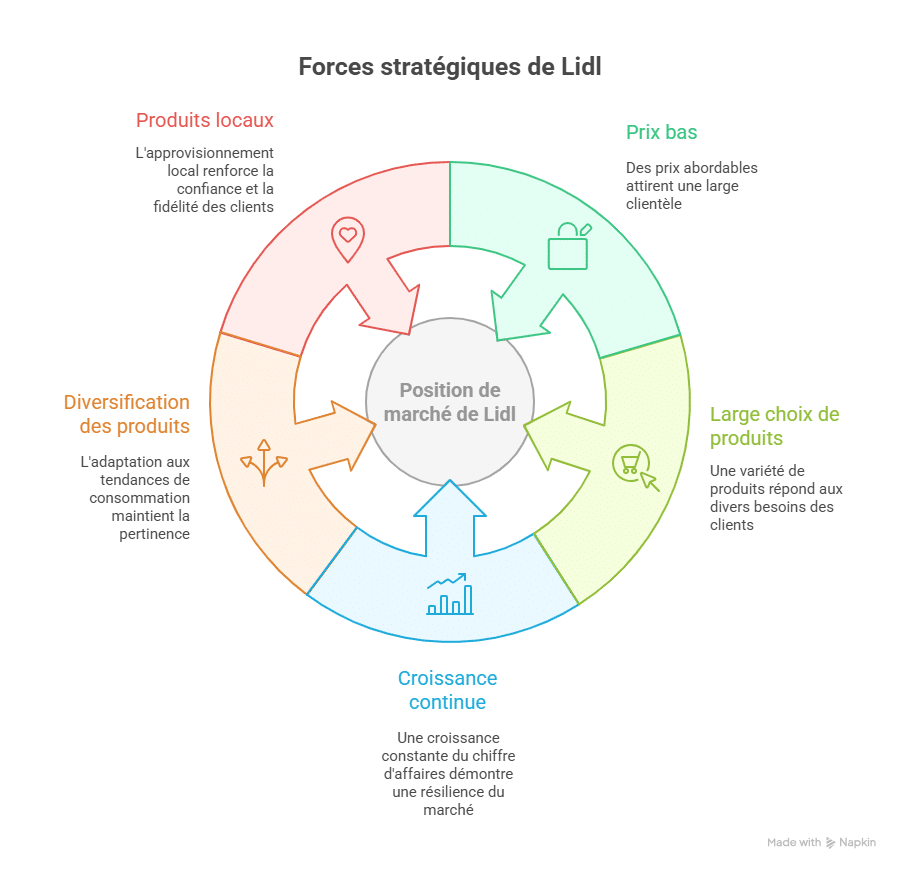
Lidl’s strengths are diverse and often interconnected. Among the most significant are:
- Consistently low prices year-round, attractive to a wide customer base. 🛒
- A wide product selection, including a majority of private label items, ensuring perceived high quality. 📦
- Continuous growth even after periods of decline, illustrated by a steady increase in revenue. 📈
- Product diversification to anticipate consumption trends, especially towards local products. 🌱
These strengths result from a well-developed strategy that allows Lidl to stand out in an extremely competitive market. For instance, the fact that 75% of products on shelves are of French origin enhances the brand image, which aims to be close to its customers and their expectations.
Weaknesses
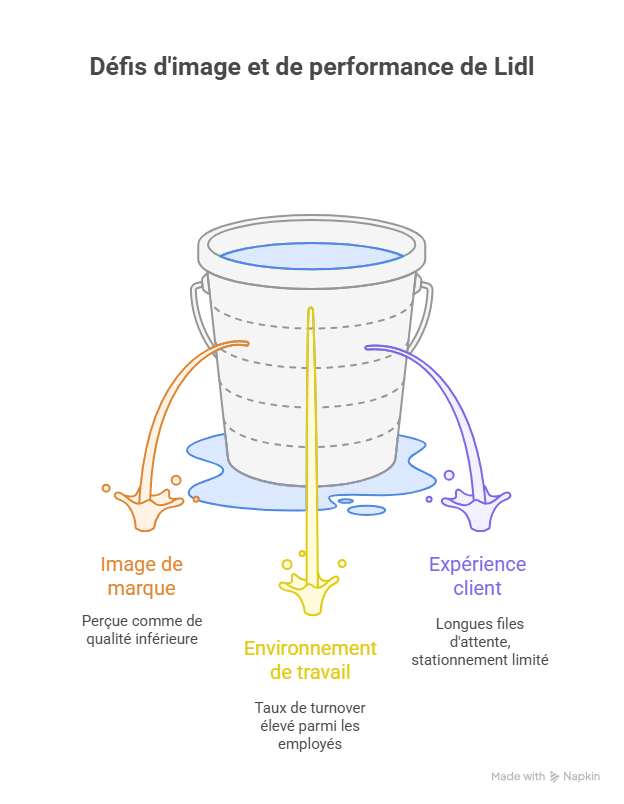
Despite these strengths, Lidl must deal with several weaknesses that could impact its image and performance:
- An image of the brand still associated with hard discount, often perceived as inferior quality. ⚠️
- A challenging working environment, leading to a high turnover rate among employees. 😩
- Additional issues such as long wait times at checkout and limited parking space. ⏳
These weaknesses, although addressable, require strategic attention to avoid damaging the brand’s reputation. Lidl therefore implements policies focused on improving customer experience while seeking to change its brand perception.


Opportunities
In the face of a constantly evolving market, Lidl has the opportunity to explore new development avenues:
- An geographic expansion into new regions or countries, capitalizing on its growing reputation. 🌍
- Development of e-commerce, meeting the expectations of modern consumers. 🖥️
- Adapting to the demand for organic products, highlighting items that meet environmental commitments. 🍏
This positions the brand for continued growth and adaptation to new consumer habits. Diversification into healthier and more eco-friendly products appears to be a strategic direction for the future.
| Opportunities | Impact potential |
|---|---|
| International expansion | Rapidly increasing brand recognition |
| Online commerce development | Enhancing customer experience |
| Offering organic products | Attracting a new customer base |

Threats
In this sector, Lidl must contend with several threats that could impact its market position:
- The intensified competition from other hard discount giants such as Aldi and Leader Price. ⚔️
- The growth of online shopping, which is gaining popularity and attracting an expanding customer base. 🛍️
- Economic fluctuations and political uncertainties that could affect consumers’ purchasing power. 💸
These threats require constant vigilance and rapid strategic adaptation. Lidl must remain agile, responsive to environmental challenges, and continue to leverage its strengths while mitigating its weaknesses.
Future Perspectives for Lidl
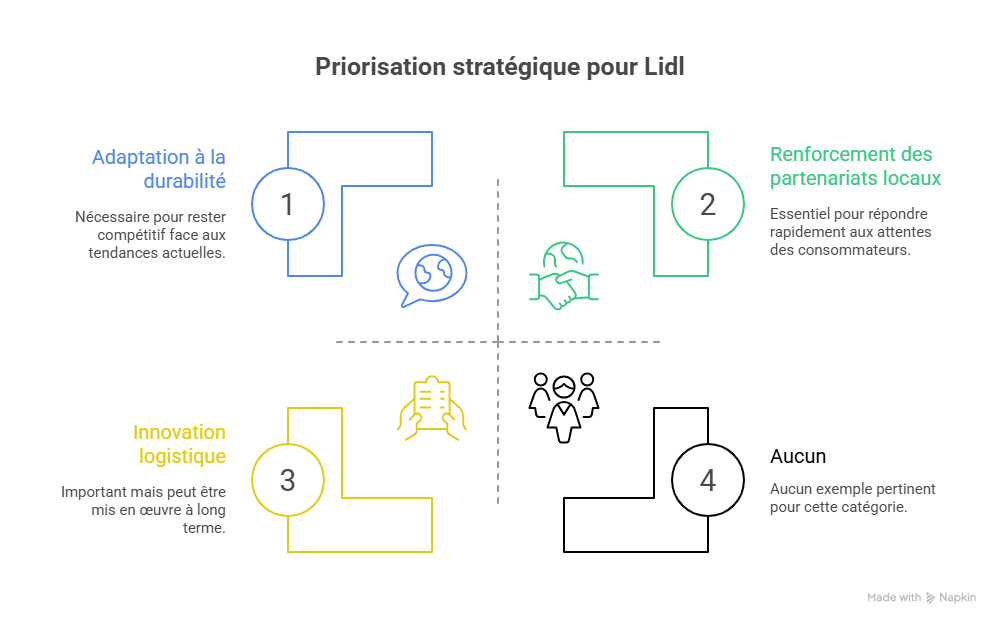
Based on the previous analyses, it appears that Lidl has solid assets for the future. However, the path forward requires constant vigilance against sector challenges. Strategic axes to consider might include:
- A pursuit of innovation in logistics processes to optimize supply chain efficiency. 🔄
- Strengthening partnerships with local producers to meet demand for quality and proximity products. 👩🌾
- Continuous adaptation to evolving consumer expectations, especially regarding sustainability and environmental respect. 🌍
Overall, Lidl seems well positioned to expand while staying aligned with market trends. SWOT analysis, beyond just being a tool for analysis, should become a real strategic lever to anticipate challenges and seize opportunities.
FAQ
What is Lidl’s main strength?
Lidl’s main strength lies in its ability to offer low prices while ensuring a perceived high quality of its products.
How does Lidl position itself against its competitors?
Lidl positions itself as a leader in the hard discount sector, with increasing market shares against competitors like Aldi and Leader Price.
What threats should Lidl monitor?
Threats include competition from other discount giants and the rise of online shopping, which impacts consumer buying habits.
How does Lidl manage its brand image?
Lidl conducts targeted advertising campaigns to improve its image and reposition itself as a “smart discount,” often focusing on the quality of its products.
What are Lidl’s future challenges?
Future challenges include innovation, geographic expansion, and adapting to new consumer demands, especially regarding ecological concerns.



Sur le même thème
- In-Depth Analysis of the SWOT Method at Toyota
- SWOT Analysis: Understanding its definition, mastering the method, and discovering a concrete example
- Discovery of Louis Vuitton’s SWOT analysis
- Exploring Samsung’s Strengths and Weaknesses: A SWOT Analysis
- An In-Depth Exploration of Crédit Agricole’s SWOT Analysis
📊 Analyses SWOT similaires
📊 Voir aussi : notre hub centralisé de toutes les analyses SWOT & PESTEL (206 études) classées par secteur — Tech, Auto, Mode, Distribution, Finance.
Tu prépares le BTS Assurance ?
Cette analyse SWOT fait partie des thèmes abordés dans les épreuves. Notre E-book de révision couvre l'intégralité du programme en fiches claires et synthétiques.
- 100 % du programme BTS Assurance
- Fiches 1ère et 2ème année
- Créé par un diplômé
- Téléchargement immédiat

Entraîne-toi avec nos Quiz de révision
Fini les lectures passives. Pour retenir les notions clés du BTS Assurance, teste-toi ! Inscris-toi pour recevoir 1 quiz par jour directement dans ta boîte mail.


