


In summary
| 🧩 Section | 📄 Key Content |
|---|---|
| 🎯 Introduction | Double analysis SWOT + PESTEL to understand Danone: internal strengths/weaknesses and external opportunities/threats (health, sustainability, competition, innovation). |
| 🕰️ Historical context | 1919, Barcelona, Isaac Carasso → health yogurts (Pasteur ferments). Internationalization, agri-food refocusing, present in 120+ countries. |
| 🔭 Vision – Mission – Objectives | Vision One Planet. One Health; mission: healthy & sustainable nutrition. Objectives: carbon neutrality by 2050, rise of plant-based products, growth in emerging markets, end-to-end traceability. |
| 🛡️ Strengths (SWOT) | Brand image health-oriented, large portfolio (dairy, plant-based, waters, infant/medical), global presence, R&D supported, partnerships (Partner for Growth). |
| ⚡ Weaknesses (SWOT) | Dependence on dairy (volatile costs), rigidity in certain segments, pressure on margins, reputational risk, multi-country execution complexity. |
| 🚀 Opportunities (SWOT) | Growth in plant-based and health nutrition, expansion in Asia/China, co-innovation (Partner for Growth), sponsorship (Olympics 2024), acceleration of CSR. |
| 🌪️ Threats (SWOT) | Taste volatility, competition from plant-based/organic, health crises, geopolitical tensions, regulatory pressure. |
| 🧭 Competitors | Nestlé, Lactalis, Oatly/Alpro, Unilever: pricing pressures, plant-based innovation, and marketing speed → need to innovate and premiumize. |
| 🏛️ Policy (PESTEL) | Local regulations, taxation, quotas/barriers, trade agreements, labor laws → impacts on costs and deployment. |
| 💶 Economy (PESTEL) | Purchasing power, raw material inflation, exchange rates, partnerships → require price agility and efficiency. |
| 👥 Sociocultural (PESTEL) | Quest for health, sustainability, transparency; engagement in sports/social; rise of responsible consumption. |
| 🔬 Tech & 🌱 Ecology (PESTEL) | Foodtech, traceability, sustainable packaging, optimized logistics, personalized nutrition; measurable CSR goals. |
| ⚖️ Legal (PESTEL) | Labeling, health standards, environmental laws, nutritional policies, GDPR → compliance and investment. |
| 🧪 Case studies | Alpro/So Delicious, acquisition of Follow Your Heart (2021), COP28, restructuring 2022-2023 → repositioning toward plant-based and efficiency. |
| ✅ Conclusion | Solid strengths but challenges: succeed in the plant-based transition, manage regulation and volatility; keys are anticipation, partnerships, innovation. |
| ❓ FAQ | Reminders: usefulness of SWOT/PESTEL, role of Partner for Growth, challenges of the dairy sector, complementarity of methods, RSE integration. |
Understanding the complex universe of Danone involves an informed view of its internal and external environment through SWOT and PESTEL analyses. This insight allows grasping the company’s intrinsic strengths and weaknesses, but also the opportunities and threats shaping its development in a rapidly changing dairy and nutrition market. Moreover, it opens a window on crucial issues related to health, sustainable development, competition, and innovation—fundamental vectors for its longevity. Let’s explore these two strategic analysis methods together, essential for understanding the dynamics and challenges faced by Danone today.
Founded in 1919 in Barcelona by Isaac Carasso, Danone was born of a simple desire: to offer healthy yogurts inspired by Pasteur’s ferments to improve digestive health. Over a century, the company has become a major player in global nutrition, present in more than 120 countries.
After international expansion in the 1970s, Danone gradually refocused on the food industry, divesting from non-strategic activities to concentrate its resources on health, well-being, and sustainable innovation.
Today, the company faces new structural challenges: rising plant-based products, ecological transition, transparency demands, global economic volatility, and rapid changes in eating habits. These challenges are redefining Danone’s growth and differentiation levers.
Summary:
- The essential strengths of Danone in the global agri-food landscape
- Structural weaknesses and internal challenges to Danone’s strategy
- Strategic opportunities offered by current market trends
- Threats and risks that will weigh on Danone’s growth
- Political factors impacting the group’s international expansion
- Economic influences and their impact on commercial strategy
- Sociocultural dimensions and issues related to health and sustainable development
- Impact of technological and ecological evolutions on innovation at Danone

Vision, mission, and strategic objectives
Understanding Danone also involves grasping its vision and its mission for the long term. The company frames its strategy around the slogan “One Planet. One Health,” a conviction that the health of people and that of the planet are deeply interconnected.
-
🌍 Vision: promote healthy and sustainable eating accessible to all.
-
🧭 Mission: design products that combine nutritional quality, innovation, and environmental respect, while positively contributing to the societies in which it operates.
-
🎯 Major strategic objectives:
-
Achieve carbon neutrality by 2050.
-
Increase the share of plant-based products in total revenue.
-
Strengthen presence in emerging markets such as China, India, and Africa.
-
Ensure full traceability across the entire supply chain.
-
This vision provides a clear direction for all commercial, R&D, and environmental initiatives of the group.

The essential strengths of Danone in the global agri-food landscape through its SWOT analysis
In the competitive landscape of the agri-food sector, Danone holds a very crucial position thanks to a strong identity based on numerous strengths. These assets are not just a simple foundation; they define the company’s ability to establish itself and respond effectively to consumer needs. In essence, understanding these strengths means grasping why Danone today is an essential reference, especially in the dairy products market.
A major pillar lies in the extensive range of products offered. Danone is not limited to traditional dairy products; the company has diversified its catalog with plant-based products, waters, as well as infant and medical nutrition solutions. This diversity offers a broad palette to reach a highly varied audience, from daily nutrition to specific health needs—a real strength to capitalize on several market segments.
- 🌟 Strong brand image: Danone has built its reputation around healthy, reliable, and accessible products, ensuring solid trust worldwide.
- 🤝 Strong human values: Proximity, humanism, openness, and enthusiasm are core values that resonate with a society seeking meaning.
- 🌍 Global presence: Operating in more than 120 countries, Danone benefits from an establishment allowing it to seize diverse opportunities and smooth regional fluctuations.
- 🚀 Innovation capacity: The group regularly invests in research and development, especially to answer new consumption trends and health needs.
- 💼 Strategic partnerships: The “Partner for Growth” program, launched in 2023, exemplifies the collaborative approach to strengthen growth and co-innovation.
These strengths mutually reinforce each other and form the backbone of Danone’s strategy. For example, product diversity not only broadens the market but also bolsters an image of a company committed to health and sustainable development. Building on these foundations, Danone’s history dates back to 1919, when Isaac Carasso sought to offer health-focused yogurts made from Pasteur’s ferments. This story is not merely anecdotal; it embeds the brand in a continuous tradition of caring for consumer health.
| 🏆 Key strengths | 🌟 Description |
|---|---|
| Brand image | Strong association with healthy and natural products |
| Diversification | Wide range of dairy, plant-based, waters, and specialized nutrition products |
| Values | Humanism, proximity, openness, commitment to health |
| Global presence | Presence in over 120 countries, cultural adaptability |
| Innovation | Continuous research and launch of products aligned with trends |
| Strategic partnerships | “Partner for Growth” program for collaborative growth |
To better understand all the details of this consolidated strategic analysis, it is relevant to consult specialized resources such as Danone’s SWOT diagnosis or in-depth studies on Danone’s SWOT analysis. These readings offer a comprehensive overview essential for understanding the company’s leverage points.
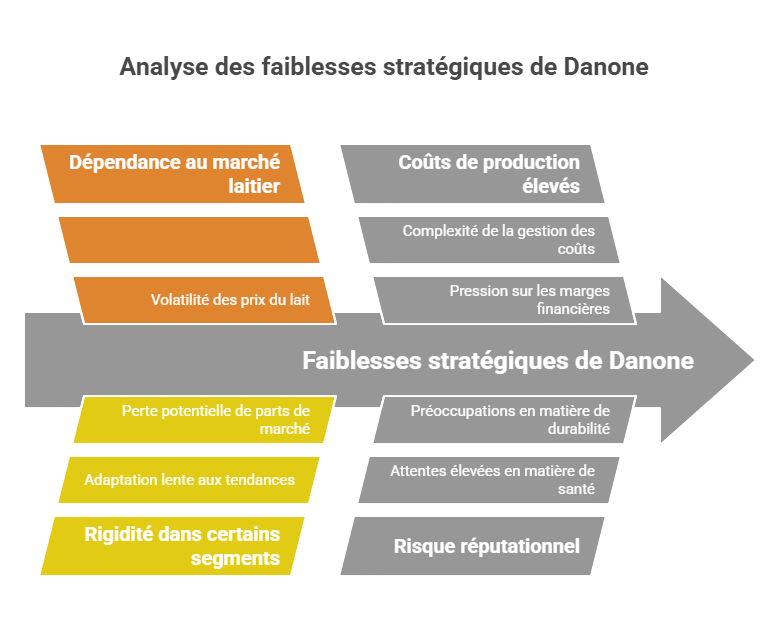
Structural Weaknesses and Internal Challenges Revealed by SWOT Analysis
Many strengths, of course, but every sector giant also has flaws and blind spots. SWOT analysis precisely pinpoints these weaknesses that can hinder growth or increase vulnerability to competition. For Danone, several major challenges must be managed, notably its high dependence on the traditional dairy market.
Already, more than 60% of revenue comes from dairy products. This exposes Danone to fluctuations in milk prices, which directly impact production costs. When prices soar, the company’s margins feel the effect—which can sometimes affect profits. This is a major economic constraint in a context where raw materials are increasingly volatile.
- ⚠️ Dependence on milk: vulnerability linked to unstable raw material prices.
- 🔄 Rigidity in certain segments: difficulty adapting quickly to changing consumer tastes and behaviors.
- 💸 High production costs: complexity in controlling expenses in a tense environment.
- ❗ Reputational risk: health and sustainability expectations impose strict standards, and any misstep can be costly.
- 🌐 Managing emerging markets: difficult adaptation in some countries, especially with local regulations and diverse food cultures.
This list emphasizes how much Danone needs to stay attentive and agile in a rapidly changing market. For example, the rise of plant-based alternatives requires swift responsiveness to prevent losing market share. That’s why the company regularly launches new nutritional and health initiatives, but this also demands significant investments that can weigh on short-term results.
| ⚡ Weaknesses | 💡 Issues |
|---|---|
| Dependence on the dairy market | Exposure to unpredictable milk price variations |
| Rigidities in trends | Potential loss of innovation and market share |
| High costs | Pressure on financial margins |
| Reputational risk | Impact of scandals or controversies on consumer trust |
| Geographical complexity | Adapting to local specifics |
For a more detailed dive into these aspects, it is interesting to visit combined SWOT and PESTEL analyses of Danone, which help measure the scope of these challenges within the group’s overall strategy and operational management.

Strategic opportunities in the dairy and nutrition market that Danone can seize according to its SWOT analysis
In a dynamic world where consumers are increasingly demanding health, ethical standards, and innovative flavors, Danone has a significant opportunity to accelerate its growth. The SWOT analysis reveals golden opportunities, provided they are well exploited.
A flagship initiative is the “Partner for Growth” program, launched in September 2023. This plan aims to collaborate with complementary actors to boost innovation and adopt joint strategies to broaden the group’s commercial reach. Three partners have already signed, including companies specializing in biosciences, a sector that enhances innovation capacity in specific and medical nutrition.
- 🚀 Strategic partnerships: multiply alliances to accelerate R&D and distribution.
- 🌿 Growing demand for health and sustainable products: a major lever driven by ecological awareness and well-being.
- 🌏 Expansion in emerging markets: especially in Asia with the aging Chinese population, a promising target.
- ⚡ Product innovation: introduction of plant-based and medical lines adapted to new needs.
- 🎯 Sports and social engagement: sponsorship of the 2024 Olympics demonstrates a strong desire for visibility and societal integration.
Adapting to demands for personalized or medical nutrition opens new opportunities for Danone. Infant and medical nutrition, for example, remains a lucrative market with steady growth. These sectors enhance the company’s image as responsible and innovative. Additionally, sustainability challenges push for the development of increasingly eco-friendly products—a movement Danone embraces to anticipate regulation and consumer demand.
| 🎯 Opportunities | 📈 Potential |
|---|---|
| “Partner for Growth” program | Accelerate growth through collaboration and shared innovation |
| Expansion in China | Strategic market, especially for the senior segment |
| Increase in plant-based products | Respond to flexitarian and environmental trends |
| Sponsoring the 2024 Paris Olympics | Visibility and societal presence |
| Sustainable development | Align with societal expectations to reinforce trust |
Feel free to deepen this reflection by consulting combined SWOT and PESTEL case studies on Danone which provide a detailed view of exploitable strategic paths.

Threats facing Danone and risks to anticipate according to its SWOT analysis
In the nutrition sector, nothing is ever guaranteed. Danone must contend with threats that could undermine its momentum if not properly anticipated. SWOT analysis provides a clear and precise diagnosis of these potential dangers, essential to consider for guiding strategy.
The variability of consumer preferences is a constant challenge. While dairy products remain popular, the rise of plant-based alternatives and new consumption patterns forces Danone to continuously innovate or risk losing market share to fierce competition. Concurrently, rapid changes in global health conditions directly influence trust in the brand. An incident related to product quality or traceability could have disastrous effects on reputation.
- ⏳ Rapid trend evolution: ongoing adaptation needed to maintain position.
- 🌪️ Growing competition: emergence of innovative players in plant-based or organic products.
- 🛑 High reputational risk: with increasing transparency and consumer expectations.
- ⚠️ Health instability: crises or alerts impacting supply chain or consumption.
- 🌍 Uncertain geopolitical context: potentially affecting distribution in certain countries.
Therefore, the company must “keep its ear to the ground,” monitor markets in real-time, and maintain adaptability based on research, innovation, and solid partnerships. The slightest misstep can lead to lasting loss of market share if consumer trust is compromised.
| ❗ Threats | 🚨 Possible consequences |
|---|---|
| Volatile consumer trends | Decreased sales in certain segments |
| Competition in plant-based products | Market share loss to innovative players |
| Health crisis | Reputation damage and operational disruptions |
| Political instability | Logistical difficulties and localized sales decline |
| Regulatory pressures | Increased compliance costs |
To better understand this sometimes critical issue, reading articles on integrating SWOT and PESTEL analyses in strategic management provides a pragmatic insight.

Comparison with major global competitors
To accurately grasp Danone’s position, it is essential to compare it with its main global competitors. These companies shape the market and directly influence the group’s strategy.
| Competitors | Positioning | Specificities | Threats to Danone |
|---|---|---|---|
| Nestlé | Very diversified | Global leader, strong R&D and communication capacity | Direct competition in infant nutrition and health products |
| Lactalis | Dairy specialist | Dominant presence in Europe, strong local roots | Price pressures and competition in traditional ranges |
| Oatly / Alpro | Plant-based products | Green and innovative positioning | Market share erosion of traditional dairy products |
| Unilever | Food & well-being | Global marketing strength | Ability to quickly launch competing ranges |

Political analysis: impact of national contexts on Danone’s strategies
Establishing operations in over 120 countries is a logistical feat but also a political puzzle. PESTEL analysis reveals how much political factors weigh on the group’s performance. Government destabilization, fiscal changes, or trade policies can quickly reshape business landscapes.
For example, in some emerging markets, distribution regulations and import taxes fluctuate regularly based on political orientations. Danone’s ability to adapt its strategies according to each local context is therefore crucial for success. The brand also seeks to comply with national policies on nutrition and health, which are not always uniform across countries.
- 🏛️ Local governance: adapting to political and bureaucratic systems.
- 💰 Variable taxation: influence on margins depending on zones.
- 🔄 Changing trade policies: fluctuating tariffs and import quotas.
- 🕊️ International agreements: impact of free trade treaties or economic sanctions.
- 👥 Social relations: labor legislation and union issues affecting production.
While political factors can sometimes pose risks, they may also create opportunities if the company anticipates these evolutions and builds solid relationships with local actors. Continuous political monitoring is therefore essential in the overall strategy. More information on these dynamics is detailed in Danone’s PESTEL analysis.
| 🏛️ Political Factors | 📊 Effects on Danone |
|---|---|
| Political instability | Fluctuations in sales and operations |
| Tax changes | Price and margin adjustments |
| Food regulations | Mandatory compliance for distribution |
| International relations | Trade opportunities or restrictions |
| Labor legislation | Management of human resources and production |
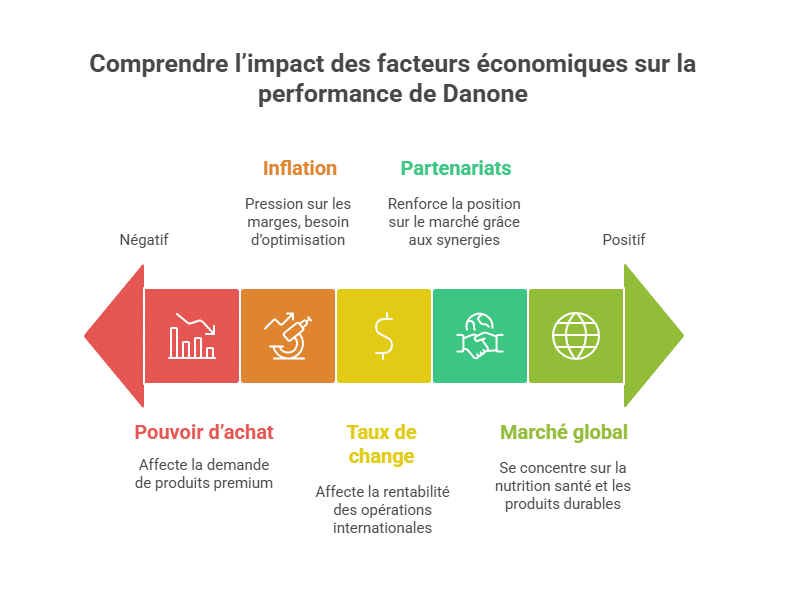
Economic influences: how the global situation affects Danone according to the PESTEL analysis
The economic sphere is simply essential to understanding Danone’s trajectory. With the pandemic and recent geopolitical tensions, the global economy has become a shifting mix of challenges and opportunities. This is where the “Partner for Growth” program comes into play, designed to smooth out uncertainties and pave the way for sustainable and shared economic growth.
On a macroeconomic level, fluctuations in purchasing power, inflation, and currency variations directly influence pricing and demand. Additionally, the structure of agricultural markets affects production costs. For Danone, mastering these parameters is vital to ensure competitiveness in the dairy and nutrition markets.
- 💸 Consumer purchasing power: impact on demand for premium or standard products.
- 📉 Raw material inflation: pressure on margins and need for optimization.
- 🌍 Exchange rate variations: affecting profitability of international operations.
- 💼 Economic partnerships: boosting growth through synergies between companies.
- 📈 Global market developments: increased segmentation toward health and sustainable products.
These dynamics highlight the importance of close-to-the-ground and flexible financial management, capable of anticipating turbulence. The use of programs like “Partner for Growth” demonstrates a management aware of balancing economic sustainability and sustainable development.
| 💰 Economic Dimensions | 🔍 Impact on Danone |
|---|---|
| Fluctuations in purchasing power | Direct influence on food choices |
| Raw material costs | Price and margin modifications |
| Exchange rates | Variability in international profitability |
| Market growth through partnerships | strengthening market position |
| Market segmentation | Focus on health nutrition and sustainable products |
To delve deeper into the economic factors analysis at Danone, the sectoral economic study 2025 clarifies the stakes facing the food industry in general and Danone in particular.

Sociocultural dimensions and their influence on Danone’s strategy through the PESTEL analysis
The sociocultural aspect is a crucial driver for a company like Danone, positioning itself as an engaged actor in health and overall well-being. Understanding behaviors, expectations, and social trends helps tailor offerings, communication, and even product design.
Danone leverages its collaborative strategy by partnering with various actors, such as the collective of 8 Olympic and Paralympic champions during the 2024 Paris Games. This approach clearly shows a commitment to social fabric, associating the brand with strong values of effort, excellence, and health. It creates a powerful bond with consumers seeking authenticity.
- 👨👩👧👦 Evolution of lifestyles: rising concerns about health, organic, and sustainability.
- 🤝 Sociatal values: importance of humanism, solidarity, and environmental responsibility.
- 🤸 Sports and social support: impact on image and reputation.
- 🌱 Responsible consumption: increased preference for ethical and environmentally friendly products.
- 📢 Tailored communication: need for total transparency and genuine dialogue with consumers.
This sociocultural focus gives Danone an advantage in staying aligned with customer aspirations but also demands constant vigilance over rapid changes. The ability to interpret these signals is key to long-term success.
| 🌍 Sociocultural Factors | 🧩 Effects for Danone |
|---|---|
| Health and well-being concerns | Adoption of quality nutritional products |
| Social and sports engagement | Enhanced credibility and image |
| Sustainable consumption | Development of eco-friendly ranges |
| Humanist values | Creating an authentic bond with consumers |
| Transparency requirement | Adapting communication campaigns |
To better understand these issues, a detailed focus is available in Danone’s in-depth sociocultural analysis.

Legal analysis
The legal framework is a foundational pillar for Danone’s activity. Food, environmental, and social regulations directly shape its innovation, distribution, and communication policies.
| Legal Factors | Impact on Danone |
|---|---|
| Labeling standards (EU, USA) | Ongoing adaptation of packaging, increased transparency to consumers |
| Strict health regulations | Enhanced quality controls and investments in traceability |
| Environmental laws (plastics, emissions) | Shift toward bio-sourced packaging, reduction of carbon footprint |
| Public nutritional policies | Reformulation of products to reduce sugar, salt, and additives |
| Data protection (GDPR) | Securing customer data and digital compliance |
These legal requirements impose significant investments but also present an opportunity to reinforce Danone’s credibility and transparency.

Impact of technological and ecological evolutions on Danone’s innovation according to the PESTEL analysis
Innovation is the lifeline in a demanding sector such as nutrition and dairy products. The technological and ecological dimension, analyzed through PESTEL, reveals how crucial adapting to new technologies and environmental constraints has become as a lever for Danone’s continued growth.
On the technological front, the company heavily invests in applied research: new manufacturing processes, innovative plant-based offerings, or solutions in medical nutrition. The rapid evolution of foodtech also pushes Danone to incorporate advanced techniques to optimize quality, traceability, and shelf life.
From an ecological perspective, the group faces major challenges related to carbon footprint, bio-sourced or recyclable packaging, and sustainable resource management. Growing consumer awareness and environmental regulations intensify this pressure. Danone responds by aligning its CSR objectives with clear commitments.
- 🔬 Technological progress: adopting innovations to improve health and sustainability.
- ♻️ Eco-responsible packaging: reducing environmental impact.
- 📊 Supply chain optimization: waste reduction and lower carbon footprint.
- 🌱 Strong CSR commitment: measurable objectives for sustainable development.
- 🧬 Personalized nutrition: leveraging biotech to meet specific needs.
| 🔧 Technological & Ecological Factors | 💼 Impacts on Danone |
|---|---|
| New food technologies | Better quality, product innovation, increased traceability |
| Responsible packaging | Reduced environmental impact |
| Logistics optimization | Less waste, lower costs |
| CSR commitment | Enhanced image and regulatory compliance |
| Biotechnologies in nutrition | Targeted innovation in medical and personalized nutrition |
To explore this integration of technology, ecology, and strategy further, analyses on Danone’s technological and environmental PESTEL provide targeted insights.
Recent case studies
To illustrate these strategic issues, here are some notable recent cases in Danone’s trajectory:
-
🌱 Launch of Alpro and So Delicious ranges → strategic offensive in plant-based alternatives to capture flexitarian consumers.
-
🛒 Acquisition of Follow Your Heart (2021) → strengthening of the premium vegan portfolio in the United States.
-
🌍 COP28 partnership → clear positioning on climate commitments and social responsibility.
-
🏭 2022-2023 restructuring → refocusing on performance, margins, and operational efficiency, with new leadership team.
These initiatives demonstrate the group’s ability to reposition itself amid rapid global market changes.



Conclusion
At the end of this SWOT and PESTEL analysis, Danone appears as a historic actor in a state of change. Its brand power, diversification, and social commitment are strong levers to remain competitive.
However, many challenges remain: shifting toward plant-based offerings, increasing regulatory demands, economic volatility, and growing competition through innovation.
Danone’s success will depend on its ability to anticipate trends, forge solid strategic partnerships, and stay ahead in nutritional and ecological innovation. In a rapidly transforming agri-food market, agility and credibility will be the key words for its future.
FAQ: key questions to understand Danone’s strategy and environment
SWOT analysis helps identify strengths, weaknesses, opportunities, and threats, providing a clear vision to guide strategy in a competitive market.
This program promotes strategic alliances, strengthening R&D and commercial expansion through targeted partnerships.
Price volatility of milk, consumer preference shifts toward plant-based, and cost management are ongoing challenges.
While SWOT examines internal and external strengths and weaknesses, PESTEL focuses on macro-environmental factors: political, economic, social, technological, ecological, and legal.
Through concrete CSR commitments, ecological innovations, and actions responding to growing consumer demand for responsible products.
📊 Analyses SWOT similaires
📊 Voir aussi : notre hub centralisé de toutes les analyses SWOT & PESTEL (206 études) classées par secteur — Tech, Auto, Mode, Distribution, Finance.
Tu prépares le BTS Assurance ?
Cette analyse SWOT fait partie des thèmes abordés dans les épreuves. Notre E-book de révision couvre l'intégralité du programme en fiches claires et synthétiques.
- 100 % du programme BTS Assurance
- Fiches 1ère et 2ème année
- Créé par un diplômé
- Téléchargement immédiat

Entraîne-toi avec nos Quiz de révision
Fini les lectures passives. Pour retenir les notions clés du BTS Assurance, teste-toi ! Inscris-toi pour recevoir 1 quiz par jour directement dans ta boîte mail.


