


Summary
| 📜 Section | 📝 Description |
|---|---|
| 🛑 Definition | Failure to pay the insurance premium refers to the failure to pay the premium at the agreed deadline in the insurance contract. |
| 📉 Causes | 1. Financial Difficulties: Lack of financial resources. 2. Forgetfulness: Lack of reminders or distractions. 3. Knowledge Gaps: Misunderstanding of deadlines or amounts. 4. Disagreement: Dissatisfaction with the contract terms. |
| ⚠️ Consequences | 1. Contract Termination: Loss of insurance coverage. 2. PENALTIES: Late interest and other financial penalties. |
| 🚗 10-30-10 Rule | A specific rule for auto insurance allowing termination of the contract if premiums are not paid within the specified timeframes (10 then 30 then 10 days). |
| 💡 Solutions | 1. Choose Payment Method: Adapt the payment method to the financial situation. 2. Payment Reminders: Use reminders to prevent forgetfulness. 3. Modify Terms: Negotiate more flexible conditions with the insurer. 4. Negotiation of Conditions: Adjust contract terms to reduce costs or improve coverage. |
The non-payment of the insurance premium is a significant issue affecting many policyholders. Indeed, it can happen that, for various reasons, a person fails to pay their premium on time. Failure to pay the insurance premium can have serious consequences, both for the insured and the insurer.

Definition of Non-Payment of Premium in Insurance
Failure to pay the insurance premium refers to the fact of not paying the due premium by the scheduled date in the insurance contract. The insurance premium is the amount the insured must pay to the insurer in exchange for the coverage provided by the insurance contract.
Legal Framework for Non-Payment of Premium in Insurance
Non-payment of an insurance premium is not just a financial difficulty or forgetfulness: it is a situation regulated by law.
📌 Legal References
In France, it is Article L.113-3 of the Insurance Code that establishes the procedure:
-
Formal notice: the insurer must send a registered letter with acknowledgment of receipt to the client.
-
Suspension of coverage: after 30 days without rectification, the insurance is suspended. The insured is no longer covered.
-
Permanent termination: if after an additional 10 days the premium has still not been paid, the contract is terminated.
⚠️ Without compliance with these deadlines, termination can be legally challenged.
📊 Practical Example
-
Scheduled due date: March 1st.
-
Formal notice sent on March 10th.
-
Coverage suspended from April 10th.
-
Effective termination on April 20th if no payment is made.
👉 This regulation protects the insured against sudden termination, while providing the insurer with a clear framework to act.
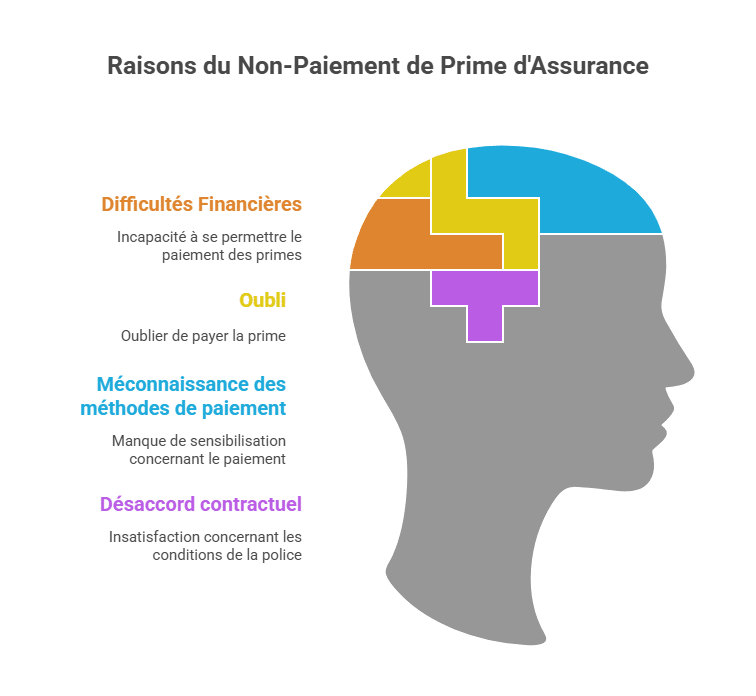
Causes of Non-Payment of Insurance Premium
Financial Difficulties
One of the main causes of non-payment of insurance premium is difficulty in finding the means to pay this premium. Policyholders may experience financial difficulties for various reasons, such as job loss, a drop in income, or unforeseen expenses. These situations can prevent them from paying their premiums on time. For some, the budget is already <strong tight, and adding an insurance premium can be financially inaccessible.
Forgetfulness
Sometimes policyholders forget to pay their insurance premium. This forgetfulness can be due to an obstacle like illness or travel, a lack of vigilance, or simply a lack of knowledge of payment terms. People with a busy schedule or those managing multiple finances can easily miss the due date. A simple oversight can thus lead to unexpected and often costly consequences.
Ignorance of Payment Terms
Sometimes, policyholders do not know the payment conditions of their insurance premiums. They may, for example, be unaware of the due date or the amount to be paid. This lack of knowledge can result from insufficient communication from the insurer or a misunderstanding of the contract’s terms. In some cases, policyholders may ignore options available to facilitate payment, such as automatic withdrawals or installment payments.
Disagreement with Contract Terms
In some cases, policyholders may not pay their insurance premiums because they disagree with the conditions of the insurance contract. They might, for example, believe that the coverage provided is insufficient or that the premium amount is too high. Policyholders may also be dissatisfied with the services provided or feel that they do not receive good value for money. This dissatisfaction can lead them to delay or refuse to pay the premiums, hoping to obtain a better offer or an adjustment to their contract.
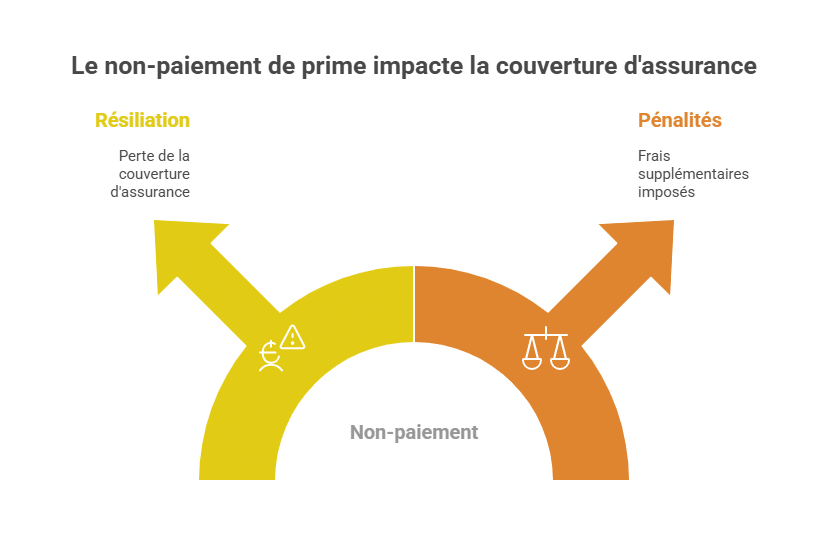
Effects of Non-Payment of Premium in Insurance
Contract Termination
The non-payment of insurance premiums can lead to the termination of the insurance contract, meaning that the insured loses their coverage. This can be very detrimental in the event of a claim, when the insured needs to benefit from the warranties provided by their policy. Without coverage, the costs of damages or repairs must be borne entirely by the insured, which can have devastating financial consequences. The loss of coverage also means that the insured can no longer benefit from protection against risks for which they initially purchased the insurance.
Late Payment Interest or Penalties
The non-payment of insurance premiums can also result in the payment of late payment interest or penalties, which can significantly increase the cost of insurance for the insured. These penalties are often imposed to compensate for late payment and can accumulate quickly, increasing the total amount owed. In addition to unpaid premiums, the insured must also pay additional fees, which can further strain their financial difficulties. Late interest can also negatively impact the relationship between the insured and the insurer, making future negotiations for more favorable conditions more difficult.
Impact on Unpaid Claims File
When a contract is terminated for non-payment, the insurer can declare the insured to AGIRA (Association for Managing Risk Information in Insurance).
Direct Consequences
-
Difficulty in obtaining a new contract from a traditional insurer.
-
Access only possible to specialized offers, often more expensive.
-
Example: in auto insurance, the policyholder might be forced to go through the Central Tarification Office (BCT) to obtain at least mandatory liability coverage.
Financial Consequences
-
Application of surcharges (significant rate increases).
-
Refusal of promotional offers or payment facilities.
👉 Being blacklisted as a “bad payer” in insurance is a lasting handicap, sometimes for several years.
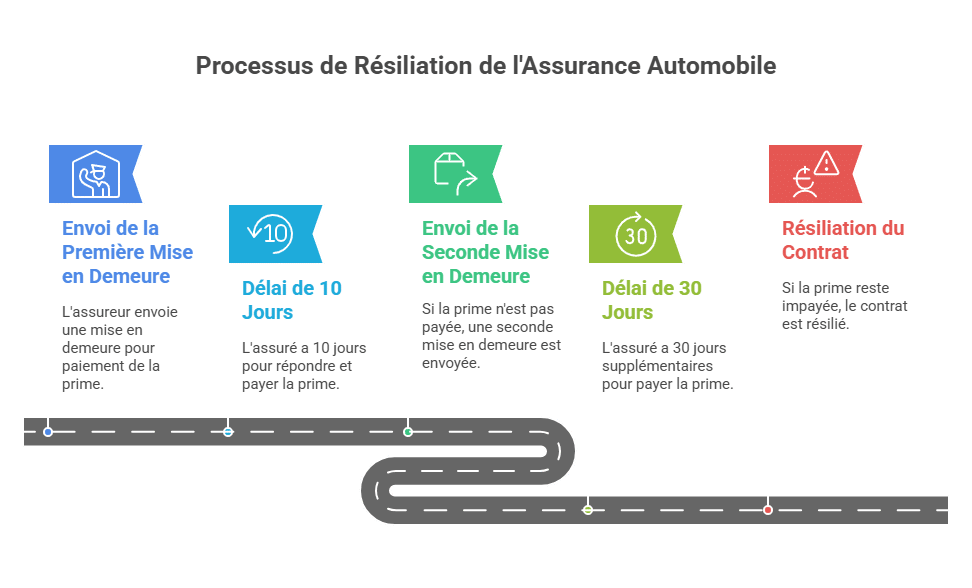
The 10-30-10 Rule in Auto Insurance
The 10-30-10 rule is a specific provision concerning the non-payment of the auto insurance premium. It allows the insurer to terminate the auto insurance contract if the policyholder does not pay their premium within the deadlines specified by the contract. According to this rule, the insurer must first send a formal notice to the policyholder, requesting payment within a deadline of 10 days. If the policyholder does not respond to this formal notice and does not pay their premium within this timeframe, the insurer can send a second formal notice demanding payment within 30 days. If the policyholder still does not respond and does not pay within this second period, the insurer can then terminate the auto insurance contract. It is important to note that the 10-30-10 rule applies only to auto insurance contracts and that the deadlines for formal notices and termination can vary depending on the insurance policies and insurers. It is therefore advisable to check with your insurer for the payment terms of your premium and the consequences of non-payment in insurance.
| Step | Insurer’s Action | Deadline | Consequences for the Policyholder |
|---|---|---|---|
| First Formal Notice | Sending a formal notice for premium payment | 10 days | Must pay the premium within this period |
| Second Formal Notice | Sending a second formal notice if the premium is unpaid | 30 days | Must pay the premium within this period |
| Contract Termination | Contract termination if the premium remains unpaid | After 30 days | Insurance contract is terminated, coverage lost |
Differences Between Types of Insurance
All insurances follow the Insurance Code, but certain specificities exist.
Auto insurance
-
Strict application of the 10-30-10 rule.
-
The policyholder remains responsible in case of an accident: they will have to compensate victims out of pocket if the contract is suspended.
-
Example: a material accident costing €15,000 can directly impact the policyholder in default of payment.
Home Insurance
-
Suspension leads to the absence of coverage in case of fire, water damage, or theft.
-
The risk: having to finance repairs alone, which can reach several tens of thousands of euros.
Health and Personal Risk Insurance
-
Coverage (medical expenses, daily allowances) ceases at the expiry of the legal deadline.
-
Special case of group policies: some provide specific deadlines or temporary coverage continuity.
👉 This illustrates that the risk linked to non-payment varies according to the contract, but it always carries serious consequences.
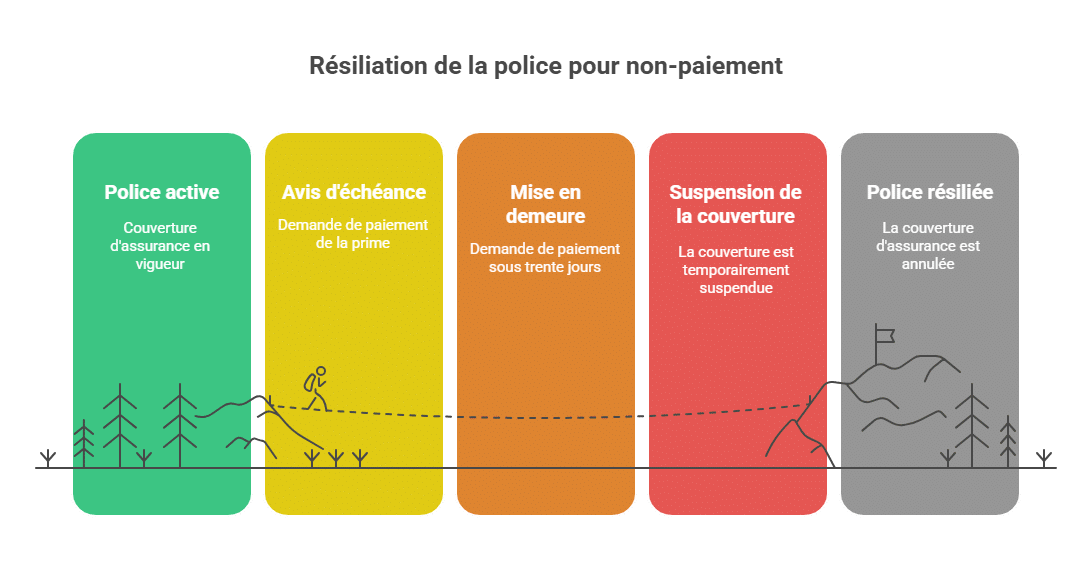
Case Study: Cancellation due to Non-Payment
Context
An insurer sent a payment notice for a premium payable before December 1, 2019, covering the period from December 1, 2019, to November 30, 2020. Due to non-payment, a formal notice was sent on December 23, 2019, requesting settlement before January 21, 2020.
Suspension and Cancellation
Since the premium was not paid within the thirty days following the formal notice, the coverage under the contract was suspended. Ten days after this suspension and still without payment, the contract was canceled on January 31, 2024, in accordance with legal deadlines.
Regularization and Request for Reinstatement
The policyholder settled the payment of their premium on February 5, 2024, after the contract’s cancellation. They then requested either the restoration of the contract or a refund of the paid premium.
Decision of the Mediator
According to article L.113-3 of the Insurance Code, coverage can be suspended thirty days after an unsuccessful formal notice, followed by a termination ten days after this suspension. A non-terminated contract can resume its effects at noon the day after the overdue premium and those due during the suspension are paid.
However, once the contract is extinguished, the insurer is not obliged to reinstate it even after regularization. In this case, the insurer nevertheless refunded the premium for the period after the cancellation, which they were not required to do. The Mediator confirmed that the insurer was not obliged to reinstate the contract and that the refund was satisfactory.
Proactive Management by Insurers
Contrary to what is commonly believed, insurers do not have an interest in canceling all their late-paying clients.
Implemented Actions
Automatic follow-ups via SMS and emails before the due date.
Personalized phone calls from advisors.
Payment facilities: monthly installments, exceptional deferrals.
Fidelity offers: discounts for online or direct debit payments.
Concrete Example
A policyholder behind on their home insurance premium may be offered a 3-month installment plan instead of immediate cancellation. This allows the insurer to retain their customer and the policyholder to regularize their situation.
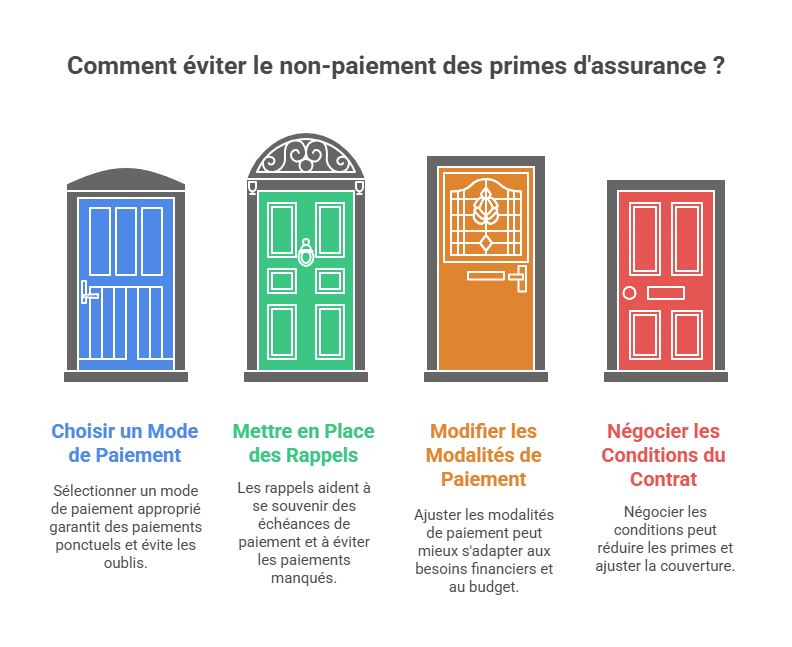
Solutions to Prevent Non-Payment of Insurance Premiums
Choose an Appropriate Payment Method
It is essential to select a payment method that suits your financial needs to avoid forgetting payments and ensure timely premium payments. Available payment options include automatic debit, check, or bank transfer. Automatic debit is often the best solution for those who want to ensure their premium is paid regularly without worrying about deadlines. By choosing the most appropriate payment method for your financial situation, you can minimize the risks of non-payment.
Implement Payment Reminders
Payment reminders help prevent forgetting to settle your insurance premium on time by sending notifications before each due date. These reminders can be via SMS messages, emails, or even phone alerts. Many insurers provide this service free of charge, and it can be activated simply by contacting your insurer or using their online services. Payment reminders are especially useful for those with busy schedules or managing multiple accounts and payments.
Modify Payment Terms
If current payment terms do not suit your needs, it is possible to modify them with your insurer, for example, by requesting installment payments or online payments. Some policyholders prefer monthly payments instead of annual to better manage their budget. Discussing your preferences with your insurer often makes it possible to find a flexible solution that allows you to spread costs more evenly throughout the year. Online payments also offer convenience and increased speed, enabling policyholders to pay their premiums from anywhere and at any time.
Negotiate Contract Terms
You can negotiate the insurance contract terms to reduce premium amounts or adjust warranties according to your needs. Policyholders may compare offers from different insurers to find the best value for money. By discussing with your insurer, you might renegotiate certain aspects of the contract, such as deductibles or included coverages, to obtain more affordable premiums. It may also be beneficial to review your risk profile and make improvements that can lead to premium discounts, such as installing security devices in a home or improving driving habits for auto insurance.
Choose an appropriate payment mode
-
Automatic debit = maximum security.
-
Monthly or quarterly payments = reduced budget effort.
-
Annual payment = possible discount but requires solid cash flow.
Set up reminders
-
SMS or email alerts before due date.
-
Mobile insurance apps with notifications.
Adjust your contract
-
Remove unnecessary coverages.
-
Review deductible levels to reduce premium costs.
-
Bundle multiple contracts within the same company to benefit from multi-policy discounts.
Negotiate with your insurer
-
Request an exceptional installment plan.
-
Discuss a reduction of temporary coverages.
-
Compare competing offers to put your insurer in competition.
Case Studies and Statistics
Numerical Data
6% of auto insurance cancellations are due to non-payment.
In home insurance, approximately 4% of contracts are affected.
The average cost of an unpaid premium is €350 for auto and €280 for home (source: France Assureurs).
Real Example
A car policyholder with an annual premium of €420 who did not pay had their contract canceled. During a responsible accident, they had to pay €8,500 for repairs out of pocket.
👉 These figures highlight the importance of paying premiums on time.
Advice for BTS Insurance Students
Failure to pay the premium is a common practical case in BTS Insurance, especially in the E5 (Claims Management and Customer Relations) exam.
Key points to remember
-
Cite Article L.113-3 of the Insurance Code.
-
Explain the 10-30-10 rule in auto insurance.
-
Describe the consequences for the insured: suspension, cancellation, blacklisting, difficulties in re-insurance.
-
Propose practical solutions: installment payments, reminders, adjustment of coverage.
👉 Structuring your answer well around the SWOT of the situation (strengths/weaknesses/opportunities/threats for the insurer and the insured) is a real advantage in exams.
Conclusion
Failure to pay an insurance premium is never just a delay: it is a situation regulated by law, with serious consequences (suspension, cancellation, blacklisting). However, solutions exist to prevent or regularize unpaid premiums: reminders, negotiations, adapted payment methods, or even contract adjustments.
For professionals as well as students in insurance, this topic perfectly illustrates the importance of client education: explain, prevent, support. Because beyond financial risk, it’s about maintaining trust between the insured and their insurer.
FAQ – Non-payment of insurance premium
1. What is non-payment of insurance premium?
Failure to pay the insurance premium refers to the failure to settle the premium by the scheduled date in the contract. This can be due to forgetfulness, financial difficulties, or disagreements with the insurer.
2. What does the law say about non-payment of premium?
According to Article L.113-3 of the Insurance Code, the insurer must send a formal notice to the insured.
-
After 30 days, coverage is suspended.
-
After 10 additional days, the contract can be permanently canceled.
3. What are the consequences of non-payment of premium?
The main consequences are:
-
Suspension and then cancellation of the contract.
-
Loss of coverage in case of claim.
-
Payment of late payment interest and penalties.
-
Possible blacklisting in unpaid claims databases (AGIRA), making it difficult to subscribe to a new policy.
4. How to avoid non-payment of premium?
To avoid this situation, it is advised to:
-
Opt for automatic debit.
-
Implement SMS or email reminders.
-
Choose a monthly or quarterly payment plan suited to your budget.
-
Negotiate with your insurer if facing financial difficulties.
5. What is the 10-30-10 rule in auto insurance?
It is a specific rule for auto insurance:
-
10 days to regularize after the first formal notice.
-
30 days of suspension if the premium remains unpaid.
-
10 days after this suspension, the contract can be canceled.
6. Can the contract be recovered after cancellation for non-payment?
No, once canceled, the contract cannot be reinstated, even if the premium is paid afterward.
On the other hand, the insurer must refund the part of the premium corresponding to the period not covered after cancellation.
7. Is it possible to regain insurance after non-payment?
Yes, but it can be difficult. The policyholder may face refusals or surcharges. In auto insurance, they can contact the Central Tarification Office (BCT) to force an insurer to provide at least the minimum legal coverage (liability).
8. What advice for BTS Insurance students?
In practical cases, it is necessary to:
-
Cite Article L.113-3.
-
Explain the 10-30-10 rule.
-
Detail the consequences for the policyholder and insurer.
-
Propose practical solutions (installments, reminders, coverage adjustments).


For Further Reading
https://youtu.be/8dlDNtx0A_Y

Entraîne-toi avec nos Quiz de révision
Fini les lectures passives. Pour retenir les notions clés du BTS Assurance, teste-toi ! Inscris-toi pour recevoir 1 quiz par jour directement dans ta boîte mail.


