


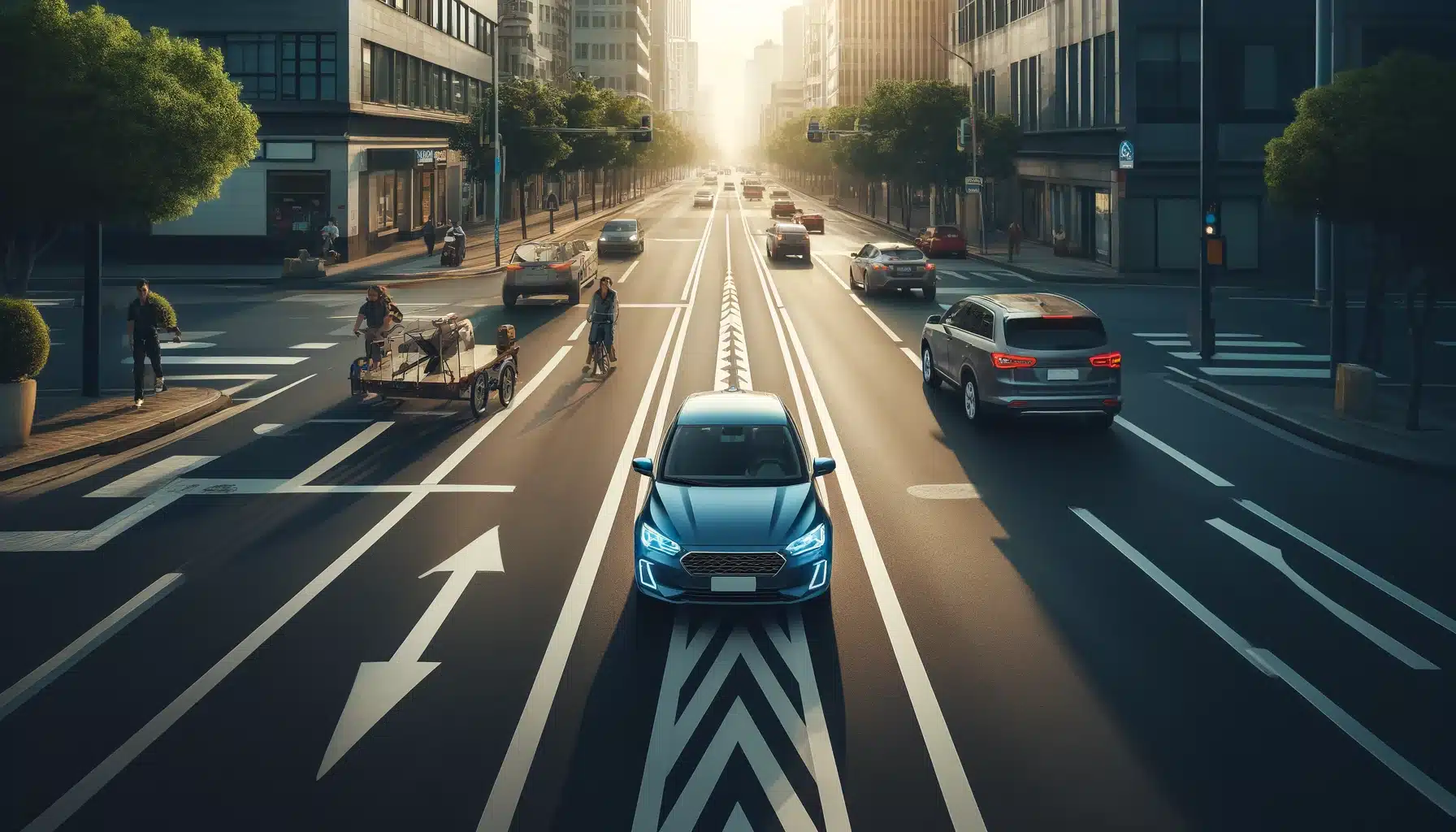


Summary
| 🚗 Section | 📋 Content Summary |
|---|---|
| Case Studied | The Case 17 involves a situation where Vehicle Y changes lanes while turning left onto a side road. This complex maneuver involves crossing the median and requires increased vigilance. |
| Context | Y crosses a two-way road to enter a side lane. This action requires a precise assessment of traffic and the timing of the turn. |
| Presumed Responsibilities | Y is presumed responsible because it initiates a risky lane change. X, normally driving, is only at fault if it engaged in dangerous behavior (speeding, failing to maintain safe distances). |
| Legal Basis | According to Article R412-9 of the Highway Code, the driver must drive on the right and may only cross the median axis if visibility and safety permit. This rule directly applies to Case 17. |
| Insurance Analysis | The IRSA scale considers Y responsible 100% because it is the origin of the maneuver. The insurance company believes that those who change lanes must ensure the safety of their trajectory. |
| Possible Types of Accidents | – Frontal collision: Y misjudges the distance of an oncoming vehicle. – Side collision: miscalculation when crossing lanes. |
| Road Consequences | Poor execution of the maneuver endangers Y, X, and other road users. It contributes to increased accident risks and compromises road safety. |
| Prevention Measures (Y) | – Use turn signals in advance. – Check blind spots before changing lanes. – Never cross a solid line. |
| Prevention Measures (X) | – Adopt a cautious driving. – Maintain a sufficient safety distance to avoid collisions. |
| Practical Tips | – Avoid combining lane change + simultaneous turn. – Adjust speed before the maneuver. – Anticipate traffic and use mirrors regularly. |
| Concrete Example | On a departmental road, Y turns left without signaling in time and collides with X. The expert concludes that Y bears 100% responsibility. |
| Insurance and Compensation | – If Y is responsible: their insurance covers X’s damages but not their own damages (unless comprehensive coverage). – If X is not at fault: they are fully reimbursed. – In case of disagreement, evidence (accident report, dashcam, witnesses) is essential. |
| Conclusion | Case 17 highlights that prudence, signaling, and visibility are essential when changing lanes or making a turn. Following these rules reduces the risk of accidents. |
| FAQ – Key Points | – Main Responsible: Y. – Contestation possible: only if the maneuver was safe and visible. – Risks for Y: loss of bonus, increased insurance premium. – Protection: detailed accident report and use of a dashcam. |
In the context of traffic rules and responsibility allocation in case of an accident, Case 17 describes a situation where Y changes lanes while making a left turn onto a side road. This complex maneuver can often lead to misunderstandings or accidents if not performed correctly.

Context of Case 17
Case 17 focuses on a specific maneuver where Y changes lanes and makes a left turn. This action involves crossing the median of the road, an area that requires special attention to avoid collisions.
Details of the Maneuver
- Y changes lanes: Y begins moving from the right to the left, potentially crossing the median of the road.
- Y turns left: Simultaneously, Y executes a left turn to enter a side road, which requires a precise assessment of oncoming traffic.
Presumptions and Responsibilities
- Presumption against Y: In this situation, Y is presumed responsible for risks related to crossing the median. If a collision occurs, Y will generally be considered at fault unless it clearly demonstrates that the maneuver was safe and compliant with traffic rules.
- Presumption in favor of X: X, traveling in its lane, is presumed to respect its lane of travel. X bears no responsibility unless it is proven that it contributed to the accident through negligent driving.
🧾 Legal Basis of Case 17
According to Article R412-9 of the Highway Code, “every driver must drive on the right side of the roadway and can only cross the median line if visibility is sufficient and no hindrance is caused to other users”.
This means that any lane change to the left is a deliberate and therefore risky maneuver. In case of collision, the driver changing lanes is almost always held responsible unless accompanied by evidence that the maneuver was safe and authorized.
This rule is regularly confirmed by French jurisprudence, especially in cases evaluated according to the IRSA scale.
💬 Expert Insurance Analysis
In the IRSA scale (used by insurers to determine responsibilities in case of an accident between two insured vehicles in France), Case 17 corresponds to a lane change with a left turn.
In this scenario, vehicle Y is declared responsible at 100% because it initiated the maneuver leading to the risk of collision.
The insurance considers that the driver who changes trajectory is master of their maneuver and must ensure that it can be done safely.
Conversely, vehicle X has no presumed fault unless evidence (witness, video, excessive speed) demonstrates reckless driving.
Summary Table of Case 17
| 🚘 Element | 📋 Details |
|---|---|
| Situation Described | Vehicle Y changes lanes while turning left onto a side road |
| Presumed Responsible | Y, because it performs a risky double maneuver involving crossing the median |
| Possible Fault of X | Possible only if there’s excessive speed or failure to respect distances |
| Type of Common Accident | Head-on collision or lateral collision depending on the moment of the turn |
| Legal Reference | Article R412-9 of the Highway Code: obligation to drive on the right and to only cross the median line if it can be done safely |
Risks and Consequences
Collision Scenarios
- Head-on collision: If Y miscalculates its maneuver, it may collide head-on with an oncoming vehicle.
- Lateral collision: An incorrect estimation of distance and speed of vehicles in the new lane can also lead to a lateral collision with X.
Impact on Road Safety
Poorly executed Y actions endanger not only Y and X but also other road users. Road safety is compromised, increasing the risk of serious accidents.
Prevention Measures
Recommendations for Y
- Use turn signals: Y must clearly indicate intentions with blinkers well before changing lanes and turning.
- Check blind spots: Before lane changing, especially when turning, Y must ensure the way is clear by checking blind spots and accurately assessing approaching vehicle speeds.
Recommendations for X
- Maintain cautious driving: X should stay alert to Y’s signals and be ready to react if Y’s maneuver appears unsafe or reckless.
- Keep a safe distance: Especially in areas with frequent lane changes, X should maintain sufficient safe distance to react in an emergency.
🚗 How to Avoid an Accident in Case 17?
-
Avoid combining two maneuvers: if possible, perform the lane change first, then the left turn, rather than both simultaneously.
-
Always anticipate traffic: observe vehicles in front and behind. A blinkers applied too late can create confusion.
-
Adjust speed: gradually reduce speed before the turn to maintain vehicle control and prevent skidding.
-
Use mirrors and check blind spots: a split second of inattention can cause missing a vehicle in the adjacent lane.
-
Never cross a solid line: crossing it is automatically considered an offense and fault in case of an accident.
🧩 Concrete Example
On a two-way departmental road, driver Y leaves their lane to turn left onto an agricultural path. They turn on their indicators too late, and vehicle X, approaching from the opposite direction, brakes suddenly without avoiding the collision.
The expert concludes that Y bears 100% responsibility because the lane change and the crossing of the median caused the accident.
This example demonstrates the importance of clear anticipation and adequate prior signaling before any maneuver.
💰 Insurance and Compensation
| Situation | Likely Compensation |
|---|---|
| Y is responsible | Their insurance covers third-party damages (X) via liability coverage but not their own damages unless comprehensive coverage is included. |
| X is not at fault | They are fully reimbursed by Y’s insurance. |
| Shared responsibilities | Compensation is proportional to the fault rate determined by experts. |
| Disagreement on liability | The accident report and testimonies (photos, dashcam footage, witnesses) are crucial in resolving disputes. |
Conclusion
Case 17 emphasizes that prudence, signaling, and visibility are essential during lane changes and turns. Following these rules reduces accident risks. At the same time, X should adopt defensive driving to respond effectively to unforeseen situations. These practices significantly contribute to improving road safety and reducing traffic incidents.


❓ FAQ – Case 17: Lane Change and Left Turn
Who is responsible in Case 17?
Driver Y, because they perform a lane change and a left turn, two maneuvers requiring increased vigilance.
Can liability in Case 17 be contested?
Yes, but proof that the maneuver was performed safely (good visibility, timely signaling, no hindrance) is necessary.
What are the risks for Y in case of an accident?
Loss of bonus, higher insurance premium, and coverage of X’s repairs.
How to protect oneself legally?
Always fill out a detailed accident report, take photos, and, if possible, use a dashcam to establish the facts.
📋 Conventions d'indemnisation

Entraîne-toi avec nos Quiz de révision
Fini les lectures passives. Pour retenir les notions clés du BTS Assurance, teste-toi ! Inscris-toi pour recevoir 1 quiz par jour directement dans ta boîte mail.


