


In the complex navigation of traffic rules, Cases 13 and 15 of the IRS scale illustrate specific situations where vehicles X and Y interact without changing lanes or change lanes under certain conditions. These cases are crucial for understanding how responsibilities are allocated in the event of an incident.
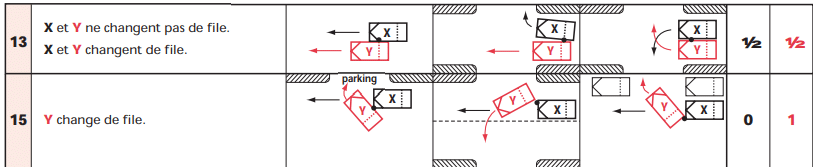


Case 13: X and Y Do Not Change Lanes
The Case 13 pertains to situations where two vehicles, X and Y, are traveling in the same direction and on the same lane, with no lane change involved. This typical scenario can occur in various traffic contexts, such as slowdowns or traffic jams.
Conditions and Responsibilities
- X is rear-ended by Y: In this scenario, Y is generally considered responsible for hitting X. The basic rule states that each driver must maintain a sufficient safety distance from the vehicle ahead to be able to stop without causing a collision.
- Maintaining distance: It is essential that Y observes a safety distance to prevent accidents, especially in dense traffic conditions where frequent stops are anticipated.
Prevention and Safety
To avoid this type of accident, Y drivers should:
- Adjust their speed: Reduce speed according to traffic density.
- Be attentive: Constantly monitor traffic flow and be ready to react to sudden changes.
Case 15: Y Changes Lane
The Case 15 is distinguished by Y initiating a lane change. This case addresses the dynamics of lane changing and its potential implications for road safety.
Conditions and Responsibilities
- Initiated by Y: Y decides to change lanes and, during or after this maneuver, collides with X, who is already established in the target lane. Y is typically responsible for this collision for not performing the lane change safely.
- Safety during lane change: Y must ensure that the lane is clear and that the change can be executed without risk to other road users, including X.
Prevention and Safety
Measures Y should take include:
- Using indicators: Clearly signal intentions before changing lanes.
- Checking blind spots: Ensure no vehicle, including X, is in the blind spot or at a distance that could lead to a collision during the lane change.


Conclusion
The Cases 13 and 15 highlight the importance of caution and adherence to traffic rules, particularly regarding maintaining safety distance and lane change maneuvers. Drivers must constantly be attentive to their environment and the position of other vehicles to navigate these situations with safety and efficiency. These analyses contribute to a better understanding of responsibilities in the event of an accident and emphasize actions drivers can take to minimize risks on the road.
📋 Conventions d'indemnisation

Entraîne-toi avec nos Quiz de révision
Fini les lectures passives. Pour retenir les notions clés du BTS Assurance, teste-toi ! Inscris-toi pour recevoir 1 quiz par jour directement dans ta boîte mail.


