





In summary
| 🏷 Section | 📄 Key Content |
|---|---|
| 🌍 Introduction & Context | Introduces the deep changes in the healthcare sector in 2025: aging population, geopolitical crises, digitalization, and new societal expectations. |
| 🧠 Understanding the PESTEL Framework | Explains the strategic analysis tool PESTEL and its importance for anticipating opportunities and risks in health. |
| 🏛 Political Factors | Details the impact of regulations, public policies, subsidies, and health-related decisions on sector stakeholders. |
| 💶 Economic Factors | Analyzes health budgets, inflation, the labor market, insurance, and medical costs influencing profitability and investments. |
| 🧍♂️ Sociocultural Factors | Highlights telemedicine, mental health, transparency, and new patient expectations regarding personalized care. |
| 🤖 Technological Factors | Emphasizes the key role of AI, blockchain, connected devices, and telemedicine platforms in sector transformation. |
| 🧪 Case Study | Illustrates analysis with Doctolib and Sanofi, two actors adapting their strategies to PESTEL mutations. |
| 🌿 Ecological Factors | Explains environmental issues: medical waste, emissions, green regulations, and adoption of sustainable practices. |
| ⚖ Legal Factors | Analyzes safety standards, data protection, advertising regulations, and medical labor law. |
| 📊 PESTEL Table | Provides a structured synthesis of the 6 factors with their main issues, opportunities, and risks. |
| 🌐 Perspectives 2030 | Presents strategic recommendations: innovation, training, partnerships, sustainability, and anticipating future trends. |
| ❓ Enriched FAQ | Answers key questions about PESTEL analysis and its impacts in health. |
| 📝 Conclusion | Emphasizes the role of PESTEL analysis as a strategic compass to navigate a rapidly changing environment. |
The healthcare sector in 2025 presents a fertile ground of opportunities and challenges stemming from rapid technological progress, political dynamics, and societal trends. Companies in this sector — whether major pharmaceutical giants like Sanofi, Roche, or Pfizer, or innovative medical structures — must navigate a complex landscape of external influences. This text explores the implications of PESTEL analysis in this context, highlighting political, economic, sociocultural, technological, ecological, and legal factors shaping the future of healthcare.
By 2025, the health sector faces deep mutations. Accelerated aging of the population leads to an increase in chronic diseases, demanding more robust and flexible care systems 🧓. Meanwhile, recurring geopolitical crises strain medication supply chains 🌍. The rise of medical technologies and digitalization disrupt traditional care models 📲. Finally, new societal expectations, such as cost transparency, inclusion, and mental health considerations, redefine the patient-professional relationship 🧠.
This global context makes PESTEL analysis particularly relevant for anticipating challenges and capturing opportunities amid rapid transformation.
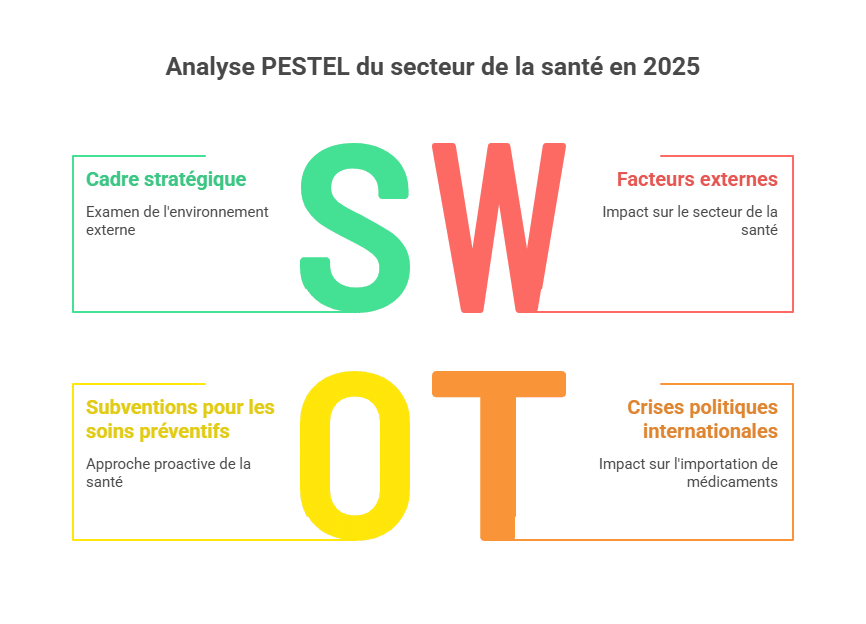
Understanding the PESTEL analysis framework
The PESTEL analysis is a strategic tool aimed at examining a company’s external environment. In 2025, this analysis gains particular significance, especially in a vital sector like healthcare. Each component of PESTEL — political, economic, sociocultural, technological, environmental, and legal — offers different and essential perspectives to consider.
The political dimensions influencing the healthcare sector
Political decisions play a fundamental role in structuring the healthcare system. This framework includes regulations on medical practices, funding policies, and public health decisions. The political stakes, especially prominent in 2025, are crucial for healthcare companies.
- Subsidies for preventive care can promote a proactive approach to health.
- Changes in reimbursement policies significantly affect the revenues of medical structures.
- New regulations on obtaining medical licenses influence the opening of new facilities.
- Decisions on vaccination policies can build trust within the sector.
- International political crises can impact the importation of medications.
| Political Factors | Impact on the Healthcare Sector |
|---|---|
| Regulations on obtaining medical licenses | Establishes a rigorous framework for medical practices |
| Healthcare reimbursement policies | Adjusts the revenues of healthcare establishments |
| Subsidies for healthcare innovation | Encourages the creation of new healthcare solutions |
| Public health policies | Has a direct influence on services offered to populations |
| Regulatory changes | Requires continuous adaptation to remain compliant |
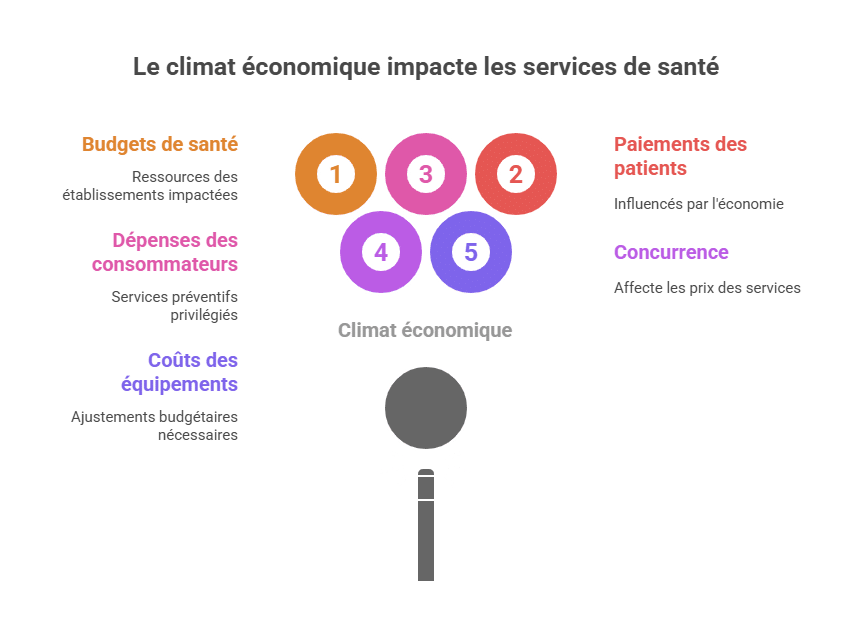
The economic factors shaping the healthcare industry
The economic climate is a key factor for health services. Analyzing economic trends helps understand how companies can adapt to current challenges. In 2025, some key issues are emerging:
- Fluctuations in healthcare budgets ↔️ Potential impact on resource availability in facilities.
- Patients’ ability to pay is influenced by the overall economic situation 💰.
- Spending choices shift towards preventive health services 🩺.
- Competitive pressures in healthcare can affect prices of services and treatments 💸.
- Rising costs of medical equipment require significant budget adjustments.
| Economic Factors | Implications for the Healthcare Sector |
|---|---|
| Inflation | Rising operational costs for facilities |
| Government health budget | Fluctuations in investment capacities in infrastructure |
| State of the labor market | Labor shortages or surpluses in the medical sector |
| Evolution of health insurance | Impact on patient coverage and facility revenues |
| Drug costs | Direct influence on pharmaceutical profitability |
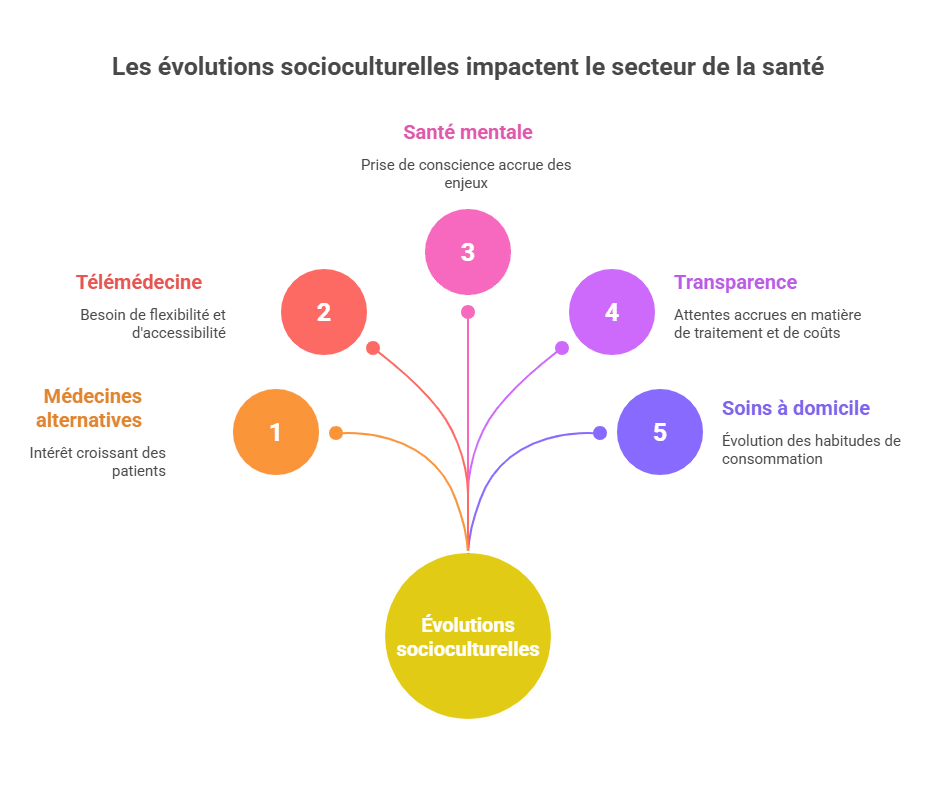
The sociocultural trends in healthcare
Sociocultural shifts in 2025 show a growing demand for personalized care, driven by increasingly high health expectations. Patients seek treatments that consider their specific needs.
- The rise of alternative medicine 🌱 marks a major change in patient preferences.
- Flexibility and accessibility needs strengthen telemedicine 📱.
- Awareness of mental health issues is rising 🧠.
- Expectations for increased transparency in treatments and costs are becoming standard.
- Consumer habits are shifting toward home care, requiring adaptation of services 💻.
| Sociocultural Factors | Impacts on the Healthcare Sector |
|---|---|
| Growing preference for remote consultations | Encourages innovation in telemedicine |
| Interest in preventive medicine | Shifts care offerings toward prevention |
| Increasing ecological concerns | Pushes facilities to adopt eco-friendly practices |
| Demand for a holistic health approach | Expands services offered by medical facilities |
| Changes in social norms | Adjusts offerings based on cultural diversity |

Technology and its role in healthcare
Technical advancements serve as catalysts for change in the healthcare industry. By 2025, integrating these innovations is essential to improve patient experience and facilitate care management.
- The digitization of medical records proves to be a major asset for efficiency 💻.
- Artificial intelligence is expanding rapidly, enabling more precise and faster diagnostics 🤖.
- The use of wearable medical devices ensures real-time health monitoring.
- Innovative telemedicine platforms improve access to care for remote populations 🌐.
- Blockchain technology is beginning to be applied to ensure patient data confidentiality 🔒.
| Technological Factors | Impact on the Healthcare Sector |
|---|---|
| Integration of AI in healthcare services | Improved diagnostic accuracy |
| Wearable health monitoring devices | Personalization of care and needs anticipation |
| Telemedicine platforms | Increased access for isolated patients |
| Data analysis tools | Enhancement of clinical research and treatments |
| Health applications | Facilitate personal health management |
Pas le temps de ficher tout le programme ?
Découvre l'E-book de révision avec 100% des cours de 1ère et 2ème année synthétisés. L'outil indispensable, créé par un diplômé, pour valider ton BTS sans stress.
Découvrir l'E-book🧪 Case Study: Doctolib and Sanofi Facing PESTEL Changes
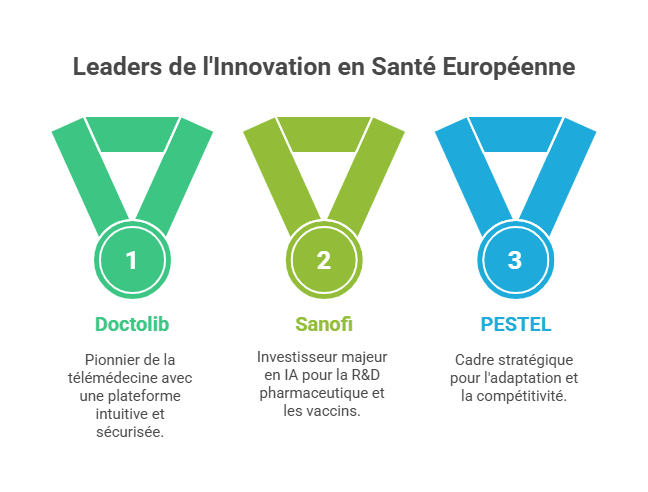
Doctolib, the European leader in telemedicine, exemplifies adaptation to technological and sociocultural factors. Through an intuitive platform 📱, it responds to patients’ needs for flexibility and accessibility, while integrating enhanced security protocols 🔒 to comply with the European legal framework (GDPR).
Sanofi, a longstanding pharmaceutical player, invests heavily in artificial intelligence to optimize its R&D processes 🤖. The company also develops public-private partnerships to anticipate political and regulatory changes related to vaccine production and distribution.
These examples demonstrate how actors of different sizes and missions can leverage PESTEL analysis to guide their strategies and stay competitive.
Ecological framework and its implications for health
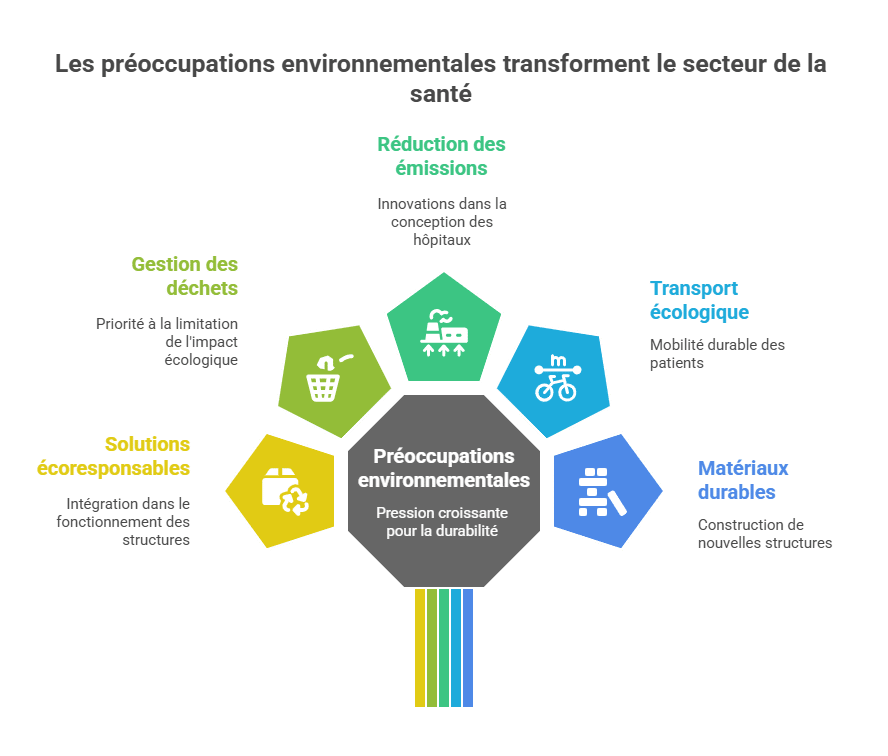
Environmental concerns regarding health are intensifying, prompting companies to adopt more sustainable practices. By 2025, this aspect becomes essential for most health actors.
- Facilities must incorporate eco-responsible solutions into their operations ♻️.
- The management of medical waste becomes a priority to limit ecological impact 🌿.
- The need to reduce CO2 emissions drives innovations in hospital and clinic design 🏥.
- Promoting eco-friendly transportation systems for patient mobility has become crucial 🚴.
- Use of sustainable building materials for new structures is emerging.
| Ecological Factors | Impact on the Healthcare Sector |
|---|---|
| Strict environmental regulations | Necessity to adapt practices of healthcare facilities |
| Growing demand for sustainable solutions | Integration of environmentally friendly products |
| Societal pressure to reduce waste | Implementation of recycling and medical waste management programs |
| Ecological awareness among the population | Alteration of consumer behavior towards more responsible choices |
| Impact of climate issues on health | Adapting services to face new public health challenges |

Legal framework and its impacts on the healthcare industry
The legal environment is an essential parameter in the operationalization of health services. With an ever-evolving regulatory landscape, actors must navigate carefully through legal requirements.
- Compliance with health safety standards is imperative to avoid disputes ⚖️.
- Patient data protection laws pose technical and adaptive challenges.
- Regulations on advertising medical services impose limits 🤫.
- Ethical requirements influence daily practices of health professionals.
- Labor regulations within healthcare facilities condition hiring practices.
| Legal Factors | Implications for the Healthcare Sector |
|---|---|
| Sanitary safety standards | Obligation to implement strict procedures |
| Data confidentiality laws | Strengthening data protection systems |
| Regulations on advertising services | Limits on promoting treatments and services |
| Accreditation requirements | Complex approval procedures for opening facilities |
| Labor law in the medical sector | Framework for working conditions and contracts |
Summary table
| Factor | Main issues | Opportunities for the sector | Major risks |
|---|---|---|---|
| Political | Reimbursement policies, vaccination, licenses | Support for innovation, stabilization of practices | Regulatory instability, reliance on government decisions |
| Economic | Inflation, budgets, insurance | New markets, diversification of services | Reduced purchasing power, rising equipment costs |
| Sociocultural | Telemedicine, mental health, patient expectations | Personalized care, new preventive offers | Access inequalities, unfulfilled expectations |
| Technological | AI, blockchain, connected devices | Fast diagnostics, data valorization, remote monitoring | Cybersecurity, digital divide |
| Ecological | Medical waste, emissions, green regulations | Sustainable hospitals, ecological innovation | High adaptation costs, legal constraints |
| Legal | Confidentiality, accreditation, labor law | Building trust, solid normative framework | Regulatory complexity, administrative burden |
🌐 Future outlook and strategic recommendations for 2030
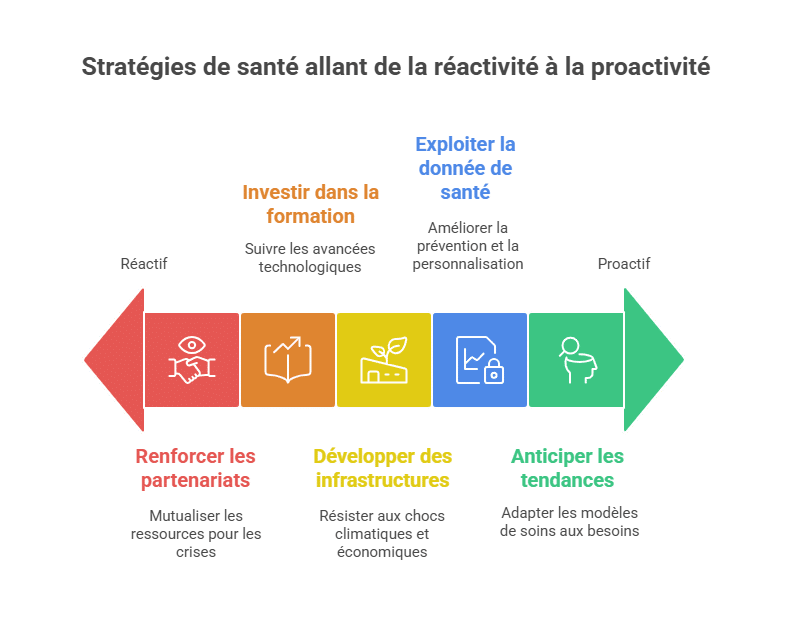
By 2030, the healthcare sector will need to demonstrate strategic agility to adapt to a constantly evolving environment. Companies and medical institutions should:
-
Strengthen public-private partnerships to pool resources and accelerate responses to future health crises 🏥.
-
Invest in continuous training for healthcare professionals to keep pace with technological advances and new medical practices 📚.
-
Develop resilient and sustainable infrastructures, capable of withstanding climate, economic, or health shocks 🌿.
-
Leverage health data ethically and securely, complying with regulations while harnessing its potential to improve prevention and personalized care 🔐.
-
Anticipate societal trends, particularly around mental health, prevention, and transparency expectations, to adapt care models to populations’ real needs.
Hence, PESTEL analysis becomes a proactive strategic tool, not only to understand the external environment but also to build sustainable competitive advantages in healthcare.
Conclusion
The health sector in 2025 is at a decisive turning point, driven by rapid technological developments, unprecedented societal expectations, and a rapidly changing political and economic environment. In this complex context, PESTEL analysis emerges as a key strategic lever to anticipate changes and adapt economic and organizational models of sector actors.
By thoroughly examining the political, economic, sociocultural, technological, ecological, and legal factors, it becomes possible to accurately identify opportunities to seize and risks to master. Whether for large pharmaceutical groups or innovative startups, success lies in the ability to adapt and in establishing agile strategies aligned with external environment mutations.
Looking toward 2030, healthcare companies that will be able to integrate innovation, strengthen partnerships, adopt sustainable practices, and place patient data at the core of decisions while respecting ethics and regulations will shape the future of care. More than just an analysis tool, PESTEL thus becomes an indispensable strategic compass to navigate an ever-evolving healthcare landscape.


FAQ
What is a PESTEL analysis?
The PESTEL analysis is a strategic tool that examines the political, economic, sociocultural, technological, ecological, and legal factors influencing a sector or a company. It helps understand the external environment.
How does PESTEL analysis impact the healthcare sector?
It enables sector stakeholders to identify potential trends and challenges, thereby facilitating the development of strategies tailored to meet the constantly evolving needs of patients and health systems.
What are the main challenges in 2025 for the healthcare sector?
Technological innovation, ecological concerns, demographic shifts, and regulatory evolutions are key factors influencing the sector in 2025.
What role does technology play in health?
Technology enhances the efficiency of care, facilitates access to health services, and offers solutions for personalized, real-time monitoring of patients’ well-being.
How can health companies adapt to sociocultural changes?
By listening to patient needs, offering tailored services, and integrating innovative solutions that meet increasing expectations for personalized care.
What trends are expected to shape healthcare by 2030?
Key trends include the widespread adoption of telemedicine, predictive medicine enabled by AI, the growth of sustainable hospitals, universal access to secure health data, and a patient-centered approach integrating physical, mental, and environmental health.
What are the benefits of a PESTEL approach for health startups?
It provides a comprehensive view of the market, helps identify strategic niches, understand regulatory constraints, and anticipate societal and technological trends to better guide the development of their solutions.
Entraîne-toi avec nos Quiz de révision
Fini les lectures passives. Pour retenir les notions clés du BTS Assurance, teste-toi ! Inscris-toi pour recevoir 1 quiz par jour directement dans ta boîte mail.

