


Summary
| Section | Key Points |
|---|---|
| Renault’s Strengths | Global presence with a solid market share (22% in France, 8% in Brazil, 6% in Russia). Strong commitment to innovation (electric, hybrid vehicles, partnerships with Nissan/Daimler). Strong brand identity (Clio, 4L) and motivated and dedicated employees. |
| Renault’s Weaknesses | Primarily positioned on economical vehicles, lack of a luxury range. High production costs related to French labor. Dependence on process optimization to remain competitive. |
| Market Opportunities | Growing demand for electric and hybrid vehicles. Expansion into emerging markets (notably China and Latin America). Strategic partnerships to reduce R&D costs and boost innovation. |
| Competitive Threats | Increased competition from Asian and international brands. Fluctuations in raw material costs (metals, components). Potential impact of economic crises on sales and margins. |
| Development and Innovation Strategy | Ongoing investments in R&D. Development of new hybrid and electric models. Partnerships for connectivity and autonomous driving. Goal: strengthen Renault’s position in sustainable and intelligent mobility. |
| FAQ | Importance of SWOT analysis to guide strategy. Main strengths: innovation, global presence, motivated employees. Challenges: competition, high costs, lack of diversification. Opportunities: eco-friendly vehicles, emerging markets. Threats: competition, costs, economic crises. |
In the current automotive industry context, the need for precise and systematic evaluation of companies is increasingly felt. SWOT analysis, which allows to assess a company’s strengths and weaknesses while taking into account market opportunities and competitive threats, becomes an essential tool. Using Renault as an example, this iconic manufacturer, this article explores its strategic features in depth. From its rich history to future prospects, each element of this exercise is crucial for understanding how Renault positions itself in a sector in constant change.
- Renault’s Strengths
- Renault’s Weaknesses
- Market Opportunities
- Competitive Threats
- Development and Automotive Innovation Strategy

Renault’s Strengths: A Strong Heritage and a Global Presence
Renault is a major player in the automotive sector, with several undeniable assets. Among Renault’s strengths, its international position can be highlighted. Indeed, the group is present in many countries, both in Europe and beyond, which allows it to diversify its markets. For example, Renault’s sales have seen significant growth in key markets such as Latin America and Russia, highlighting rising interest in its models.
| Market | Market Share (%) | Comment |
|---|---|---|
| Brazil | 8 | Strong progress thanks to adapted models. |
| Russia | 6 | Robust market share in a challenging environment. |
| France | 22 | Pioneer of the national automotive market. |
Another key strength lies in Renault’s commitment to automotive innovation. The group has made significant investments in research and development, particularly in electric and hybrid vehicles, in collaboration with industry giants like Nissan and Daimler. This proactive strategy in the field of sustainability positions Renault ahead of the ecological wave, attracting an increasingly environmentally-conscious clientele.
Finally, employee motivation and engagement remain a significant asset. Renault employees are known for their passion and dedication to the brand, which fosters a productive and innovative working environment. The historical success of iconic models like Clio or 4L also reflects Renault’s ability to appeal to different generations while maintaining a strong brand identity.

Renault’s Weaknesses: Challenges to Overcome
Despite its many assets, Renault must face certain weaknesses of Renault that could hinder its development. One of the most notable aspects is its market positioning. The brand has long focused on the economic segment, which excludes it from the luxury markets. While this has allowed it to reach a broad customer base, it raises questions about its ability to compete with premium brands attracting wealthier clients.
- Focus on affordable vehicles 💵
- Lack of luxury models 🏎️
- High production costs due to French labor 😕
Another major challenge is the high cost of labor in France, which remains relatively elevated compared to other countries. This factor can limit Renault’s ability to make necessary investments or adjustments in a competitive market. Consequently, the brand must think of innovative solutions to offset these costs while maintaining the quality and craftsmanship that define its reputation.
Thus, diversifying its offerings and reducing production costs are crucial for Renault. This could involve increasing manufacturing outside France or optimizing production processes. However, the commitment to quality and innovation must remain intact; these are fundamental aspects of its brand.
Market Opportunities: Toward a Promising Future
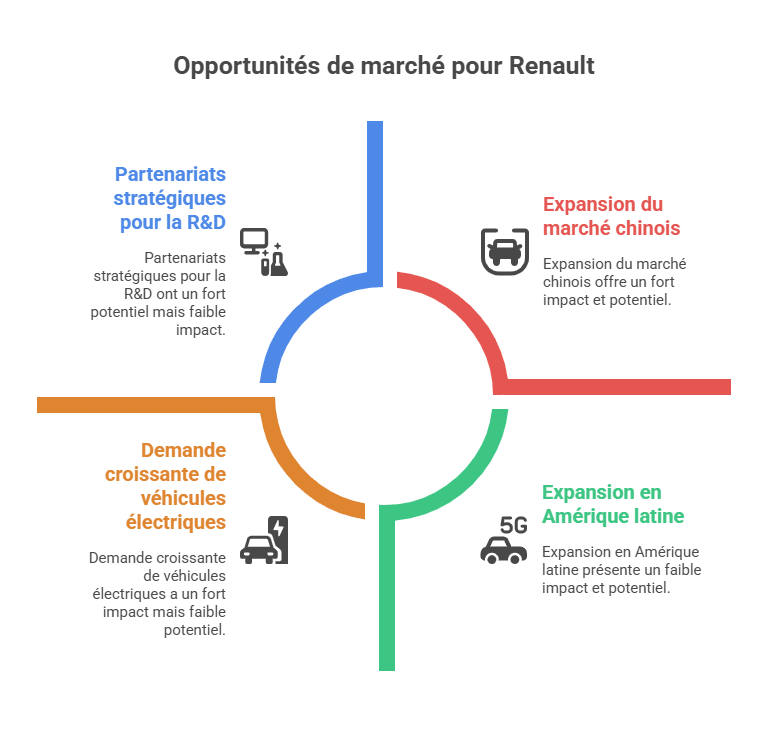
With the evolution of the automotive market, market opportunities are arising for Renault. First, the growing demand for eco-friendly vehicles, especially hybrid and electric cars, offers a golden opportunity for the manufacturer. More consumers are adopting responsible buying behaviors, and Renault could leverage this trend by expanding its ecological model range.
- Growing demand for electric vehicles ⚡
- Expansion into emerging markets 🌍
- Strategic R&D partnerships 🔬
Renault’s presence in the Chinese market also presents a major opportunity. This rapidly growing market offers enormous potential for sales. Starting to establish itself there since 2016, Renault hopes to capture a few percentage points of market share within a sea of 21 million vehicles sold annually. This emphasizes the importance for Renault to stay attuned to market trends and adapt its offerings accordingly.
| Region | Opportunity | Potential Impact |
|---|---|---|
| China | Market expansion | Targeting 3% market share |
| Europe | Electric vehicles | Increase in eco-friendly sales |
| Latin America | Growing demographics | Increase in customer base |
Strategic partnerships for research and development also represent a significant opportunity. By collaborating with other industry players, Renault could strengthen its technological and innovation offerings while reducing R&D costs. This would also enable better response to consumer expectations regarding sustainability and performance.
Competitive Threats: A Challenging Environment
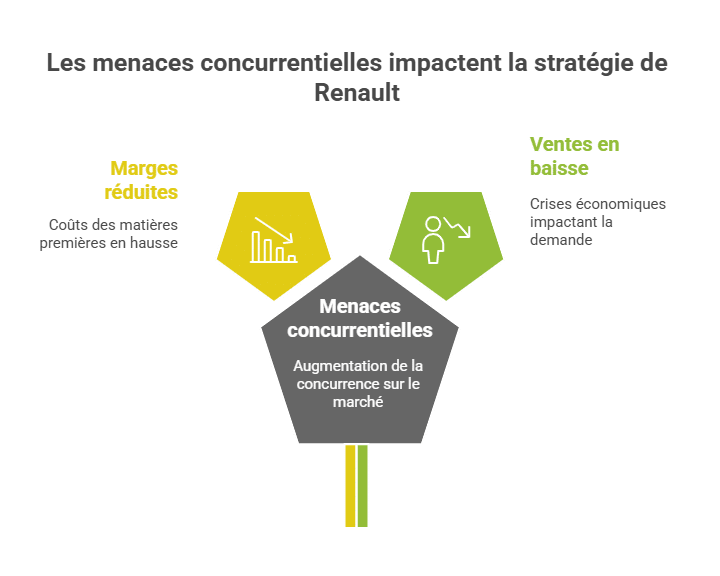
The automotive sector faces competitive threats that impact Renault’s development strategy. Competition, both European and international, is intensifying. New entrants are entering the market with attractive models at competitive prices, making it more difficult for Renault to retain its customers. Asian brands, for example, represent a growing challenge with their affordable and innovative vehicles.
- Increased competition 🚗
- Fluctuations in raw material costs 📉
- Economic crises impacting sales 📉
Another notable threat concerns the rise in raw material costs. Fluctuations in the prices of metals and other materials necessary for vehicle manufacturing can affect Renault’s profit margins. This situation could force Renault to pass these costs onto vehicle prices, making its offers less competitive.
Economic crises can also significantly impact sales. Although recent figures indicate overall growth in new vehicle sales, any economic downturn could reduce demand and margins. Therefore, Renault must closely monitor these trends and adapt proactively to an evolving environment.
Development and Innovation Strategy for the Future of Renault
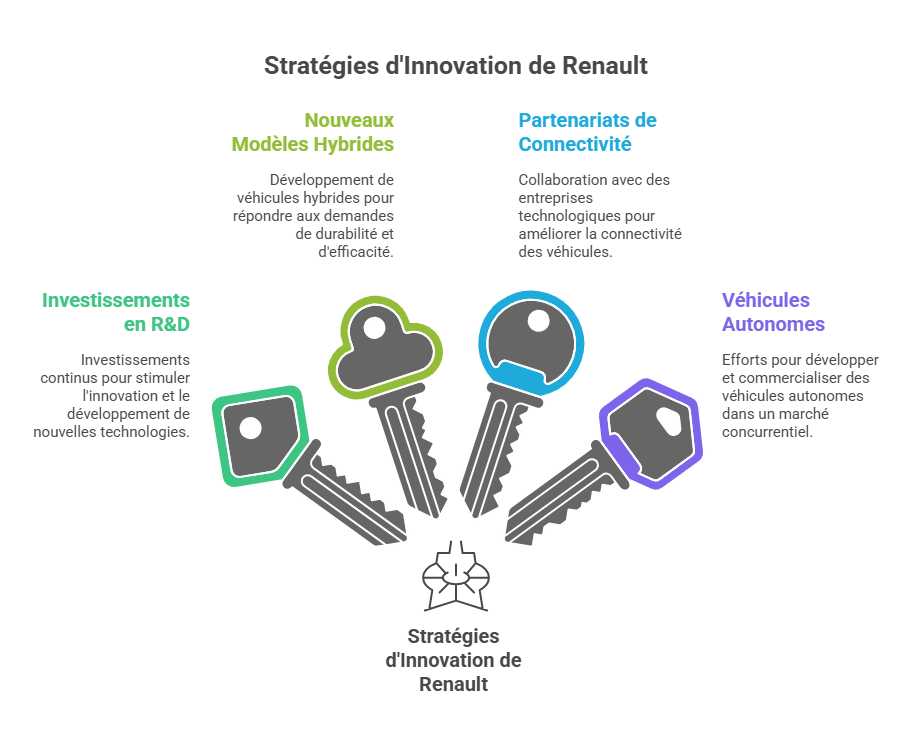
Renault’s development strategies must be both reactive and innovative to adapt to modern market dynamics. With an increased focus on automotive innovation, the company should concentrate on developing models that meet customer expectations, particularly in sustainability and smart technologies. Moreover, this involves paying special attention to the connected aspect of vehicles, integrating modern information technologies.
- Investments in R&D 💡
- New hybrid vehicle models ⚙️
- Partnerships for connectivity 🚀
The future of autonomous vehicles is also on the table. This topic presents both an opportunity and a challenge, as competition in this field is already very strong. Renault will need to intensify efforts to establish its position in this growing automotive segment. By focusing on innovation, Renault can become a leader in sustainable mobility while meeting the needs of an increasingly demanding customer base.
| Initiative | Impact on Renault | Longevity |
|---|---|---|
| Development of electric vehicles | Increasing market share | Sustainable |
| Autonomous driving technologies | Attraction of new customers | High potential |
| Constant technological evolution | Maintaining innovation | Essential |

Corporate Social Responsibility (CSR)
Beyond its industrial strategy, Renault aims to strengthen its role as a responsible and committed company in the face of climate and societal challenges. The ecological transition is now at the heart of its identity, and the French brand is undertaking numerous initiatives to reduce its carbon footprint. The goal is clear: to become a leading manufacturer in sustainable mobility.
Among the notable actions is an ambitious battery recycling program used in electric vehicles, enabling the recovery of rare materials and extending the lifespan of components. Renault is also committed to establishing plants aiming for carbon neutrality by 2030, relying on renewable energies and optimized logistics. Finally, the manufacturer is involved in green partnerships with startups and institutions to accelerate research in circular economy and environmental innovation.
Table – Renault’s CSR Initiatives
| Initiative | Objective | Expected Impact |
|---|---|---|
| Battery Recycling 🔋 | Reuse of valuable materials | Reduction of carbon footprint |
| Zero-carbon factories 🌱 | Carbon neutrality by 2030 | Enhanced sustainable image |
| Green partnerships 🤝 | Cooperation with eco-startups | Innovation in sustainable mobility |
Financial Performance and Profitability
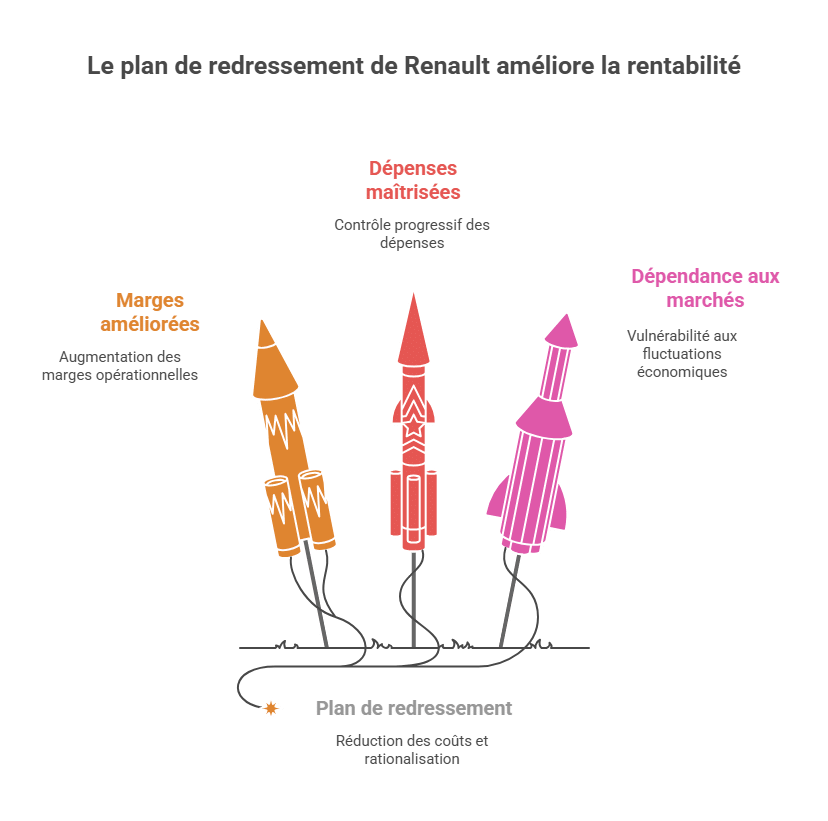
Renault’s strategic analysis cannot be complete without an assessment of its financial performance. After several challenging years, marked notably by the 2020 health crisis and the worldwide decline in car sales, Renault has implemented an ambitious turnaround plan. This program aims to reduce costs by several billion euros, through rationalizing production sites and optimizing supply chains.
Recent results show a slight recovery in profitability, with improved operating margins and a gradual control of expenses. This trend is explained by a refocus on the most promising segments, better valuation of electric models, and streamlining of the product portfolio. However, Renault remains heavily dependent on European markets, which makes its results sensitive to economic fluctuations and international crises.
In other words, Renault’s profitability depends on its ability to maintain a balance between cost reduction, product innovation, and expansion into emerging markets.
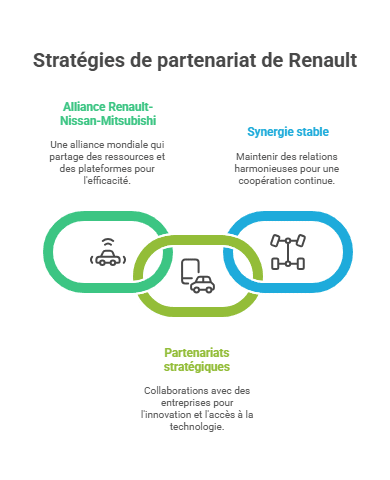
Alliances and Strategic Partnerships
Renault is a part of the Renault-Nissan-Mitsubishi alliance, considered one of the most significant global collaborations in the automotive industry. This alliance enables the French group to share resources in research and development, to share production platforms, and benefit from economies of scale. It is a major strategic lever to maintain competitiveness in a market where development costs are skyrocketing.
At the same time, Renault maintains strategic partnerships with players like Daimler for hybrid technology development or with startups specializing in connectivity and artificial intelligence. These collaborations give Renault privileged access to cutting-edge innovations while reducing the time and cost of bringing new technologies to market.
Nevertheless, these alliances are not without challenges: internal tensions, notably with Nissan, have sometimes weakened cooperation. Renault’s success will thus depend on its ability to maintain a stable synergy and to maximize the potential of these partnerships to continue innovating.
Table – Main Renault Partnerships
| Partner | Domain | Benefit for Renault |
|---|---|---|
| Nissan | Electric Vehicles & Platforms | Sharing R&D resources |
| Daimler | Hybrid technologies | Speeding up innovation |
| Tech startups | Connectivity and AI | Enhancement of smart vehicles |
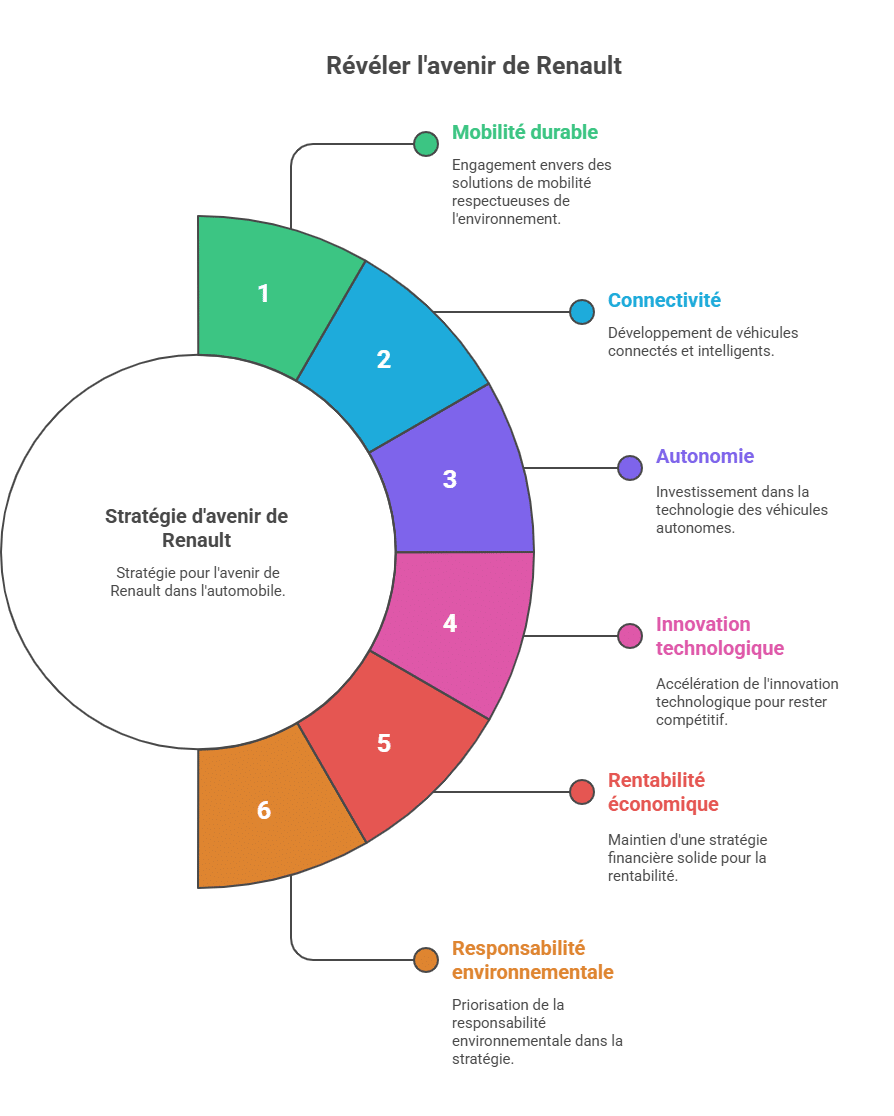
Future Perspectives
Renault’s future revolves around three key areas: sustainable mobility, connectivity, and vehicle autonomy. The manufacturer faces a major challenge: remaining true to its popular brand image while establishing itself as an essential player in the new automotive era.
Electric vehicles will continue to be at the center of its strategy, with plans to expand the range to meet growing consumer concern for the environment. The development of connected and intelligent cars is also a key issue, especially through the integration of new technologies related to artificial intelligence and assisted driving.
Finally, the autonomous vehicles market presents both an opportunity and a highly competitive field, dominated by giants like Tesla, Toyota, and emerging Chinese manufacturers. To stand out, Renault will need to accelerate its R&D investments while maintaining a strong financial strategy.
Renault’s future will thus depend on its ability to combine technological innovation, economic profitability, and environmental responsibility, in order to stay competitive in a rapidly changing sector.
Conclusion: Renault Facing Tomorrow’s Challenges and Opportunities
Renault’s SWOT analysis highlights a company with a contrasting profile, but possessing significant strengths to face the sector’s transformations. On one side, the manufacturer benefits from a strong international presence, a solid industrial heritage, and a stated commitment to innovation, especially in electric and hybrid vehicles. On the other side, it still faces structural weaknesses like high labor costs and the lack of a premium segment position.
The growth opportunities are numerous, whether it’s the rise of sustainable mobility, the potential of emerging markets, or strategic alliances that can reduce R&D costs. However, competitive threats are equally strong, with fierce competition, rising raw material costs, and global economic uncertainties.
To stay competitive, Renault must continue to innovate while optimizing resource management and enhancing strategic agility. Its future success depends on its ability to anticipate demand trends, adapt to economic constraints, and uphold an accessible, modern, and responsible corporate image.



SWOT Analysis FAQ for Renault
Why is SWOT analysis important for Renault?
SWOT analysis provides a clear picture of Renault’s strengths, weaknesses, opportunities, and threats, helping the company steer its development strategy.
What are Renault’s main strengths?
Renault is distinguished by its strong international presence, its commitment to innovation, and motivated employees.
What challenges must Renault overcome?
Renault must face challenges such as increased competition, high labor costs in France, and the need to diversify its offerings.
How can Renault benefit from market opportunities?
By investing in ecological models and expanding into emerging markets, Renault can maximize its growth potential.
What competitive threats does Renault face?
Threats include intensified competition, fluctuations in raw material costs, and the impact of potential economic crises.
📊 Analyses SWOT similaires
📊 Voir aussi : notre hub centralisé de toutes les analyses SWOT & PESTEL (206 études) classées par secteur — Tech, Auto, Mode, Distribution, Finance.
Tu prépares le BTS Assurance ?
Cette analyse SWOT fait partie des thèmes abordés dans les épreuves. Notre E-book de révision couvre l'intégralité du programme en fiches claires et synthétiques.
- 100 % du programme BTS Assurance
- Fiches 1ère et 2ème année
- Créé par un diplômé
- Téléchargement immédiat

Entraîne-toi avec nos Quiz de révision
Fini les lectures passives. Pour retenir les notions clés du BTS Assurance, teste-toi ! Inscris-toi pour recevoir 1 quiz par jour directement dans ta boîte mail.


