


- Analysis of political and regulatory challenges
- Status of economic forces and impact of interest rates
- Social and behavioral issues amid a changing landscape
- Emerging technologies and digital transformation
- Environmental impact and climate change
- Assessment of regulatory trends in Europe
- Opportunities and threats for banking sector players
- Future outlook and strategic orientation

Analysis of Political and Regulatory Challenges
Politics and regulation play a key role in the banking landscape in 2025. Diverse regulatory regimes between Europe and the United States influence bank competitiveness. The framework of Basel IV, expected to be fully implemented by 2033, is shaping up as a major concern for institutions such as Crédit Agricole, Société Générale, and La Banque Postale. Political tensions, especially those generated by recent elections, could also bring about significant regulatory changes.
At the European level, the ECB might maintain a strict stance, which could severely impact how European investment banks operate. Current discussions on capital and liquidity regulations indicate enhanced oversight could become the norm.
| Regulation | Impact on institutions | Examples |
|---|---|---|
| Basel IV | Increased capital costs | BNP Paribas, Crédit Agricole |
| Sector consolidation | Reduce competition | LCL, Société Générale |
| Better risk management | Portfolio optimization | HSBC France, Nova Bank |

Major Political Challenges in 2025
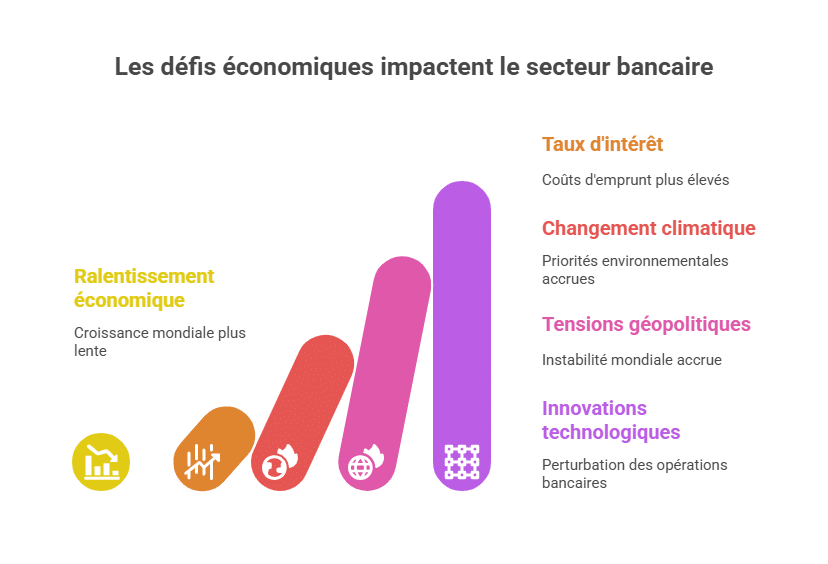
Beyond Basel IV, several global policies also impact the sector. The revision of monetary policies by numerous central banks, aiming to stabilize the economy, but also facing increasing geopolitical tensions, forces banks to adapt swiftly.
Regulatory Impacts on Competitiveness
To remain competitive, banks need to develop robust strategies to manage these regulations. For example, Boursorama Bank and Fortuneo, digital players, could benefit from this complexity by offering more flexible services tailored to consumer needs. Traditional institutions, meanwhile, must reconsider their approach to maintain a strong market position.
Economic Forces and Interest Rate Impact
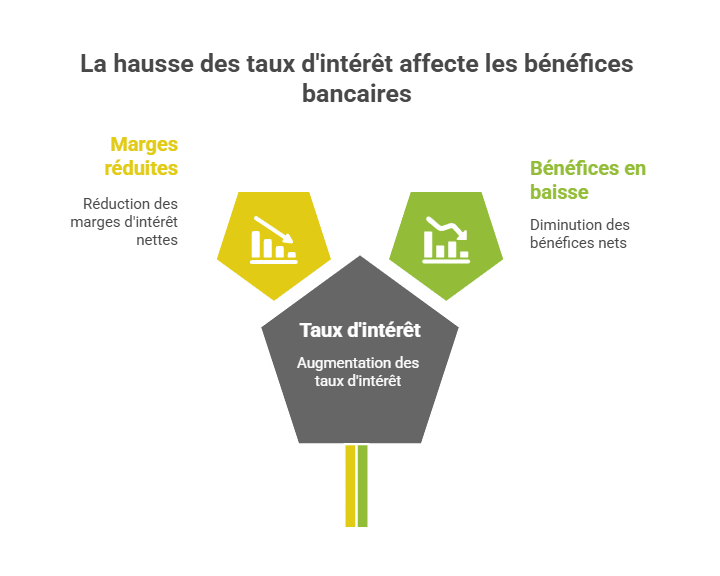
The global economic slowdown puts pressure on the European banking sector. Forecasts indicate that growth could remain modest, making revenue generation even more difficult. Rising interest rates could also affect net interest margins, which are critical for banks. A drop of 50 basis points might reduce these revenues by 3%, significantly impacting net profits.
- Impact of interest rates on borrowing
- Reduction in profit margins
- Strategies to offset revenue loss
| Year | Estimated interest rate (%) | Impact on profits |
|---|---|---|
| 2023 | 2.50 | Stable |
| 2024 | 3.00 | Decreasing |
| 2025 | 2.50 | Slight recovery |
Sector Participants’ Adaptations
In response to this situation, banks must develop new ways of thinking. Partnerships and collaborations with technology companies could prove effective to diversify revenue sources and refine cost structures. Crédit Mutuel and HSBC France, for their part, are investing in digitizing their services to stay ahead in the competitive arena.
Social and Behavioral Challenges amid a Changing Landscape
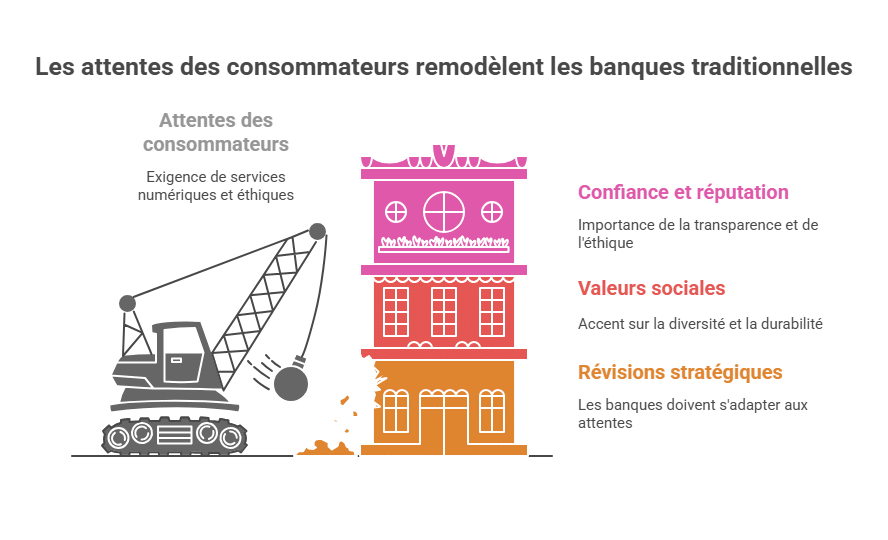
By 2025, consumers are changing their approach to banking services. The rise of fintechs and digitization of services are prompting traditional banks to reconsider their operational models. Growing customer expectations for ethical, transparent, and easily accessible services require these institutions to develop tailored products.
- Rising expectations of consumers for digital services
- Growing importance of social and ESG values
- Trust and reputation of banking institutions
Customer Expectations in 2025
Customers, especially younger generations, seek complete transparency in banking services. Boursorama Bank, for example, has quickly adapted by offering products tailored to the specific needs of generations Z and Y. AI-based services also enable personalized experiences that attract young borrowers.
Social Challenges and Impacts on Traditional Banks
Banks such as La Banque Postale and LCL must align with these expectations and consider strategic revisions. Social issues related to diversity, inclusion, and sustainability have become key elements in attracting new clients.
Emerging Technologies and Digital Transformation
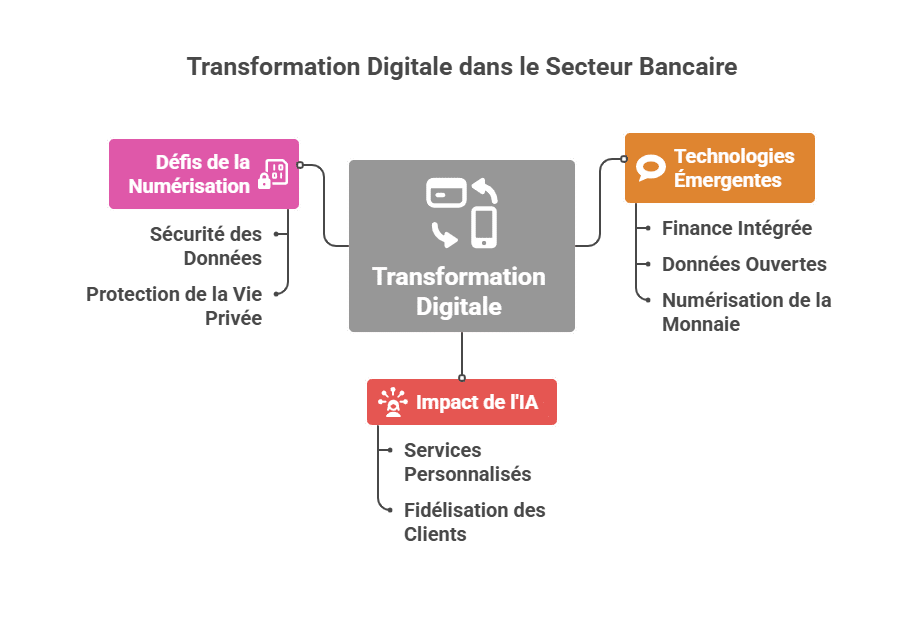
Technological innovations continue to reshape the banking landscape. Innovations such as integrated finance, open data, and digital currency redefine client-bank interactions. Many institutions, including Crédit Agricole and Nova Bank, are investing heavily in these technologies to optimize client interactions and strengthen their market position.
- Integration of artificial intelligence into services
- Growing use of blockchains for secure transactions
- Development of intuitive mobile applications
| Technology | Potential Impact | Participating Banks |
|---|---|---|
| AI | Enhanced customer experience | HSBC France, Crédit Mutuel |
| Blockchain | Fast and secure transactions | BNP Paribas, Nova Bank |
| Apps | Simplification of banking operations | Boursorama Bank, Fortuneo |
Impact of AI on Banking Operations
AI tools allow banks to offer personalized services that increase customer loyalty. These contradictions between technology and traditional practices are causing a market repositioning. All banks must engage in these transformations to stay ahead of the competition.
Challenges Associated with Digitization
Despite these advances, digitization also poses challenges. Data security and privacy protection have become paramount in a context of increasing cybercrime. Société Générale and Crédit Agricole are investing in cybersecurity solutions to address these concerns.
Environmental Impact and Climate Change
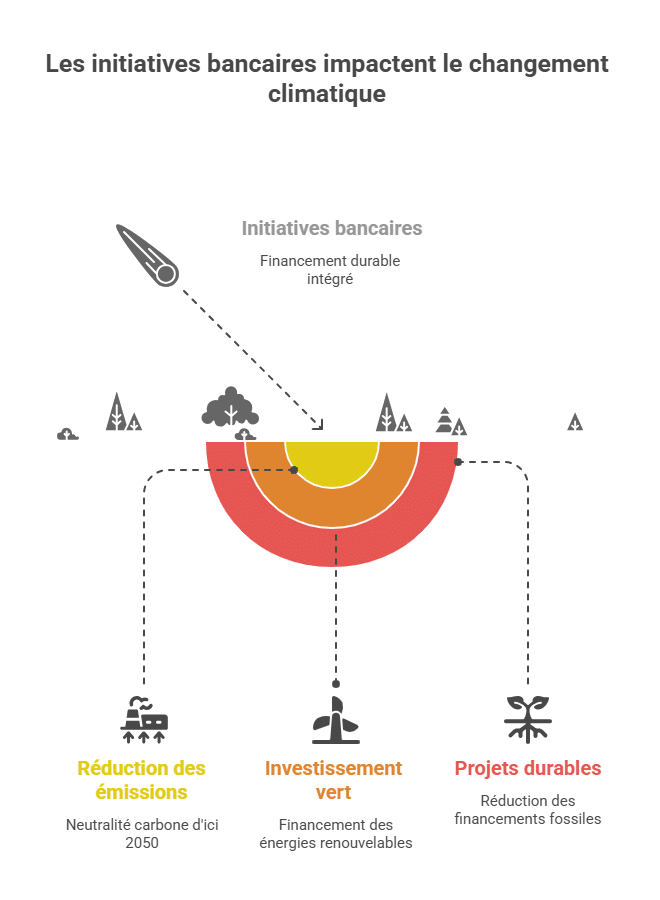
Within the context of climate issues, banks are pushed to rethink their strategies in response to the climate emergency. Understanding how institutions such as BNP Paribas and HSBC France incorporate sustainability goals into their operations is crucial. The Net Zero Banking Alliance is a notable example of this growing awareness.
- Implementation of green initiatives in investment portfolios
- Commitment to rapid and effective decarbonization
- Assessment of environmental impact of financing

| Environmental Goal | Participating Banks | Projected Impact |
|---|---|---|
| Carbon neutrality by 2050 | BNP Paribas, Crédit Agricole | Reduction of CO2 emissions |
| Financing renewable energy | HSBC France, Nova Bank | Increase in green investments |
| Reduction of fossil fuel financing | Fortuneo, La Banque Postale | Growth of sustainable projects |
Bank Initiatives in Response to Climate Change
Banks are increasingly aware of their environmental responsibilities. By integrating sustainable financing into their core strategies, banks can not only meet customer expectations but also enhance their reputation and market position.
Risks of a Slow Transition
Time is pressing, and delays in implementing these strategies could have detrimental consequences. Studies show that banks with irrelevant emission targets risk damaging their reputation and long-term viability.
Assessment of Regulatory Trends in Europe
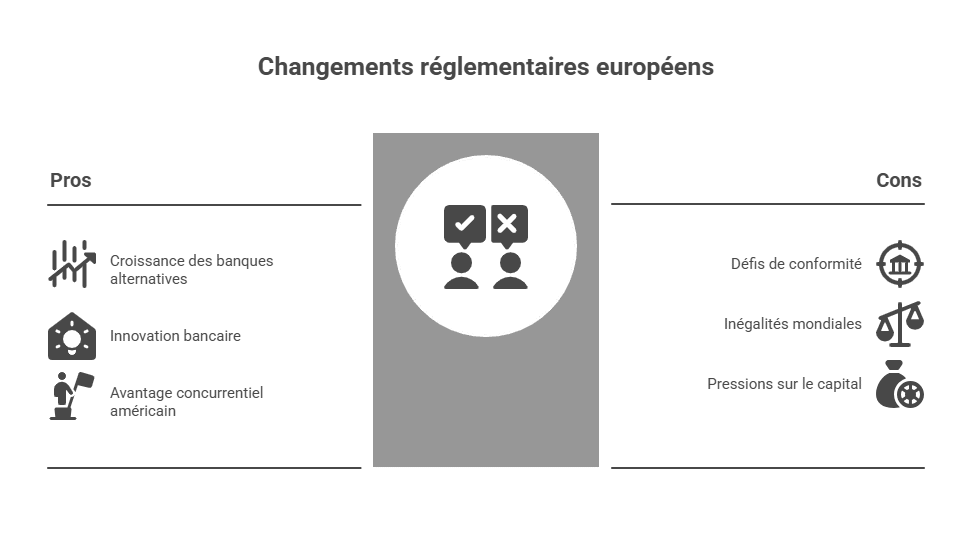
With debates on regulation considering diverging market contexts in Europe and the US, each player must navigate skillfully. Discussions on simplifying IPO procedures could also impact banks such as Société Générale and Crédit Agricole.
- Evolution of the European regulatory framework
- Challenges for banks facing common policies
- Growth opportunities for alternative banking models
Expected Changes with Basel IV
The implementation of Basel IV could significantly transform the regulatory landscape. For US banks, the lack of full adoption of these rules might give them a competitive advantage, potentially widening gaps in global competition.
Impacts of Regulation on the Banking Sector
To withstand capital surcharges, banks must innovate and adjust their cost structures. Established players such as Crédit Agricole and BNP Paribas need to continue exploring innovative solutions to secure their position amid this changing environment.
Opportunities and Threats for Banking Sector Players
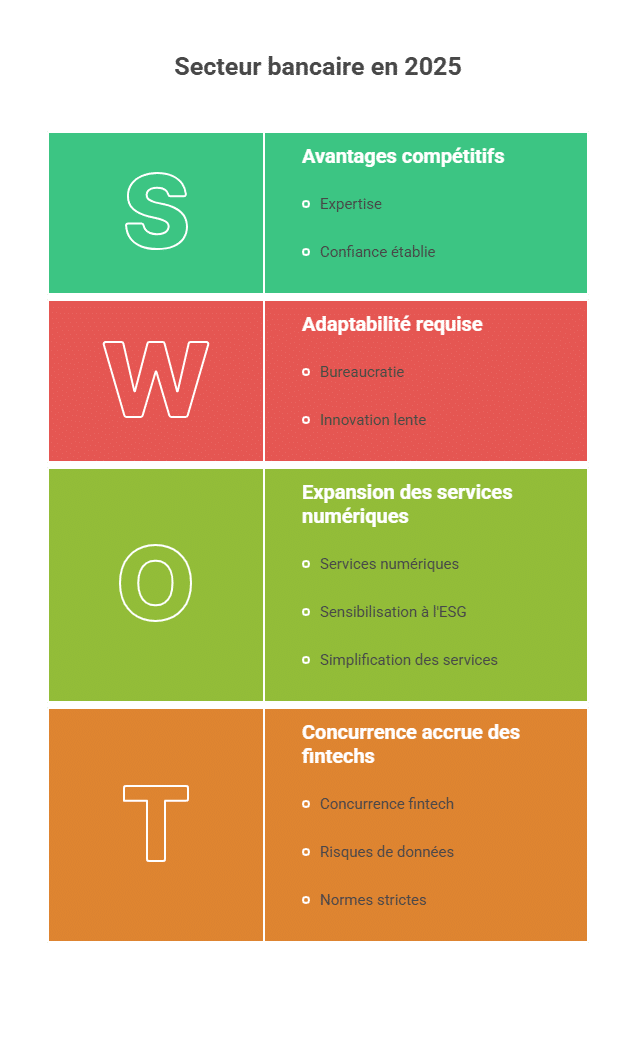
The banking sector in 2025 is a landscape full of opportunities amid risks. While banks like Crédit Mutuel and HSBC France explore new market segments, they must also contend with significant challenges. Evolving customer expectations, the rising role of fintechs, and the importance of social engagement are key elements to consider.
- Competitive advantages of traditional players over fintechs
- Importance of innovation to stay relevant
- Threats of a consumer trust crisis

| Opportunity | Threat | Affected Banks |
|---|---|---|
| Expansion into digital services | Increased competition from fintechs | Crédit Agricole, Boursorama Bank |
| Focus on ESG | Stricter regulatory standards | BNP Paribas, La Banque Postale |
| Simplification of services | Cybersecurity and data risks | Société Générale, LCL |
How Are Banks Responding to Threats?
The key for banks will be adaptability. For institutions like Crédit Mutuel and HSBC France, diversification alone will not suffice; they will also need to develop innovative and improved solutions to remain relevant.
Future Outlook and Strategic Directions
The prospect of institutional renewal will be a necessary condition for banks to survive and thrive. With increased focus on innovation and social engagement, the potential for transformation within the banking sector is enormous. Committing to a sustainable path could not only strengthen long-term viability but also boost consumer confidence in their financial institutions.
FAQ
What are the main challenges facing the banking sector in 2025?
The banking sector must manage rising interest rates, increasingly strict regulations, environmental concerns, and heightened consumer expectations for digital services.
How do technologies influence the banking sector?
Technologies such as artificial intelligence and blockchain facilitate digital transformation in banking, enabling secure transactions and an improved customer experience.
Which major banks are involved in the transition to sustainable practices?
Institutions like BNP Paribas, HSBC France, and Crédit Agricole are implementing decarbonization strategies and renewable energy financing.
How important is regulation for the banking sector in 2025?
Regulation is crucial because it determines the competitiveness of banks and their ability to manage economic crises.
How can banks stay competitive against fintechs?
To remain competitive, banks must innovate constantly, diversify their services, and adapt to new consumer expectations to maintain relevance in the market.
- Rising expectations of consumers for digital services
- Growing importance of social and ESG values
- Trust and reputation of banking institutions
Customer Expectations in 2025
Customers, especially younger generations, seek complete transparency in banking services. Boursorama Bank, for example, has quickly adapted by offering products tailored to the specific needs of generations Z and Y. AI-based services also enable personalized experiences that attract young borrowers.
Social Challenges and Impacts on Traditional Banks
Banks such as La Banque Postale and LCL must align with these expectations and consider strategic revisions. Social issues related to diversity, inclusion, and sustainability have become key elements in attracting new clients.
Emerging Technologies and Digital Transformation
Technological innovations continue to reshape the banking landscape. Innovations such as integrated finance, open data, and digital currency redefine client-bank interactions. Many institutions, including Crédit Agricole and Nova Bank, are investing heavily in these technologies to optimize client interactions and strengthen their market position.
- Integration of artificial intelligence into services
- Growing use of blockchains for secure transactions
- Development of intuitive mobile applications
| Technology | Potential Impact | Participating Banks |
|---|---|---|
| AI | Enhanced customer experience | HSBC France, Crédit Mutuel |
| Blockchain | Fast and secure transactions | BNP Paribas, Nova Bank |
| Apps | Simplification of banking operations | Boursorama Bank, Fortuneo |
Impact of AI on Banking Operations
AI tools allow banks to offer personalized services that increase customer loyalty. These contradictions between technology and traditional practices are causing a market repositioning. All banks must engage in these transformations to stay ahead of the competition.
Challenges Associated with Digitization
Despite these advances, digitization also poses challenges. Data security and privacy protection have become paramount in a context of increasing cybercrime. Société Générale and Crédit Agricole are investing in cybersecurity solutions to address these concerns.
Environmental Impact and Climate Change
Within the context of climate issues, banks are pushed to rethink their strategies in response to the climate emergency. Understanding how institutions such as BNP Paribas and HSBC France incorporate sustainability goals into their operations is crucial. The Net Zero Banking Alliance is a notable example of this growing awareness.
- Implementation of green initiatives in investment portfolios
- Commitment to rapid and effective decarbonization
- Assessment of environmental impact of financing
| Environmental Goal | Participating Banks | Projected Impact |
|---|---|---|
| Carbon neutrality by 2050 | BNP Paribas, Crédit Agricole | Reduction of CO2 emissions |
| Financing renewable energy | HSBC France, Nova Bank | Increase in green investments |
| Reduction of fossil fuel financing | Fortuneo, La Banque Postale | Growth of sustainable projects |
Bank Initiatives in Response to Climate Change
Banks are increasingly aware of their environmental responsibilities. By integrating sustainable financing into their core strategies, banks can not only meet customer expectations but also enhance their reputation and market position.
Risks of a Slow Transition
Time is pressing, and delays in implementing these strategies could have detrimental consequences. Studies show that banks with irrelevant emission targets risk damaging their reputation and long-term viability.
Assessment of Regulatory Trends in Europe
With debates on regulation considering diverging market contexts in Europe and the US, each player must navigate skillfully. Discussions on simplifying IPO procedures could also impact banks such as Société Générale and Crédit Agricole.
- Evolution of the European regulatory framework
- Challenges for banks facing common policies
- Growth opportunities for alternative banking models
Expected Changes with Basel IV
The implementation of Basel IV could significantly transform the regulatory landscape. For US banks, the lack of full adoption of these rules might give them a competitive advantage, potentially widening gaps in global competition.
Impacts of Regulation on the Banking Sector
To withstand capital surcharges, banks must innovate and adjust their cost structures. Established players such as Crédit Agricole and BNP Paribas need to continue exploring innovative solutions to secure their position amid this changing environment.
Opportunities and Threats for Banking Sector Players
The banking sector in 2025 is a landscape full of opportunities amid risks. While banks like Crédit Mutuel and HSBC France explore new market segments, they must also contend with significant challenges. Evolving customer expectations, the rising role of fintechs, and the importance of social engagement are key elements to consider.
- Competitive advantages of traditional players over fintechs
- Importance of innovation to stay relevant
- Threats of a consumer trust crisis
| Opportunity | Threat | Affected Banks |
|---|---|---|
| Expansion into digital services | Increased competition from fintechs | Crédit Agricole, Boursorama Bank |
| Focus on ESG | Stricter regulatory standards | BNP Paribas, La Banque Postale |
| Simplification of services | Cybersecurity and data risks | Société Générale, LCL |
How Are Banks Responding to Threats?
The key for banks will be adaptability. For institutions like Crédit Mutuel and HSBC France, diversification alone will not suffice; they will also need to develop innovative and improved solutions to remain relevant.
Future Outlook and Strategic Directions
The prospect of institutional renewal will be a necessary condition for banks to survive and thrive. With increased focus on innovation and social engagement, the potential for transformation within the banking sector is enormous. Committing to a sustainable path could not only strengthen long-term viability but also boost consumer confidence in their financial institutions.
FAQ
What are the main challenges facing the banking sector in 2025?
The banking sector must manage rising interest rates, increasingly strict regulations, environmental concerns, and heightened consumer expectations for digital services.
How do technologies influence the banking sector?
Technologies such as artificial intelligence and blockchain facilitate digital transformation in banking, enabling secure transactions and an improved customer experience.
Which major banks are involved in the transition to sustainable practices?
Institutions like BNP Paribas, HSBC France, and Crédit Agricole are implementing decarbonization strategies and renewable energy financing.
How important is regulation for the banking sector in 2025?
Regulation is crucial because it determines the competitiveness of banks and their ability to manage economic crises.
How can banks stay competitive against fintechs?
To remain competitive, banks must innovate constantly, diversify their services, and adapt to new consumer expectations to maintain relevance in the market.
- Analysis of political and regulatory challenges
- Status of economic forces and impact of interest rates
- Social and behavioral issues amid a changing landscape
- Emerging technologies and digital transformation
- Environmental impact and climate change
- Assessment of regulatory trends in Europe
- Opportunities and threats for banking sector players
- Future outlook and strategic orientation
Analysis of Political and Regulatory Challenges
Politics and regulation play a key role in the banking landscape in 2025. Diverse regulatory regimes between Europe and the United States influence bank competitiveness. The framework of Basel IV, expected to be fully implemented by 2033, is shaping up as a major concern for institutions such as Crédit Agricole, Société Générale, and La Banque Postale. Political tensions, especially those generated by recent elections, could also bring about significant regulatory changes.
At the European level, the ECB might maintain a strict stance, which could severely impact how European investment banks operate. Current discussions on capital and liquidity regulations indicate enhanced oversight could become the norm.
| Regulation | Impact on institutions | Examples |
|---|---|---|
| Basel IV | Increased capital costs | BNP Paribas, Crédit Agricole |
| Sector consolidation | Reduce competition | LCL, Société Générale |
| Better risk management | Portfolio optimization | HSBC France, Nova Bank |
Major Political Challenges in 2025
Beyond Basel IV, several global policies also impact the sector. The revision of monetary policies by numerous central banks, aiming to stabilize the economy, but also facing increasing geopolitical tensions, forces banks to adapt swiftly.
Regulatory Impacts on Competitiveness
To remain competitive, banks need to develop robust strategies to manage these regulations. For example, Boursorama Bank and Fortuneo, digital players, could benefit from this complexity by offering more flexible services tailored to consumer needs. Traditional institutions, meanwhile, must reconsider their approach to maintain a strong market position.
Economic Forces and Interest Rate Impact
The global economic slowdown puts pressure on the European banking sector. Forecasts indicate that growth could remain modest, making revenue generation even more difficult. Rising interest rates could also affect net interest margins, which are critical for banks. A drop of 50 basis points might reduce these revenues by 3%, significantly impacting net profits.
- Impact of interest rates on borrowing
- Reduction in profit margins
- Strategies to offset revenue loss
| Year | Estimated interest rate (%) | Impact on profits |
|---|---|---|
| 2023 | 2.50 | Stable |
| 2024 | 3.00 | Decreasing |
| 2025 | 2.50 | Slight recovery |
Sector Participants’ Adaptations
In response to this situation, banks must develop new ways of thinking. Partnerships and collaborations with technology companies could prove effective to diversify revenue sources and refine cost structures. Crédit Mutuel and HSBC France, for their part, are investing in digitizing their services to stay ahead in the competitive arena.
Social and Behavioral Challenges amid a Changing Landscape
By 2025, consumers are changing their approach to banking services. The rise of fintechs and digitization of services are prompting traditional banks to reconsider their operational models. Growing customer expectations for ethical, transparent, and easily accessible services require these institutions to develop tailored products.
- Rising expectations of consumers for digital services
- Growing importance of social and ESG values
- Trust and reputation of banking institutions
Customer Expectations in 2025
Customers, especially younger generations, seek complete transparency in banking services. Boursorama Bank, for example, has quickly adapted by offering products tailored to the specific needs of generations Z and Y. AI-based services also enable personalized experiences that attract young borrowers.
Social Challenges and Impacts on Traditional Banks
Banks such as La Banque Postale and LCL must align with these expectations and consider strategic revisions. Social issues related to diversity, inclusion, and sustainability have become key elements in attracting new clients.
Emerging Technologies and Digital Transformation
Technological innovations continue to reshape the banking landscape. Innovations such as integrated finance, open data, and digital currency redefine client-bank interactions. Many institutions, including Crédit Agricole and Nova Bank, are investing heavily in these technologies to optimize client interactions and strengthen their market position.
- Integration of artificial intelligence into services
- Growing use of blockchains for secure transactions
- Development of intuitive mobile applications
| Technology | Potential Impact | Participating Banks |
|---|---|---|
| AI | Enhanced customer experience | HSBC France, Crédit Mutuel |
| Blockchain | Fast and secure transactions | BNP Paribas, Nova Bank |
| Apps | Simplification of banking operations | Boursorama Bank, Fortuneo |
Impact of AI on Banking Operations
AI tools allow banks to offer personalized services that increase customer loyalty. These contradictions between technology and traditional practices are causing a market repositioning. All banks must engage in these transformations to stay ahead of the competition.
Challenges Associated with Digitization
Despite these advances, digitization also poses challenges. Data security and privacy protection have become paramount in a context of increasing cybercrime. Société Générale and Crédit Agricole are investing in cybersecurity solutions to address these concerns.
Environmental Impact and Climate Change
Within the context of climate issues, banks are pushed to rethink their strategies in response to the climate emergency. Understanding how institutions such as BNP Paribas and HSBC France incorporate sustainability goals into their operations is crucial. The Net Zero Banking Alliance is a notable example of this growing awareness.
- Implementation of green initiatives in investment portfolios
- Commitment to rapid and effective decarbonization
- Assessment of environmental impact of financing
| Environmental Goal | Participating Banks | Projected Impact |
|---|---|---|
| Carbon neutrality by 2050 | BNP Paribas, Crédit Agricole | Reduction of CO2 emissions |
| Financing renewable energy | HSBC France, Nova Bank | Increase in green investments |
| Reduction of fossil fuel financing | Fortuneo, La Banque Postale | Growth of sustainable projects |
Bank Initiatives in Response to Climate Change
Banks are increasingly aware of their environmental responsibilities. By integrating sustainable financing into their core strategies, banks can not only meet customer expectations but also enhance their reputation and market position.
Risks of a Slow Transition
Time is pressing, and delays in implementing these strategies could have detrimental consequences. Studies show that banks with irrelevant emission targets risk damaging their reputation and long-term viability.
Assessment of Regulatory Trends in Europe
With debates on regulation considering diverging market contexts in Europe and the US, each player must navigate skillfully. Discussions on simplifying IPO procedures could also impact banks such as Société Générale and Crédit Agricole.
- Evolution of the European regulatory framework
- Challenges for banks facing common policies
- Growth opportunities for alternative banking models
Expected Changes with Basel IV
The implementation of Basel IV could significantly transform the regulatory landscape. For US banks, the lack of full adoption of these rules might give them a competitive advantage, potentially widening gaps in global competition.
Impacts of Regulation on the Banking Sector
To withstand capital surcharges, banks must innovate and adjust their cost structures. Established players such as Crédit Agricole and BNP Paribas need to continue exploring innovative solutions to secure their position amid this changing environment.
Opportunities and Threats for Banking Sector Players
The banking sector in 2025 is a landscape full of opportunities amid risks. While banks like Crédit Mutuel and HSBC France explore new market segments, they must also contend with significant challenges. Evolving customer expectations, the rising role of fintechs, and the importance of social engagement are key elements to consider.
- Competitive advantages of traditional players over fintechs
- Importance of innovation to stay relevant
- Threats of a consumer trust crisis
| Opportunity | Threat | Affected Banks |
|---|---|---|
| Expansion into digital services | Increased competition from fintechs | Crédit Agricole, Boursorama Bank |
| Focus on ESG | Stricter regulatory standards | BNP Paribas, La Banque Postale |
| Simplification of services | Cybersecurity and data risks | Société Générale, LCL |
How Are Banks Responding to Threats?
The key for banks will be adaptability. For institutions like Crédit Mutuel and HSBC France, diversification alone will not suffice; they will also need to develop innovative and improved solutions to remain relevant.
Future Outlook and Strategic Directions
The prospect of institutional renewal will be a necessary condition for banks to survive and thrive. With increased focus on innovation and social engagement, the potential for transformation within the banking sector is enormous. Committing to a sustainable path could not only strengthen long-term viability but also boost consumer confidence in their financial institutions.
FAQ
What are the main challenges facing the banking sector in 2025?
The banking sector must manage rising interest rates, increasingly strict regulations, environmental concerns, and heightened consumer expectations for digital services.
How do technologies influence the banking sector?
Technologies such as artificial intelligence and blockchain facilitate digital transformation in banking, enabling secure transactions and an improved customer experience.
Which major banks are involved in the transition to sustainable practices?
Institutions like BNP Paribas, HSBC France, and Crédit Agricole are implementing decarbonization strategies and renewable energy financing.
How important is regulation for the banking sector in 2025?
Regulation is crucial because it determines the competitiveness of banks and their ability to manage economic crises.
How can banks stay competitive against fintechs?
To remain competitive, banks must innovate constantly, diversify their services, and adapt to new consumer expectations to maintain relevance in the market.
- Politics and regulation play a key role in the banking landscape in 2025.
- Impact of interest rates on borrowing
- Reduction in profit margins
- Strategies to offset revenue loss
- Rising expectations of consumers for digital services
- Growing importance of social and ESG values
- Trust and reputation of banking institutions
- Integration of artificial intelligence into services
- Growing use of blockchains for secure transactions
- Development of intuitive mobile applications
- Implementation of green initiatives in investment portfolios
- Commitment to rapid and effective decarbonization
- Assessment of environmental impact of financing
- Evolution of the European regulatory framework
- Challenges for banks facing common policies
- Growth opportunities for alternative banking models
In Summary
| PESTEL Factor | Key Challenges 2025 |
|---|---|
| Political & Regulatory | Implementation of Basel IV → increased capital costs, enhanced oversight by the ECB, geopolitical tensions influencing regulation. |
| Economic | Global economic slowdown, net interest margins under pressure, fluctuating interest rates (2.5% → 3%), partnerships to diversify revenue streams. |
| Social | Growing consumer expectations for digital, ethical, and inclusive services, rising ESG values, trust/reputation at the center. |
| Technological | Digital transformation: AI (personalization, loyalty), blockchain (security, speed), mobile applications (simplicity, accessibility). |
| Environmental | Pressure from climate change, carbon neutrality by 2050, reduction of fossil fuel financing, growth of green investments. |
| Legal | Strengthening of data protection and cybersecurity standards, adaptation to divergent regulations Europe/USA, strict monitoring of ESG obligations. |
On the eve of 2025, the banking sector faces a set of complex challenges that are redefining its practices and strategic directions. The slowdown of the global economy, combined with rising interest rates, suggests a difficult environment for banks. Additionally, issues related to climate change and geopolitical tensions require constant reevaluation of priorities. In this context, technological innovations significantly influence traditional banking operations. How can each sector player, whether BNP Paribas, Société Générale, or Crédit Agricole, navigate this new economic reality? This article offers an in-depth analysis of the banking sector’s PESTEL environment in 2025, highlighting challenges and future prospects.
- Competitive advantages of traditional players over fintechs
- Importance of innovation to stay relevant
- Threats of a consumer trust crisis
| Opportunity | Threat | Affected Banks |
|---|---|---|
| Expansion into digital services | Increased competition from fintechs | Crédit Agricole, Boursorama Bank |
| Focus on ESG | Stricter regulatory standards | BNP Paribas, La Banque Postale |
| Simplification of services | Cybersecurity and data risks | Société Générale, LCL |
How Are Banks Responding to Threats?
The key for banks will be adaptability. For institutions like Crédit Mutuel and HSBC France, diversification alone will not suffice; they will also need to develop innovative and improved solutions to remain relevant.
Future Outlook and Strategic Directions
The prospect of institutional renewal will be a necessary condition for banks to survive and thrive. With increased focus on innovation and social engagement, the potential for transformation within the banking sector is enormous. Committing to a sustainable path could not only strengthen long-term viability but also boost consumer confidence in their financial institutions.
FAQ
What are the main challenges facing the banking sector in 2025?
The banking sector must manage rising interest rates, increasingly strict regulations, environmental concerns, and heightened consumer expectations for digital services.
How do technologies influence the banking sector?
Technologies such as artificial intelligence and blockchain facilitate digital transformation in banking, enabling secure transactions and an improved customer experience.
Which major banks are involved in the transition to sustainable practices?
Institutions like BNP Paribas, HSBC France, and Crédit Agricole are implementing decarbonization strategies and renewable energy financing.
How important is regulation for the banking sector in 2025?
Regulation is crucial because it determines the competitiveness of banks and their ability to manage economic crises.
How can banks stay competitive against fintechs?
To remain competitive, banks must innovate constantly, diversify their services, and adapt to new consumer expectations to maintain relevance in the market.
- Rising expectations of consumers for digital services
- Growing importance of social and ESG values
- Trust and reputation of banking institutions
Customer Expectations in 2025
Customers, especially younger generations, seek complete transparency in banking services. Boursorama Bank, for example, has quickly adapted by offering products tailored to the specific needs of generations Z and Y. AI-based services also enable personalized experiences that attract young borrowers.
Social Challenges and Impacts on Traditional Banks
Banks such as La Banque Postale and LCL must align with these expectations and consider strategic revisions. Social issues related to diversity, inclusion, and sustainability have become key elements in attracting new clients.
Emerging Technologies and Digital Transformation
Technological innovations continue to reshape the banking landscape. Innovations such as integrated finance, open data, and digital currency redefine client-bank interactions. Many institutions, including Crédit Agricole and Nova Bank, are investing heavily in these technologies to optimize client interactions and strengthen their market position.
- Integration of artificial intelligence into services
- Growing use of blockchains for secure transactions
- Development of intuitive mobile applications
| Technology | Potential Impact | Participating Banks |
|---|---|---|
| AI | Enhanced customer experience | HSBC France, Crédit Mutuel |
| Blockchain | Fast and secure transactions | BNP Paribas, Nova Bank |
| Apps | Simplification of banking operations | Boursorama Bank, Fortuneo |
Impact of AI on Banking Operations
AI tools allow banks to offer personalized services that increase customer loyalty. These contradictions between technology and traditional practices are causing a market repositioning. All banks must engage in these transformations to stay ahead of the competition.
Challenges Associated with Digitization
Despite these advances, digitization also poses challenges. Data security and privacy protection have become paramount in a context of increasing cybercrime. Société Générale and Crédit Agricole are investing in cybersecurity solutions to address these concerns.
Environmental Impact and Climate Change
Within the context of climate issues, banks are pushed to rethink their strategies in response to the climate emergency. Understanding how institutions such as BNP Paribas and HSBC France incorporate sustainability goals into their operations is crucial. The Net Zero Banking Alliance is a notable example of this growing awareness.
- Implementation of green initiatives in investment portfolios
- Commitment to rapid and effective decarbonization
- Assessment of environmental impact of financing
| Environmental Goal | Participating Banks | Projected Impact |
|---|---|---|
| Carbon neutrality by 2050 | BNP Paribas, Crédit Agricole | Reduction of CO2 emissions |
| Financing renewable energy | HSBC France, Nova Bank | Increase in green investments |
| Reduction of fossil fuel financing | Fortuneo, La Banque Postale | Growth of sustainable projects |
Bank Initiatives in Response to Climate Change
Banks are increasingly aware of their environmental responsibilities. By integrating sustainable financing into their core strategies, banks can not only meet customer expectations but also enhance their reputation and market position.
Risks of a Slow Transition
Time is pressing, and delays in implementing these strategies could have detrimental consequences. Studies show that banks with irrelevant emission targets risk damaging their reputation and long-term viability.
Assessment of Regulatory Trends in Europe
With debates on regulation considering diverging market contexts in Europe and the US, each player must navigate skillfully. Discussions on simplifying IPO procedures could also impact banks such as Société Générale and Crédit Agricole.
- Evolution of the European regulatory framework
- Challenges for banks facing common policies
- Growth opportunities for alternative banking models
Expected Changes with Basel IV
The implementation of Basel IV could significantly transform the regulatory landscape. For US banks, the lack of full adoption of these rules might give them a competitive advantage, potentially widening gaps in global competition.
Impacts of Regulation on the Banking Sector
To withstand capital surcharges, banks must innovate and adjust their cost structures. Established players such as Crédit Agricole and BNP Paribas need to continue exploring innovative solutions to secure their position amid this changing environment.
Opportunities and Threats for Banking Sector Players
The banking sector in 2025 is a landscape full of opportunities amid risks. While banks like Crédit Mutuel and HSBC France explore new market segments, they must also contend with significant challenges. Evolving customer expectations, the rising role of fintechs, and the importance of social engagement are key elements to consider.
- Competitive advantages of traditional players over fintechs
- Importance of innovation to stay relevant
- Threats of a consumer trust crisis
| Opportunity | Threat | Affected Banks |
|---|---|---|
| Expansion into digital services | Increased competition from fintechs | Crédit Agricole, Boursorama Bank |
| Focus on ESG | Stricter regulatory standards | BNP Paribas, La Banque Postale |
| Simplification of services | Cybersecurity and data risks | Société Générale, LCL |
How Are Banks Responding to Threats?
The key for banks will be adaptability. For institutions like Crédit Mutuel and HSBC France, diversification alone will not suffice; they will also need to develop innovative and improved solutions to remain relevant.
Future Outlook and Strategic Directions
The prospect of institutional renewal will be a necessary condition for banks to survive and thrive. With increased focus on innovation and social engagement, the potential for transformation within the banking sector is enormous. Committing to a sustainable path could not only strengthen long-term viability but also boost consumer confidence in their financial institutions.
FAQ
What are the main challenges facing the banking sector in 2025?
The banking sector must manage rising interest rates, increasingly strict regulations, environmental concerns, and heightened consumer expectations for digital services.
How do technologies influence the banking sector?
Technologies such as artificial intelligence and blockchain facilitate digital transformation in banking, enabling secure transactions and an improved customer experience.
Which major banks are involved in the transition to sustainable practices?
Institutions like BNP Paribas, HSBC France, and Crédit Agricole are implementing decarbonization strategies and renewable energy financing.
How important is regulation for the banking sector in 2025?
Regulation is crucial because it determines the competitiveness of banks and their ability to manage economic crises.
How can banks stay competitive against fintechs?
To remain competitive, banks must innovate constantly, diversify their services, and adapt to new consumer expectations to maintain relevance in the market.
- Analysis of political and regulatory challenges
- Status of economic forces and impact of interest rates
- Social and behavioral issues amid a changing landscape
- Emerging technologies and digital transformation
- Environmental impact and climate change
- Assessment of regulatory trends in Europe
- Opportunities and threats for banking sector players
- Future outlook and strategic orientation
Analysis of Political and Regulatory Challenges
Politics and regulation play a key role in the banking landscape in 2025. Diverse regulatory regimes between Europe and the United States influence bank competitiveness. The framework of Basel IV, expected to be fully implemented by 2033, is shaping up as a major concern for institutions such as Crédit Agricole, Société Générale, and La Banque Postale. Political tensions, especially those generated by recent elections, could also bring about significant regulatory changes.
At the European level, the ECB might maintain a strict stance, which could severely impact how European investment banks operate. Current discussions on capital and liquidity regulations indicate enhanced oversight could become the norm.
| Regulation | Impact on institutions | Examples |
|---|---|---|
| Basel IV | Increased capital costs | BNP Paribas, Crédit Agricole |
| Sector consolidation | Reduce competition | LCL, Société Générale |
| Better risk management | Portfolio optimization | HSBC France, Nova Bank |
Major Political Challenges in 2025
Beyond Basel IV, several global policies also impact the sector. The revision of monetary policies by numerous central banks, aiming to stabilize the economy, but also facing increasing geopolitical tensions, forces banks to adapt swiftly.
Regulatory Impacts on Competitiveness
To remain competitive, banks need to develop robust strategies to manage these regulations. For example, Boursorama Bank and Fortuneo, digital players, could benefit from this complexity by offering more flexible services tailored to consumer needs. Traditional institutions, meanwhile, must reconsider their approach to maintain a strong market position.
Economic Forces and Interest Rate Impact
The global economic slowdown puts pressure on the European banking sector. Forecasts indicate that growth could remain modest, making revenue generation even more difficult. Rising interest rates could also affect net interest margins, which are critical for banks. A drop of 50 basis points might reduce these revenues by 3%, significantly impacting net profits.
- Impact of interest rates on borrowing
- Reduction in profit margins
- Strategies to offset revenue loss
| Year | Estimated interest rate (%) | Impact on profits |
|---|---|---|
| 2023 | 2.50 | Stable |
| 2024 | 3.00 | Decreasing |
| 2025 | 2.50 | Slight recovery |
Sector Participants’ Adaptations
In response to this situation, banks must develop new ways of thinking. Partnerships and collaborations with technology companies could prove effective to diversify revenue sources and refine cost structures. Crédit Mutuel and HSBC France, for their part, are investing in digitizing their services to stay ahead in the competitive arena.
Social and Behavioral Challenges amid a Changing Landscape
By 2025, consumers are changing their approach to banking services. The rise of fintechs and digitization of services are prompting traditional banks to reconsider their operational models. Growing customer expectations for ethical, transparent, and easily accessible services require these institutions to develop tailored products.
- Rising expectations of consumers for digital services
- Growing importance of social and ESG values
- Trust and reputation of banking institutions
Customer Expectations in 2025
Customers, especially younger generations, seek complete transparency in banking services. Boursorama Bank, for example, has quickly adapted by offering products tailored to the specific needs of generations Z and Y. AI-based services also enable personalized experiences that attract young borrowers.
Social Challenges and Impacts on Traditional Banks
Banks such as La Banque Postale and LCL must align with these expectations and consider strategic revisions. Social issues related to diversity, inclusion, and sustainability have become key elements in attracting new clients.
Emerging Technologies and Digital Transformation
Technological innovations continue to reshape the banking landscape. Innovations such as integrated finance, open data, and digital currency redefine client-bank interactions. Many institutions, including Crédit Agricole and Nova Bank, are investing heavily in these technologies to optimize client interactions and strengthen their market position.
- Integration of artificial intelligence into services
- Growing use of blockchains for secure transactions
- Development of intuitive mobile applications
| Technology | Potential Impact | Participating Banks |
|---|---|---|
| AI | Enhanced customer experience | HSBC France, Crédit Mutuel |
| Blockchain | Fast and secure transactions | BNP Paribas, Nova Bank |
| Apps | Simplification of banking operations | Boursorama Bank, Fortuneo |
Impact of AI on Banking Operations
AI tools allow banks to offer personalized services that increase customer loyalty. These contradictions between technology and traditional practices are causing a market repositioning. All banks must engage in these transformations to stay ahead of the competition.
Challenges Associated with Digitization
Despite these advances, digitization also poses challenges. Data security and privacy protection have become paramount in a context of increasing cybercrime. Société Générale and Crédit Agricole are investing in cybersecurity solutions to address these concerns.
Environmental Impact and Climate Change
Within the context of climate issues, banks are pushed to rethink their strategies in response to the climate emergency. Understanding how institutions such as BNP Paribas and HSBC France incorporate sustainability goals into their operations is crucial. The Net Zero Banking Alliance is a notable example of this growing awareness.
- Implementation of green initiatives in investment portfolios
- Commitment to rapid and effective decarbonization
- Assessment of environmental impact of financing
| Environmental Goal | Participating Banks | Projected Impact |
|---|---|---|
| Carbon neutrality by 2050 | BNP Paribas, Crédit Agricole | Reduction of CO2 emissions |
| Financing renewable energy | HSBC France, Nova Bank | Increase in green investments |
| Reduction of fossil fuel financing | Fortuneo, La Banque Postale | Growth of sustainable projects |
Bank Initiatives in Response to Climate Change
Banks are increasingly aware of their environmental responsibilities. By integrating sustainable financing into their core strategies, banks can not only meet customer expectations but also enhance their reputation and market position.
Risks of a Slow Transition
Time is pressing, and delays in implementing these strategies could have detrimental consequences. Studies show that banks with irrelevant emission targets risk damaging their reputation and long-term viability.
Assessment of Regulatory Trends in Europe
With debates on regulation considering diverging market contexts in Europe and the US, each player must navigate skillfully. Discussions on simplifying IPO procedures could also impact banks such as Société Générale and Crédit Agricole.
- Evolution of the European regulatory framework
- Challenges for banks facing common policies
- Growth opportunities for alternative banking models
Expected Changes with Basel IV
The implementation of Basel IV could significantly transform the regulatory landscape. For US banks, the lack of full adoption of these rules might give them a competitive advantage, potentially widening gaps in global competition.
Impacts of Regulation on the Banking Sector
To withstand capital surcharges, banks must innovate and adjust their cost structures. Established players such as Crédit Agricole and BNP Paribas need to continue exploring innovative solutions to secure their position amid this changing environment.
Opportunities and Threats for Banking Sector Players
The banking sector in 2025 is a landscape full of opportunities amid risks. While banks like Crédit Mutuel and HSBC France explore new market segments, they must also contend with significant challenges. Evolving customer expectations, the rising role of fintechs, and the importance of social engagement are key elements to consider.
- Competitive advantages of traditional players over fintechs
- Importance of innovation to stay relevant
- Threats of a consumer trust crisis
| Opportunity | Threat | Affected Banks |
|---|---|---|
| Expansion into digital services | Increased competition from fintechs | Crédit Agricole, Boursorama Bank |
| Focus on ESG | Stricter regulatory standards | BNP Paribas, La Banque Postale |
| Simplification of services | Cybersecurity and data risks | Société Générale, LCL |
How Are Banks Responding to Threats?
The key for banks will be adaptability. For institutions like Crédit Mutuel and HSBC France, diversification alone will not suffice; they will also need to develop innovative and improved solutions to remain relevant.
Future Outlook and Strategic Directions
The prospect of institutional renewal will be a necessary condition for banks to survive and thrive. With increased focus on innovation and social engagement, the potential for transformation within the banking sector is enormous. Committing to a sustainable path could not only strengthen long-term viability but also boost consumer confidence in their financial institutions.



FAQ
What are the main challenges facing the banking sector in 2025?
The banking sector must manage rising interest rates, increasingly strict regulations, environmental concerns, and heightened consumer expectations for digital services.
How do technologies influence the banking sector?
Technologies such as artificial intelligence and blockchain facilitate digital transformation in banking, enabling secure transactions and an improved customer experience.
Which major banks are involved in the transition to sustainable practices?
Institutions like BNP Paribas, HSBC France, and Crédit Agricole are implementing decarbonization strategies and renewable energy financing.
How important is regulation for the banking sector in 2025?
Regulation is crucial because it determines the competitiveness of banks and their ability to manage economic crises.
How can banks stay competitive against fintechs?
To remain competitive, banks must innovate constantly, diversify their services, and adapt to new consumer expectations to maintain relevance in the market.
📊 Voir aussi : notre hub centralisé de toutes les analyses SWOT & PESTEL (206 études) classées par secteur — Tech, Auto, Mode, Distribution, Finance.
Tu prépares le BTS Assurance ?
Cette analyse PESTEL fait partie des thèmes abordés dans les épreuves. Notre E-book de révision couvre l'intégralité du programme en fiches claires et synthétiques.
- 100 % du programme BTS Assurance
- Fiches 1ère et 2ème année
- Créé par un diplômé
- Téléchargement immédiat

Entraîne-toi avec nos Quiz de révision
Fini les lectures passives. Pour retenir les notions clés du BTS Assurance, teste-toi ! Inscris-toi pour recevoir 1 quiz par jour directement dans ta boîte mail.


