


What are the rules to know regarding car tuning?
If you modify your vehicle (car tuning) and this causes a change in technical features listed on the registration card, you will need to have it amended.
This is the case for example if you convert a utility vehicle into a passenger vehicle or have your motorcycle de-restricted (after reaching 2 years of experience with your A license obtained before your 24th birthday).
For which transformation is a declaration required?
The de-restriction of a motorcycle – MTT2 or transforming a utility vehicle into a passenger vehicle are clear examples of modifications that require a change of registration card. However, there are many other scenarios that necessitate an obligatory visit to the prefecture.
You must especially file a declaration if you perform one of the following modifications on your vehicle:
Modification affecting the characteristics of the descriptive notice as follows:
- power,
- weight and dimensions,
- axles,
- braking system,
- steering components,
- steering and visibility,
- energy source,
- pollutant emissions,
- nuisances (noise),
- vehicle type modification,
- de-restriction of a motorcycle performed by a professional, transitioning it from category A2 to A (for rider who has been driving for 2 years with an A license obtained before age 24).
It is possible to modify a vehicle to change the type of fuel used, particularly LPG. Any technical modification of a vehicle’s features must be reflected on the registration card. Since this information appears at P.3 of the registration certificate, it is therefore mandatory to reissue the registration document.
The following modifications must be declared:
- Adding a sidecar,
- Converting a van into a camper van,
- Converting a car into an ambulance or a vehicle capable of transporting a person in a wheelchair,
- Transforming a utility vehicle into a passenger vehicle or vice versa.
- Minor modifications
Conversely, a minor modification does not require a change of your registration card. For example, the following does not lead to a change in the registration document.
- Installing a child seat in a passenger car,
- Replacing seat covers or floor mats,
- Adding a navigation aid system,
- Adding decorative elements that do not reduce driver visibility,
- Tinted films or windows are prohibited at the front of vehicles if their transparency rate is less than 70%.
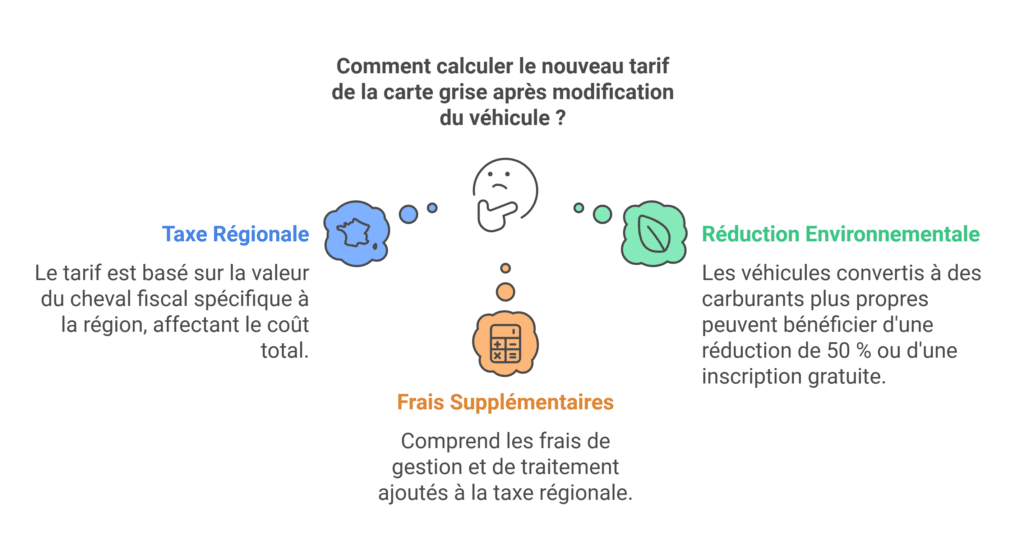
How to calculate the new price of a registration card after modification?
The fixed fee for issuing a registration card for technical modification of a vehicle, such as fuel change, is measured in fiscal horsepower, with the price varying by region of registration.
In some regions, vehicles that become environmentally friendly (for example LPG) following the modification can benefit from a 50% reduction, or even from free registration.
If you have converted a vehicle whose registration card is already in your name, the cost of a registration card for technical modifications is equivalent to your regional fiscal horsepower plus a management fee (€4) and a routing fee (€2.76). The price will vary across regions.
Specifically, in Île-de-France, it’s €52.91 according to the 2017 rate.
If you purchased a used vehicle and transformed it before changing ownership (which is allowed), you will of course pay the cost associated with a transfer of ownership.
What are the penalties for non-compliance?
The modifications made, the State grants you a one-month deadline to update the registration certificate. In case of delay, you risk a fixed fine of €135, which can theoretically reach up to €750 depending on the severity of the case.
You now know the rules regarding car tuning. To learn more about compensation in cases of traffic-related personal injury.
You have the option to receive review questionnaires by clicking the button below.
To be notified of new articles, you can register your email address below.
Frequently Asked Questions about car modifications
Is it legal to change a seat in a car?
It is legal to change a seat in a car under certain conditions. Here are some points to consider:
-
Respect current regulations: According to French traffic laws, the driver must sit in the driver’s seat and be able to control the steering and acceleration of the vehicle. It is therefore prohibited to drive while sitting on a seat other than the driver’s seat.
-
Ensure the seat is secured: If you want to replace a seat in your car, you must ensure that the seat is firmly fixed and does not move during driving. An unsecured seat can be dangerous for the driver and passengers.
-
Use appropriate seat belts: If you change the seat, you must also use suitable seat belts. Seat belts should be properly adjusted and pass over the shoulder and hip of the driver to provide adequate protection in case of collision or sudden braking.
In summary, it is legal to change a car seat provided you comply with current regulations, ensure the seat is secured, and use appropriate seat belts. Taking these precautions is essential for the safety of all vehicle occupants.
Car body modifications?
It is possible to modify a car’s bodywork, but this must be done responsibly and in accordance with current regulations. Here are some points to consider:
-
Respect regulations: According to French traffic laws, any modification to a vehicle’s body must be approved and meet safety standards. This includes changes affecting height, width, or length, as well as those impacting aerodynamic performance or driver visibility.
-
Ensure the modification is safe: Any bodywork modification must be performed so as not to compromise vehicle safety. This involves using quality materials and verifying the strength and stability of the modification.
-
Obtain approval for the modification: If you modify your vehicle’s body, you must have it approved by the relevant authority (usually the Ministry of Mines). This ensures the change complies with safety standards and regulatory requirements.
In summary, modifying a vehicle’s bodywork is possible but must be done responsibly, respecting safety norms, and obtaining homologation from the appropriate authority to ensure vehicle and occupant safety.
What types of body modifications are allowed?
Many types of body modifications can be allowed, but this depends on the regulations in your country and your vehicle type. Here are some examples of permissible body modifications:
-
Changing ride height: This can include adding lowering springs or lift kits to increase or decrease the vehicle’s height.
-
Widening or narrowing the body: This can involve adding wider rims or tires to increase width or narrower rims/tires to decrease width.
-
Lengthening or shortening the body: This could include adding extension panels or shortening kits to change vehicle length.
-
Adjusting aerodynamic features: Adding wings, spoilers, or aerodynamic kits to improve performance.
It’s important to note that these modifications may be subject to restrictions and must be approved to be authorized. Always check the current regulations before modifying your vehicle’s bodywork.
Safety standards to follow when modifying bodywork
It’s important to follow certain safety standards when modifying your vehicle’s bodywork. Here are some examples:
-
Comply with maximum allowed dimensions: According to French traffic laws, there are maximum limits for height, width, and length of vehicles. Ensure you do not exceed these during body modifications.
-
Use quality materials: Using high-quality materials ensures the strength and stability of the modification.
-
Check the strength and stability: After modifications, verify that they are securely attached and that the vehicle remains stable and safe during driving.
-
Ensure visibility is unaffected: Make sure modifications do not impair driver visibility or create dangerous blind spots.
In summary, adhere to maximum size limits, use quality materials, verify the stability of modifications, and confirm that visibility remains unaffected during bodywork modifications.
How to homologate a body modification?
To homologate a body modification, follow these steps:
-
Check current regulations: Ensure you review the standards and regulations regarding body modifications in your country. This helps you understand what modifications are permitted and which are not.
-
Consult a qualified professional: For safe modifications that meet standards, it is recommended to seek advice from a qualified expert. They can advise on authorized modifications and suitable materials.
-
Have the modification approved: After completing the body modification, you need to have it approved by the relevant authority (usually the Ministry of Mines). This confirms it complies with safety standards and regulations.
-
Obtain a new registration certificate: Once approved, a new registration document reflecting the modification must be issued. This ensures your vehicle’s legality and proper registration for road use.
In summary, to homologate a body modification, review regulations, consult a professional, get the modification approved, and obtain a new registration document.
What are the risks and benefits of modifying the bodywork?
Modifying your vehicle’s bodywork can present both risks and advantages. Here are some examples:
-
Risks:
- Increased costs: Body modifications can be expensive, requiring new equipment and quality materials.
- Non-compliance risk: Improper or unapproved modifications may not comply with regulations, leading to fines.
- Resale value reduction: Some modifications can decrease the vehicle’s resale value.
- Potential damage or accidents: Unsafe modifications can cause damage or accidents.
-
Benefits:
- Enhanced appearance: Customizing your vehicle’s body can give it a unique style.
- Improved performance: Certain modifications can improve aerodynamics or other performance aspects.
- Greater flexibility: Modifications allow personalization according to your preferences and needs.
What are the costs associated with body modifications?
The costs depend on the type of modification and materials used. Examples include:
-
Quality materials: Using premium materials like carbon fiber for wings or spoilers increases costs compared to plastic components.
-
Professional labor: Hiring qualified professionals for modifications adds to the total costs.
-
Approval fees: Obtaining homologation from the authorities may involve additional charges.
-
New registration: Getting a new registration document reflecting the modification may incur costs.
Overall, costs vary based on modification complexity, materials, homologation fees, and registration updates.
Who are qualified professionals for body modifications?
For safe and regulation-compliant body modifications, it is recommended to consult qualified professionals such as:
-
Bodywork specialists: Experts who specialize in vehicle repair and bodywork modifications, with specific training and experience.
-
Mechanics: Professionals focused on vehicle repair and maintenance, who may also perform certain body modifications related to mechanical parts.
-
Tuning workshops: Specialists in vehicle customization, often capable of executing various modifications including bodywork changes.
How to maintain and care for bodywork modifications?
Here are some tips to maintain and protect your vehicle’s body modifications:
-
Regular cleaning: Clean your vehicle often using a gentle auto shampoo and warm water to remove dirt and contaminants from the surface.
-
Apply paint protection: Using a suitable paint protector can help preserve the paint and prevent scratches and impacts.
-
Keep the vehicle sheltered: When not in use, store your vehicle in a garage or under a cover to protect it from weather conditions.
-
Periodic inspections: Have your vehicle checked regularly by a qualified professional to ensure the modifications are secure and the vehicle remains safe and in good condition.
In summary, regular cleaning, applying paint protection, sheltering the vehicle, and periodic professional inspections are key to maintaining and protecting bodywork modifications.


Entraîne-toi avec nos Quiz de révision
Fini les lectures passives. Pour retenir les notions clés du BTS Assurance, teste-toi ! Inscris-toi pour recevoir 1 quiz par jour directement dans ta boîte mail.


