Summary
| Key Elements | Summary / Impact for Apple |
|---|---|
| Strengths (SWOT) | Constant innovation, strong brand image, extensive global coverage, diversified targeting strategy, commitment to cybersecurity. |
| Weaknesses (SWOT) | High prices limiting accessibility, dependence on iPhone, reliance on China, limited traditional communication, less diversification compared to some competitors. |
| Opportunities (SWOT) | Expansion into emerging countries, sustainable development, innovations in 5G/AI/AR, growing demand for cybersecurity. |
| Threats (SWOT) | Aggressive competition (Samsung, Google, Huawei), US-China tensions, raw material fluctuations, cyber risks, strict regulatory standards. |
| Political factors (PESTEL) | High tariffs, trade restrictions, diversification of production (India/Vietnam), adaptation to local policies. |
| Economic factors (PESTEL) | Inflation, currency fluctuations, variable purchasing power, uneven growth across regions. |
| Social factors (PESTEL) | Popularity of connected and mobile products, data privacy, educational adoption, preference for sleek design. |
| Technological factors (PESTEL) | 5G/6G, AI, enhanced cybersecurity, more powerful processors, expanding VR/AR. |
| Environmental factors (PESTEL) | Recycled materials, carbon neutrality by 2030, recycling programs, renewable energies. |
| Legal factors (PESTEL) | GDPR and local laws, data litigation, eco-design standards, electronic waste responsibility, restrictions on toxic materials. |
| Competition | Samsung (diverse product range), Google (Android, software), Huawei (5G, emerging), Microsoft/Amazon (AI & cloud), disruptive startups. |
| Innovation strategies | Focus on AI, AR, connected health, product/service ecosystems, diversification, premium user experience. |
| Sustainable commitment | Carbon neutrality by 2030, renewable energies, electronic recycling, strengthened ecological communication. |
Delving into Apple’s strategy, this detailed analysis of SWOT and PESTEL reveals why this American company establishes itself as a global technology giant. From its founding in 1976 to today, Apple has successfully combined innovation, technological mastery, and business strategy to claim a leading position in an ultra-competitive market. By examining its strengths, weaknesses, opportunities, and threats, as well as external forces influencing its environment, this analysis provides a comprehensive overview of the challenges faced by Apple. In a world where digital transformation is accelerating, a fine understanding of these tools is crucial to grasp how Apple maintains its position and prepares for the future.
In this changing context, studying internal and external factors provides a complete picture to assess the robustness of its strategy, the constant pressure of competition, and the necessity of adopting practices aligned with sustainable development. This synthesis is intended for both business strategy enthusiasts and technology fans, as well as anyone interested in understanding the underlying mechanisms shaping Apple’s future and the high-tech sector.
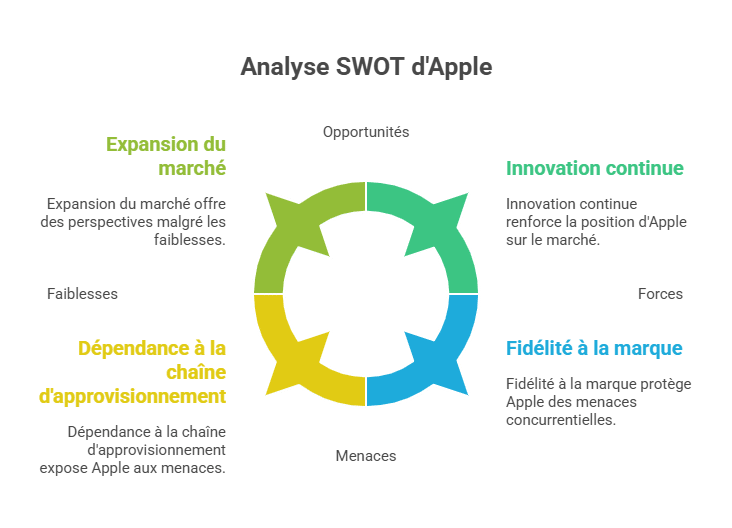
- Analysis of Apple’s strengths and weaknesses according to SWOT analysis
- Study of opportunities and threats in the technology market context
- In-depth exploration of PESTEL analysis applied to Apple
- Political and economic factors impacting Apple globally
- Social, technological, and environmental influences on the brand
- Legal and regulatory consequences for Apple
- Impact of competition and evolution of the technology market
- Innovation strategies and commitment to sustainable development
- FAQ to clarify major questions around Apple’s SWOT and PESTEL analyses

Analysis of Apple’s strengths and weaknesses according to SWOT
The SWOT analysis is an essential method to examine the strengths, weaknesses, opportunities, and threats that a company faces. In Apple’s case, this diagnosis is crucial to understanding how this major technology player has built a solid reputation while facing significant challenges.
Study of Apple’s major strengths
In the competitive landscape, Apple leverages several very critical assets:
- 🚀 Constant innovation: Apple is recognized for never resting on its laurels. Since the launch of the first iPhone in 2007, the company has continually introduced innovative products that have redefined the market.
- 🌍 Extensive geographical coverage: Present in 25 countries with more than 509 Apple Stores, the brand reaches a vast global clientele, strengthening its distribution network and visibility.
- 💼 Strong brand image: Apple enjoys great notoriety that inspires trust and loyalty. Its ability to marry design and performance makes it a preferred choice for both individuals and professionals.
- 🎯 Diversified targeting strategy: Its products appeal to a very broad clientele, from children to highly qualified professionals, ensuring a diverse and solid customer base.
- 🔒 Commitment to cybersecurity: Apple places a particular emphasis on protecting personal data, an increasingly sensitive and important subject for consumers.
These strengths enable the company to remain well-positioned in a constantly evolving market. They form the foundation of its strategy to continue dominating the sector.
Recognizing weaknesses that hinder Apple
However, even giants have their weaknesses, and in Apple’s case, several elements can limit its expansion:
- 💰 High prices: Apple’s pricing position excludes a significant portion of the population, especially less affluent social classes that cannot access its products due to cost.
- 🌱 Communication challenges: Apple does not invest heavily in traditional advertising, which can reduce its visibility against some highly aggressive competitors in this area.
- 🏭 Dependence on Chinese manufacturing chains: This dependence exposes Apple to geopolitical risks, especially with trade tensions between the United States and China.
- 🔄 Dependence on iPhone sales: A large part of revenue relies on this product, which exposes the company to slowdown risks if sales decline.
- 🛠️ Relatively limited diversification compared to some competitors that heavily invest in other emerging technological sectors.
These weaknesses are very important to consider because they can affect Apple’s responsiveness to rapid changes in the technological market and consumer expectations. For more detail, you can consult a comprehensive analysis of the company’s strengths and weaknesses.
| 🔎 Element | 💡 Impact on Apple | ⚖️ Strategic importance |
|---|---|---|
| Innovation | Continuous creation of innovative products | Very high |
| High prices | Limits accessible market | Medium |
| Industrial dependence | Exposure to geopolitical conflicts | High |
| Brand image | Strong customer loyalty | Very high |
| Limited communication | Less visibility outside existing networks | Medium |

Study of opportunities and threats in the technology market for Apple
SWOT analysis does not stop at internal factors; it also examines external opportunities and threats that can change the game. For Apple, this means closely observing the environment and market trends.
Major opportunities for Apple
Several factors favor the continuous growth of the brand in the technology market:
- 🌐 Expansion into new markets: Emerging countries present a potential target to exploit, notably in Latin America or Southeast Asia.
- 🔋 Increased focus on sustainable development: Apple’s ecological commitment can appeal to a growing customer base increasingly sensitive to environmental issues.
- 📱 Evolution of mobile technologies: 5G, more powerful processors, and new IoT features offer avenues for innovation.
- 🧠 Investment in AI and augmented reality: These fields generate global enthusiasm that could open new horizons for Apple.
- 📈 Growing demand for data security: Strengthening cybersecurity standards could enhance Apple’s positioning regarding privacy.
These opportunities encourage a more dynamic and innovative positioning, aligned with current consumer expectations. They fit perfectly within Apple’s overall innovation strategy.
External threats to monitor closely
In a highly competitive market like technology, Apple is not immune to risks that can disrupt its performance:
- ⚔️ Highly aggressive competition: Players like Samsung, Google, or Huawei offer often cheaper and innovative products.
- 🌍 Economic and political war: Tensions between the United States and China continue to weigh heavily on manufacturing and supply chains.
- 💸 Fluctuations in commodity prices: These can affect the production costs of devices.
- 🔒 Cybersecurity risks: Increasing cyberattacks require constant vigilance.
- 🛑 Strict regulatory evolution: The proliferation of environmental standards and data protection laws may impose additional constraints.
Managing these threats requires thorough strategic monitoring so that the company remains agile and can adjust its plans effectively. Access a comprehensive analysis of external issues on Apple’s PESTEL analysis.
| 📌 Factor | 🌟 Opportunities | ⚠️ Threats |
|---|---|---|
| Market | Geographical expansion, product diversification | Increased competition |
| Technology | 5G innovation, AI, augmented reality | Growing cyberattacks |
| Politics | International partnerships | US-China trade tensions |
| Environment | Sustainable development, reduced carbon footprint | Strict environmental standards |
| Economy | Influence of global purchasing power | Rising raw material costs |

Apple’s PESTEL analysis: political and economic factors
The PESTEL analysis allows examining the macro-environment in which Apple operates by detailing the political, economic, social, technological, environmental, and legal factors. This section focuses on the first two pillars, as their impact is strongly felt in the company’s overall strategy.
Political factors affecting Apple’s strategy
The international political context plays a decisive role. Apple, with its supply chain heavily anchored in China, experiences the consequences of tense relations between the United States and this country. Specifically:
- ⚖️ The US trade policy has imposed high customs duties over recent years, affecting Apple’s import costs.
- 🌐 Restrictions related to cybersecurity standards and technological exchanges complicate access to certain markets.
- 🤝 Partnerships with other countries and local regulations require Apple to continually adapt to remain competitive.
- 🛡️ Geopolitics pushes Apple to seek alternatives to its dependence on China, such as diversifying production sites to India or Vietnam.
These factors influence strategic decisions in the medium and long term, affecting prices, product offerings, and logistics. For more insight, Business Model Analyst’s detailed article provides a good perspective on these issues.
Impact of economic factors on Apple
The technology sector is sensitive to overall economic variations. Apple must contend with:
- 📉 The fluctuation of purchasing power, directly influencing demand for its premium products.
- 💹 Inflation and rising production costs, especially for electronic components.
- 🛒 Currency volatility, which could pose a risk to profit margins.
- 📊 Unequal economic growth across different continents impacts Apple’s geographical expansion strategy.
These elements make it a constantly shifting landscape requiring ongoing monitoring. Mastery over these factors will allow Apple to better anticipate market changes and adjust its prices and investments accordingly.
| 🏛️ Political factors | 💰 Economic factors |
|---|---|
| High import tariffs | Rising raw material costs |
| Restrictive trade standards | Currency fluctuations |
| Production diversification (India, Vietnam) | Global purchasing power variation |
| Local implementation policies | Regional economic disparities |
| De-escalation of geopolitical tensions | Influence of the global economic climate |

Factors social, technological, and environmental in Apple’s PESTEL analysis
To complete the understanding of the issues shaping Apple’s strategy, it is crucial to examine social, technological, and environmental parameters and their influence on the company.
Influence of social factors
Consumer behavior and cultural trends are increasingly influential:
- 👥 Growing demand for connected products accessible from an early age.
- 📱 Popularity of wearable and mobile technologies driving development of the iPhone and other devices.
- 🌐 Privacy and data security expectations reinforce Apple’s attractiveness.
- 🧑🎓 Technological adoption in education is increasing professional and personal use.
- 🎨 The pursuit of sophisticated design boosts consumer preference for Apple among those attentive to aesthetics.
Constant adaptation to social needs is at the heart of the innovations offered, ensuring a sustainable relationship with customers.
Technological advancements as drivers of innovation
Technology and innovation are inseparable at Apple. The company focuses on:
- ⚙️ Developing increasingly powerful and energy-efficient processors.
- 📶 Integrating 5G and soon 6G to improve connectivity.
- 🖥️ Evolving operating systems for better fluidity and security.
- 🎮 Developing virtual and augmented realities, a rapidly expanding sector.
- 🔐 Strengthening cybersecurity to protect customer data at every stage.
These innovations position Apple at the forefront, allowing it to capitalize on the digital boom and maintain its leadership. This technological orientation is a key strategic lever, as recently highlighted by the focus on data security and protection.
Environmental engagement and sustainable development
The growing pressure around ecological issues forces Apple to rethink its processes:
- ♻️ Reducing carbon footprint by using recycled materials in manufacturing.
- 🔋 Optimizing energy consumption of devices and data centers.
- 🌱 Implementing recycling programs and product return initiatives in Apple Stores.
- 🌍 Carbon neutrality strategy by 2030 across all activities.
- 📊 Transparent communication about environmental efforts to strengthen consumer trust.
This shift toward sustainable development is now a key element of Apple’s strategy, allowing it to stay aligned with societal expectations while minimizing its ecological impact.
| 📋 Dimension | 🌟 Apple Initiatives | 🌱 2025 Goals |
|---|---|---|
| Social | Accessible connected products | Increase technological inclusion |
| Technological | 5G, AI, enhanced security | Maintain innovation and security |
| Environmental | Recycled materials, carbon neutrality | Total carbon neutrality |

Legal and regulatory aspects in Apple’s PESTEL analysis
The legal dimension is a often overlooked but essential pillar for a company’s health. With numerous innovations and an extensive market, Apple must manage a complex regulatory framework.
Issues related to data protection and privacy
From GDPR in Europe to various local privacy laws, Apple navigates a real legal labyrinth:
- 🛡️ Strict compliance with personal data protection standards, a major commercial argument in its communication.
- ⚖️ Frequent litigations over data management, as well as access issues by authorities.
- 🔍 Ongoing monitoring of regulatory changes to stay compliant and avoid heavy sanctions.
- 📱 Regular system updates to meet legal requirements.
- 🤝 Close collaboration with regulators to anticipate regulatory changes.
Eco-design and corporate social responsibility regulations
With an emphasis on sustainable development, Apple is subject to increasing standards:
- 📜 Compliance with eco-design rules to reduce waste and pollution.
- 🌎 Transparency obligations regarding supply chains and labor conditions.
- 🔨 Increased responsibility in managing electronic waste and mandatory recycling.
- 🚫 Restrictions on using certain toxic materials in manufacturing.
- 📝 Monitoring commitments for carbon neutrality and environmental impact reduction.
These legal constraints require Apple to conduct rigorous monitoring and continuous adaptation, affecting its supply chain and overall strategy.
| ⚖️ Legal aspect | 📋 Requirements for Apple | 🌟 Associated challenges |
|---|---|---|
| Data protection | GDPR compliance, OS updates | Litigation management, regulatory innovation |
| Eco-design | Strict ecological standards | Supply chain adaptation |
| Recycling | Extended responsibility in waste treatment | Complex logistics, high costs |
Impact of competition and market evolution for Apple
The technology market is in perpetual motion, and Apple must face fierce competition to maintain its leadership.
Analysis of direct and indirect competitors
The main competitors of Apple are known for employing aggressive strategies:
- 🔥 Samsung dominates the smartphone market with a wide range at varied prices.
- ⚡ Google focuses on software innovations and its open Android system.
- 🚀 Huawei continues to increase its presence despite US sanctions.
- 🎧 Microsoft and Amazon invest in hardware and AI, opening new competitive fronts.
- 🌐 Innovative tech startups offer disruptive solutions in the market.
Therefore, Apple must reconcile continuous innovation with cost control to stay competitive.
Future market and adaptation strategies
The dominant market trends require Apple to:
- 📊 Invest in AI research and augmented reality to anticipate user expectations.
- 💼 Strengthen the comprehensive product and service ecosystem to enhance customer loyalty.
- ⚙️ Diversify its ranges to reach more market segments.
- 🌍 Explore new geographic horizons and segments, such as connected health.
- ♻️ Continue integrating sustainable development as a differentiating lever.
For a complete study of Apple’s competitive strategies, Le Blog du Dirigeant offers an insightful overview.
| 🏆 Competitors | 📈 Strategies | 🎯 Positioning |
|---|---|---|
| Samsung | Large range and competitive prices | Android leader, volume |
| Software innovation, open source | Dominant operating system | |
| Huawei | Development of equipment and 5G | Presence in China and emerging markets |
| Microsoft & Amazon | AI, cloud services, hardware | Expanded ecosystem |
| Startups | Innovative niche solutions | Disruptive |


Innovation strategies and commitment to sustainable development at Apple
Over the years, innovation has become the cornerstone of Apple’s differentiation, linking technology and design with a particular focus on ecological issues.
Innovative approaches at the core of growth
Apple concentrates its efforts on several axes:
- 💡 Developing increasingly performing, fast, and intuitive products.
- 🎯 Advanced integration of AI to personalize the user experience.
- 🌐 Expanding digital services around health, security, and entertainment.
- 🔄 Increasing use of recycled materials to limit environmental impact.
- 🚀 Exploring augmented reality to revolutionize human-machine interaction.
These strategies are set to accelerate Apple’s growth and reinforce its image as a responsible and innovative brand.
Voluntary commitment to sustainable development
In line with societal expectations, Apple clearly states its commitment to sustainable development:
- 🌳 Adoption of a carbon neutrality policy by 2030.
- ♻️ Continuous improvement in electronic waste management.
- 🌞 Investments in renewable energies to power its facilities.
- 📢 Raising awareness among customers about environmental issues through its communication campaigns.
- 🤝 Partnerships with specialized organizations to enhance ecological impact.
These measures strengthen the credibility of the brand with an increasingly environmentally conscious customer base.
| 🔧 Field | 📊 Key Initiatives | ♻️ Ecological Objectives |
|---|---|---|
| Product innovation | AI, AR, increased performance | Reduce carbon footprint |
| Materials | Recycling and eco-design | 100% recycled materials by 2030 |
| Energy | Use of renewable energies | 100% green energy supply |
| Communication | Awareness campaigns | Customer engagement |
FAQ on Apple’s SWOT and PESTEL analysis
SWOT analysis clearly identifies strengths, weaknesses, opportunities, and threats, providing an essential strategic overview to guide Apple’s decisions.
Primarily the political, economic, social, technological, environmental, and legal dimensions that strongly influence the company’s development.
The company diversifies its production sites, notably to India and Vietnam, to reduce risks associated with trade tensions between the US and China.
Apple aims for total carbon neutrality and actively invests in eco-design, recycling, and renewable energy use for its infrastructure.
They include advanced AI integration, continuous improvement in technical performance, ecosystem development, and creating unique user experiences.
📊 Analyses SWOT similaires
📊 Voir aussi : notre hub centralisé de toutes les analyses SWOT & PESTEL (206 études) classées par secteur — Tech, Auto, Mode, Distribution, Finance.
Tu prépares le BTS Assurance ?
Cette analyse SWOT fait partie des thèmes abordés dans les épreuves. Notre E-book de révision couvre l'intégralité du programme en fiches claires et synthétiques.
- 100 % du programme BTS Assurance
- Fiches 1ère et 2ème année
- Créé par un diplômé
- Téléchargement immédiat

Entraîne-toi avec nos Quiz de révision
Fini les lectures passives. Pour retenir les notions clés du BTS Assurance, teste-toi ! Inscris-toi pour recevoir 1 quiz par jour directement dans ta boîte mail.