


In summary
| Section 📌 | Key Points 📝 |
|---|---|
| Detailed presentation of Vinted and its two-sided business model | Founded in 2008 in Lithuania, Vinted operates on a two-sided model connecting sellers and buyers. Expansion in Germany (2010), USA (2011), France (2013). Main target: women aged 18-35. System based on trust and supply/demand balance. |
| Major strengths of Vinted | Strong brand recognition and engaged community; effective two-sided model; diversified and affordable offerings; significant fundraising; smooth digital user experience; ethical positioning related to the circular economy. |
| Internal weaknesses and challenges | Limited quality control; restricted men’s offering; time-consuming search process; risk of counterfeit products; complex adaptation to tax regulations. |
| Growth opportunities | Rise of the circular economy; diversification (men, home, vintage); premium subscriptions; international expansion; technological innovation (AI, personalization); strategic partnerships. |
| External threats | Intense competition (eBay, Leboncoin, Vestiaire Collective, Depop, Wallapop); regulatory and fiscal regulations; reputation risks related to frauds; pricing pressure; technical vulnerabilities. |
| Comparative analysis | Vinted: mass-market, affordable second-hand; Etsy: craftsmanship, personalization; Leboncoin/eBay: generalists; Depop/Wallapop: urban youth, social fashion; Vestiaire Collective: luxury with strict quality control. |
| Sustainability challenges | Reducing textile waste; ecological awareness; promoting responsible consumption; ethical partnerships (e.g., BlaBlaCar); need to incorporate ESG criteria for credibility. |
| Strategic prospects | Developing AI for personalization; strengthened quality control; expanding into the men’s segment; premium subscriptions; enhanced ecological communication; multisector partnerships; emerging market expansion. |
- Detailed presentation of Vinted and its two-sided economic model
- Decoding Vinted’s major strengths within the second-hand ecosystem
- Exploration of internal weaknesses and operational challenges Vinted must face
- Key opportunities offered by market trends and new technologies
- External threats: competition and regulations impacting growth
- Comparative analysis with other leading players like Etsy, Leboncoin, Depop, or Vestiaire Collective
- Sustainability challenges and Vinted’s role in today’s circular economy
- Development prospects and strategic recommendations to strengthen Vinted’s position

Complete presentation of Vinted and its two-sided business model
Vinted has established itself as an essential community platform specialized in the resale and purchase of second-hand clothing and accessories. Founded in 2008 in Lithuania by Milda Mitkute and Justas Janauskas, the company quickly expanded its presence to several European countries such as Germany (2010), France (2013), then to the United States (2011) and other European markets later on.
The success of Vinted largely relies on its functioning as a two-sided marketplace, meaning a platform bringing together two complementary and interdependent user groups: sellers, who offer items, and buyers, who seek good deals. This model requires careful management of the balance between supply and demand to ensure smooth exchanges. Essentially, the more one side grows, the more the other is compelled to register and be active, creating a virtuous circle.
The choice of a two-sided marketplace is crucial because it presents specific challenges, notably regarding user interaction and trust. Vinted addresses this by implementing a rating system, an active customer service, and an ergonomic interface that promotes transparency. This approach also helps limit quality-related risks, which are sensitive in the resale of second-hand items.
Vinted’s main customer base is predominantly female, mainly targeting young women aged 18 to 35 living in urban areas. This audience looking for economical offers and children’s items also explains why a significant share of listings is in this category. Consequently, men’s offers, still limited, represent an interesting development avenue, especially in competition with players like eBay or Leboncoin who target a broader audience.
In a context where the circular economy is gaining more importance, Vinted capitalizes on its ability to connect eco-conscious consumers’ needs with practical and economical solutions. This makes the platform a key player in digital commerce and an important pillar in the sustainable transformation of fashion.
| Year 🌟 | Key Event ⚡ | Country Concerned 🌍 | Main Impact 📈 |
|---|---|---|---|
| 2008 | Vinted’s founding | Lithuania | Launch of the two-sided marketplace concept |
| 2010 | Establishment in Germany | Germany | European expansion |
| 2011 | Entry into the US market | United States | First presence outside Europe |
| 2013 | Launch in France | France | Consolidation in a key market |
This historical timeline highlights rapid growth and successful adaptation to diverse markets but also a continual need to adjust the service to stay relevant. The platform must evolve according to the needs of both customer segments while integrating local and regulatory specificities, especially with the increasing fiscal and legal obligations.
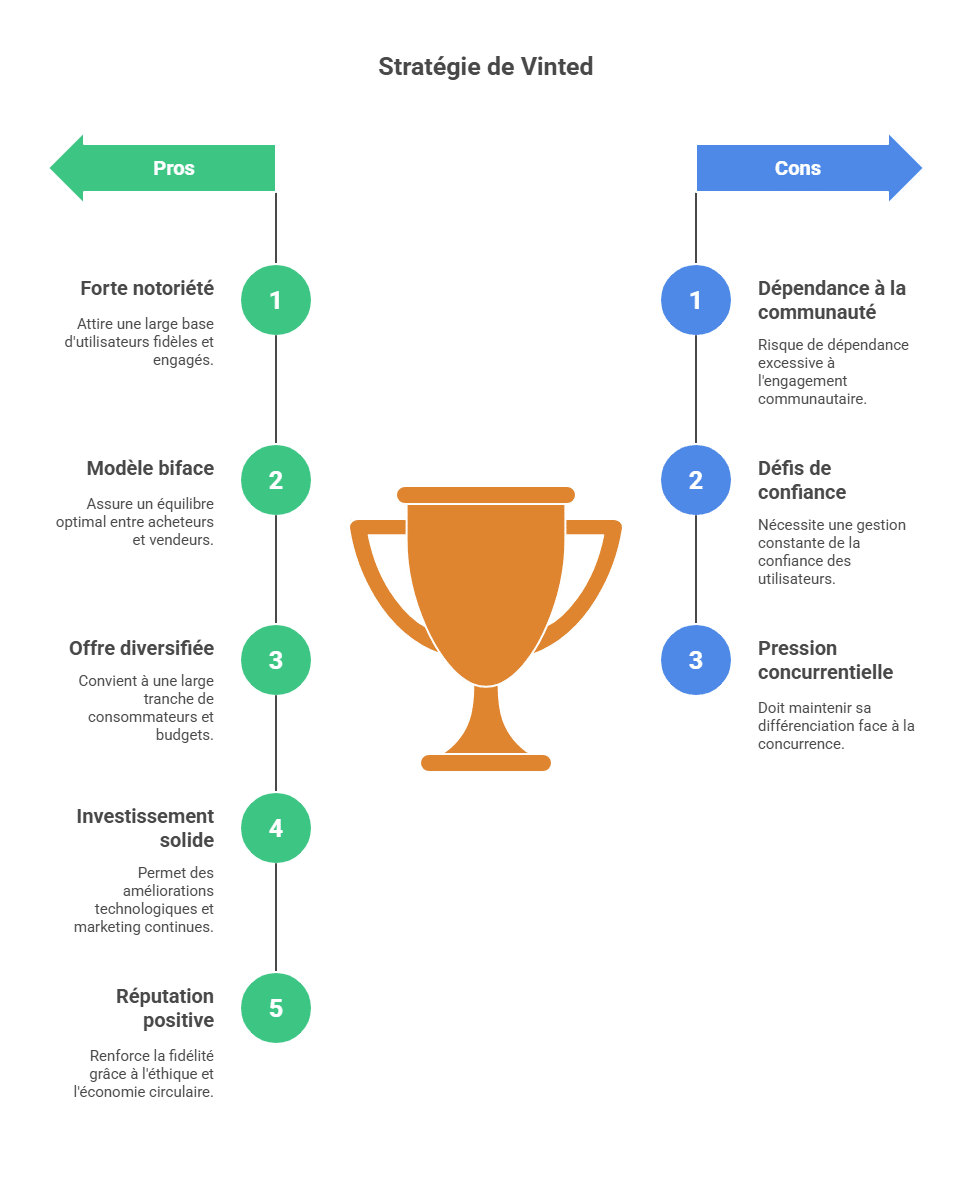
The strengths of Vinted: a solid positioning in the second-hand market
Vinted benefits from a set of strengths that explain its sustained success and visibility among consumers. Analyzing these strengths with the SWOT methodology highlights its most prominent strategic advantages.
Strong brand recognition and active community: Vinted quickly established itself as a reference in second-hand clothing thanks to targeted communication and a well-designed user experience. Its mainly female active customer base forms a dedicated community, driving exchanges and word-of-mouth. This community aspect is clearly a valuable asset.
Effective two-sided business model: Its platform enables direct interaction between sellers and buyers, optimizing satisfaction for both parties. Trust management via a rating and evaluation system secures transactions, which is key in a sensitive sector related to quality.
Diversified and accessible offerings: Unlike some competitors such as Vestiaire Collective or Zalando with their high-end segment, Vinted targets the mass market with a wide range of very affordable items, especially appealing to young consumers and those on tight budgets. This democratizes circular fashion.
Fundraising and significant investments: Thanks to solid financing, Vinted has been able to invest in technological development, marketing, and logistics, enabling it to maintain a smooth and responsive platform. This financial support is a significant lever to face competition.
- 💪 Strong digital and app presence with a simplified UX
- 💪 Continual adaptation to new ecological trends thanks to second-hand
- 💪 Integration of filters and search features, responding to the growing complexity of the catalog
- 💪 Potential strategic partnerships with complementary platforms like BlaBlaCar for mobility and responsible consumption synergies
- 💪 Positive reputation around ethics and circular economy, a pillar to reinforce loyalty
| Strengths ✨ | Strategic Impacts 🚀 | Comparison with competitors 🔍 |
|---|---|---|
| Strong brand awareness | Attracts a broad base of loyal users | Superior to Depop and Wallapop within the same target |
| Structured two-sided model | Ensures balance between buyers and sellers | Better managed than Leboncoin and PriceMinister |
| Engaged community | Promotes word-of-mouth and retention | More dynamic than Zalando Zircle |
| Accessible and diversified offerings | Appeals to a wide range of consumers | Captures a market share that Vestiaire Collective does not target |
In the current competitive landscape dominated by giants like eBay or Leboncoin, Vinted has successfully leveraged its strengths to stand out and attract its target audience. This clear differentiation is a major lever to maintain growth momentum.

Vinted’s Weaknesses: Internal Challenges and Areas for Improvement
Despite its strengths, Vinted also faces several weaknesses that could hinder its growth and impact user satisfaction.
Quality and item control remain a thorny issue. The diversity of sellers sometimes results in surprises upon receipt, ranging from poor descriptions to subpar quality. This uncertainty damages the image and calls for stronger verification without overly complicating the user experience.
Limited men’s offerings: While the platform mainly targets women, men have access to a much narrower selection. Compared to other platforms like eBay or Depop which offer greater diversity for this segment, this can limit attractiveness to that audience.
High search times for finding the right items among an abundance of poorly filtered listings. Better segmentation and personalized navigation remain significant weaknesses. The challenge is to enable a more fluid purchase journey without overwhelming users with options.
Problems related to fraudulent practices: Vinted must also handle cases of bad intent, such as selling counterfeit or non-compliant items, which jeopardizes trust and contradicts the platform’s values.
- ⚠️ Lack of strict quality control over sold items
- ⚠️ Limited and underdeveloped men’s offer
- ⚠️ Complex and time-consuming search for some users
- ⚠️ Risk of counterfeit products and inappropriate practices on the platform
- ⚠️ Adapting to complex fiscal regulations that can hinder some sellers
| Weaknesses 🚩 | Potential Consequences ⚠️ | Competitive Approaches 💡 |
|---|---|---|
| Mixed quality and reliability | Risk of losing trust, declining sales | Vestiaire Collective offers rigorous quality control |
| Limited men’s offering | Excludes an important market segment | Depop emphasizes younger and mixed segments better |
| Search too time-consuming | User frustration, disengagement | Leboncoin innovates with advanced filters and sorting |
| Fraud and counterfeiting | Reputation damage and legal risks | eBay implements strict anti-fraud systems |
These limitations highlight that Vinted must remain agile and attentive to user feedback to implement ongoing improvements. It is key to avoiding loss of ground to highly active competitors in the market.

Major Opportunities for Vinted in the Second-Hand Market
The market context and societal shifts offer Vinted several opportunities to explore to strengthen its position and address its weaknesses.
Growth of the circular economy: With increasing ecological awareness, many consumers prefer second-hand, which directly benefits Vinted. This trend fits perfectly with current societal dynamics.
Expansion into new segments such as men’s clothing or other categories (home, vintage, rare accessories) can help broaden the customer base and diversify revenues, especially compared to players like Wallapop or PriceMinister offering a wide range of products.
Development of premium subscriptions: Vinted could consider a paid model similar to YouTube or Tinder, offering ad-free experience or exclusive features, thus generating new revenue streams and enhancing user experience.
Entry into new international markets or consolidating in countries where second-hand is still underdeveloped, based on acquired expertise and solid local partnerships.
- 🌍 Capitalize on the growing eco-responsible market
- 🌍 Broaden the audience through diversification of ranges
- 🌍 Innovate in customer experience through technology, especially AI-based personalization
- 🌍 Enhance premium offerings and additional services
- 🌍 Explore synergies with complementary actors like BlaBlaCar
| Opportunities 🚀 | Expected Benefits 💼 | Market Examples 🌟 |
|---|---|---|
| International expansion | Increasing user and sales volume | Etsy capitalized on opening new countries |
| Premium subscriptions | Recurring revenue and increased loyalty | Tinder Premium is a model to follow |
| Expansion of product categories | Attracting new and complementary segments | Leboncoin broadens its offering to capture more clients |
| Adoption of AI technologies | Enhancing search and personalization | Zalando innovates with personalized recommendations |
Exploiting these opportunities is crucial for Vinted to consolidate its position and become a major player in sustainable and connected commerce. The variety of avenues also reduces risks associated with a single, heavily dependent model.

Threats impacting Vinted’s development in a highly competitive market
The second-hand resale market is now highly competitive, and Vinted must defend itself against several characteristic threats that must be clearly identified.
Intense and varied competition: Besides eBay and Leboncoin, which dominate the global second-hand goods sector, specialized platforms like Vestiaire Collective dominate the luxury segment, while newcomers like Depop or Wallapop are gaining traction with younger audiences thanks to their attractive design and social features.
Changing government and fiscal regulations: Legal frameworks now require Vinted to disclose the income generated by users beyond certain thresholds. While necessary, these rules can discourage casual sellers and slow overall activity.
Reputation risks: Like any community platform, Vinted is exposed to risks of bad publicity related to fraud, counterfeiting, or delivery issues. Any mistake can be amplified through social networks and permanently harm its image.
- ⚡ Direct competition from niche and generalist players
- ⚡ Growing complexity of fiscal and legal regulations
- ⚡ Vulnerability to criticisms about offering quality
- ⚡ Pricing pressure due to increased competition
- ⚡ Potential technical failures or outages affecting user experience
| Threats 🚨 | Possible Impacts 📉 | Strategic Responses to Consider 🎯 |
|---|---|---|
| Strong competition | Loss of market share and pressure on margins | Differentiation through user experience |
| Fiscal regulations | Discouragement for sellers and increased complexity | Clear communication, simplification of procedures |
| Reputation impacted by frauds | Loss of trust and credibility | Enhanced anti-fraud controls |
| Pricing pressures | Reduced margins and intensified competition | Unique offers and loyalty programs |
To avoid being overwhelmed, the company must closely monitor its environment and adapt quickly, especially through technological innovations and robust quality control measures. Proactive risk management is a fundamental lever in the current context.

Strategic comparison between Vinted and other major players in the market
The competitive dynamics around Vinted cannot be understood without comparing it to other emblematic platforms, each occupying a different niche.
Etsy relies on artisanal authenticity and personalization, appealing to customers seeking unique handcrafted pieces, which differs from Vinted’s volume and speed-oriented model.
Leboncoin and eBay position themselves as generalists covering a very broad range of second-hand products from clothing to cars and electronics. Their strength lies in their longevity and massive audience, though their sometimes less intuitive interface can hinder younger users.
Depop and Wallapop target a young, urban audience highly responsive to fashion trends and the social aspect of platforms, with a more community-oriented and even social network approach. This strategy poses a serious challenge for Vinted, which must innovate to retain its youth appeal.
Vestiaire Collective occupies a very different high-end segment, with strict quality control and clientele willing to invest in premium items. While this is not Vinted’s current goal, it is a pathway to diversification.
Zalando with its Zircle service and La Redoute via La Reboucle are also attempting to capture a share of the second-hand clothing market, relying on their solid logistics infrastructure and customer bases…
- 🔄 Comparison of main target segments for each player
- 🔄 Perceived quality and pricing strategies analysis
- 🔄 Evaluation of user experiences offered
- 🔄 Different marketing and communication strategies
- 🔄 Potential synergies and overlaps in their offerings
| Platform 🔍 | Target segment 🎯 | Key strategies 📊 | Differentiating assets ✨ |
|---|---|---|---|
| Vinted | Young urban women, affordable second-hand | Engaged community, smooth UX | Large volume, strong notoriety |
| Etsy | Craftsmen and lovers of artisanal products | Personalization, authenticity | Unique pieces, global reach |
| Leboncoin | General public, multi-category | Large audience, low cost | Longevity, broad coverage |
| Depop | Young urban fashion enthusiasts | Social features, influencers | Network platform, merchandising |
| Vestiaire Collective | Luxury, premium | Strict quality control | Trust, high-value pieces |
In summary, Vinted occupies a well-defined niche and must continuously adjust its strategy to retain its leadership, especially as competitors accelerate innovation and enhance their notoriety.

Role of Vinted in the circular economy and sustainability challenges
The rise of Vinted aligns with a global movement towards more sustainable consumption. The company significantly contributes to reducing textile waste by promoting reuse, a trend resonating with current societal expectations.
By encouraging users to give clothes a second life, Vinted acts as a key actor in a growing circular economy. This is reflected in:
- ♻️ Reduction of overproduction and textile industry waste
- ♻️ Increased consumer awareness of ecological footprints
- ♻️ Promotion of responsible, economical, and community-based consumption
- ♻️ Engagement of a community committed to alternative purchasing modes
This societal role gives Vinted a competitive edge because the brand is more than just a marketplace; it embodies ethical values. This positioning enables effective dialogue with institutions, local authorities, and even partnerships with companies like BlaBlaCar to promote responsible consumption together.
However, Vinted must continue strengthening its actions regarding transparency and quality to prevent abuses that could damage its credibility. By 2025, fully integrating ESG (Environmental, Social, Governance) issues will be essential to persuade both users and investors.
| Aspect of sustainability 🌿 | Social & environmental impact 🌎 | Future prospects & challenges 🚀 |
|---|---|---|
| Clothing reuse | Less textile waste, increased recycling | Strengthening quality control |
| Engaged community | Promoting behavioral change | Development of educational actions |
| Ethical partnerships | Collaboration with responsible actors | Expansion of strategic alliances |
In an era where “greenwashing” and skepticism coexist, Vinted’s credibility in the ecological sphere will be a decisive factor. The platform must build on its successes while adapting to increasing expectations.




Strategic outlook for Vinted’s future
Given its current positioning, identified challenges and opportunities, several strategic paths are emerging for Vinted to remain a key player in second-hand clothing in 2025 and beyond.
Investing in artificial intelligence and personalization: to improve user experience and reduce search time, AI can provide more relevant recommendations and refine item discovery based on tastes and needs.
Enhancing quality and trust through stricter verification measures and stronger support for sellers
Expanding into the men’s segment by targeted marketing, ensuring a diverse offering. This is a clear demand and a growth avenue for capturing more customers.
Developing premium services to diversify revenue and enhance satisfaction, such as subscriptions for an ad-free experience or exclusive options.
Amplifying communication around ecology and ethics to strengthen brand image and loyalty, especially in line with emerging ESG standards.
- 📈 Implementation of data science tools and advanced analytics
- 📈 Continuous improvement of the customer journey based on user feedback
- 📈 New multisectoral strategic partnerships
- 📈 Organization of community events or campaigns
- 📈 Strengthening presence in emerging markets
| Strategic initiative 🛠️ | Main goal 🎯 | Expected benefits 💼 |
|---|---|---|
| AI-based personalization | Reduce search times | Increase satisfaction and sales |
| Stronger control of items | Ensure quality | Build trust, foster loyalty |
| Expansion into men’s segment | Increase market share | Reach new audiences |
| Premium subscriptions | Create recurring revenue streams | Stable income and improved user experience |
The company is well positioned to continue growing as long as it keeps pace with rapid sector evolutions and continues innovating. Constant self-assessment remains an essential competitive advantage in this industry, where expectations can be very volatile.
FAQ – Frequently Asked Questions about Vinted’s SWOT analysis
- ❓ What is a SWOT analysis and why is it useful for Vinted?
A SWOT analysis identifies an organization’s Strengths, Weaknesses, Opportunities, and Threats. For Vinted, it helps understand its market positioning and adapt strategies to stay competitive. More info here. - ❓ Who are Vinted’s main competitors?
eBay, Leboncoin, Etsy, Depop, Wallapop, and Vestiaire Collective are among the main competitors depending on their segment. Each targets specific audiences and offers a distinct user experience. Detailed competitive analysis. - ❓ What is the impact of tax regulations on Vinted?
These rules now require Vinted to report users’ income beyond certain thresholds, which can discourage casual sellers. Vinted must support its users to comply with these obligations while limiting negative effects. More details on these regulations. - ❓ How could Vinted improve user experience?
By integrating more AI to refine searches and personalizations, strengthening item verification, and offering premium subscriptions for an ad-free experience. - ❓ What role does Vinted play in the circular economy?
The platform promotes clothing reuse, thereby reducing textile production and waste. It raises user awareness for more responsible and sustainable consumption, solidifying its position as an engaged actor. Learn more.
📊 Analyses SWOT similaires
📊 Voir aussi : notre hub centralisé de toutes les analyses SWOT & PESTEL (206 études) classées par secteur — Tech, Auto, Mode, Distribution, Finance.
Tu prépares le BTS Assurance ?
Cette analyse SWOT fait partie des thèmes abordés dans les épreuves. Notre E-book de révision couvre l'intégralité du programme en fiches claires et synthétiques.
- 100 % du programme BTS Assurance
- Fiches 1ère et 2ème année
- Créé par un diplômé
- Téléchargement immédiat

Entraîne-toi avec nos Quiz de révision
Fini les lectures passives. Pour retenir les notions clés du BTS Assurance, teste-toi ! Inscris-toi pour recevoir 1 quiz par jour directement dans ta boîte mail.


