


Summary
| Section 📌 | Key Points 📝 |
|---|---|
| General Overview of IKEA and Key Figures | Founded in 1943 in Sweden; over 450 stores in 50 countries; ~150,000 employees; France 2019 revenue: €3 billion; 7% decrease in 2020 due to COVID; online sales increased by 44%. |
| Major Strengths | Competitive pricing; functional and aesthetic Scandinavian design; strong commitment to sustainability; optimized logistics and supply chain; omnichannel distribution (stores + digital); significant human resources. |
| Specific Weaknesses | Complex and frustrating assembly; food scandals in cafeterias; sensitivity to economic crises; tensions related to wage policies; dependence on outsourced production. |
| Opportunities | Growing focus on sustainability and circular economy; expansion into emerging markets; development of e-commerce and digital; opening urban formats (IKEA City); furniture rental and buyback services. |
| Threats | Increased competition (local and global stores); health and economic crises; reputational criticisms; rapid changes in consumption habits; logistical risks and international tensions. |
| Sustainability in Strategy | Major asset in strengths (renewable materials, product innovation); weakness with transition costs and logistics; opportunity through green demand; threat from strict regulations and ecological competition. |
| Comparative Analysis | IKEA = low prices + broad range + global presence; competitors = either premium, local, or pure digital players; logistical advantages and volume scale of IKEA are hard to replicate. |
| Strategic Perspectives | Simplification of assembly (tutorials, augmented reality); acceleration toward sustainability and circularity; enhanced digital innovation; proactive competitive intelligence; improved internal communication and employee recognition. |
| FAQ – Key Points | SWOT helps identify strengths/weaknesses/opportunities/threats; major challenge = flat-pack assembly; IKEA aims for full circularity; opportunities = emerging markets and circular economy; strong competition, but few cover as many criteria. |
In the dynamic landscape of furniture and home equipment, IKEA remains a key player. The SWOT analysis, a highly valuable method for assessing a company’s strengths and challenges, provides a comprehensive overview of the Swedish firm. From its impressive strengths to potential threats, weaknesses to monitor, and opportunities to seize, each element influences IKEA’s strategy. Let’s explore this universe where design, competitive prices, and sustainability intertwine to shape the global furniture giant.
- General overview of IKEA and its key figures
- Main strengths of IKEA in the furniture sector
- Specific weaknesses hindering development
- Promising opportunities in an evolving market
- Threats facing the company and its markets
- The impact of sustainability in IKEA’s SWOT strategy
- Comparison with other industry players
- Strategic perspectives based on SWOT analysis
- FAQ: Frequently asked questions about IKEA’s SWOT analysis

General overview of IKEA and its key figures in the SWOT analysis
Founded in 1943 in Sweden, IKEA has become a global giant in furniture and decoration. With more than 450 stores across fifty countries, the brand boasts impressive international recognition. This retailer emphasizes competitive pricing, allowing it to reach a broad customer base. About 150,000 employees work to ensure the group’s success, continually leveraging expertise in designing and manufacturing functional and aesthetic furniture.
IKEA claims that over half of its production takes place within the European Union, which not only ensures quality but also helps to reduce supply chain delays and costs. The group demonstrates a well-established omnichannel strategy, with an essential web presence in the digital age, especially highlighted during COVID-19 restrictions. For example, its online turnover surged by 44%, confirming the importance of this channel in modern distribution.
In France, IKEA dominates the market with an approximate 20% share and a revenue exceeding €3 billion in 2019, although the 2020 fiscal year experienced a slight decline of around 7% to €2.8 billion, impacted by the pandemic. These figures illustrate how IKEA remains a giant in the sector despite real challenges.
| Indicator 📊 | Value | Remarks |
|---|---|---|
| Number of stores | 450+ | Presence in around fifty countries |
| Employees | ~150,000 | International workforce |
| France revenue (2019) | €3 billion | Leader in the French market |
| 2020 revenue decrease | ~7% | Impact of the health crisis |
| Online sales growth | +44% | Support for omnichannel sales |
It is essential to understand that IKEA’s SWOT analysis goes far beyond these raw data points. By utilizing this method, it becomes possible to highlight strengths to leverage, weaknesses to address, opportunities to explore, and threats to guard against that could hamper growth.
To deepen this introductory overview, several resources are available, such as those from Edraw Software and Manager Ocean.

Major strengths of IKEA in the furniture industry revealed by SWOT analysis
In the highly competitive furniture world, IKEA relies on several solid strengths that ensure a dominant position. This first category of the SWOT analysis reveals that the brand excels in designing products suitable for a broad audience, with excellent quality-price ratio.
- 🎯 Pricing position: IKEA is famous for its competitive prices, attracting consumers sensitive to cost/quality ratio.
- 🛋️ Accessible and functional design: products combine aesthetic appeal with utility, featuring a strong Scandinavian identity that integrates easily into many interiors.
- ♻️ Commitment to sustainability: IKEA invests in renewable materials, green energy, and aims to become a fully circular company.
- 🚛 Optimized supply chain: controlled logistics reduce costs while maintaining consistent quality.
- 🛒 Omnichannel distribution: through a mix of physical stores and a robust digital presence, IKEA remains accessible everywhere at all times.
- 👥 Human resources: over 150,000 dedicated employees enhance innovation and customer service capacity.
For example, the store has diversified its customer contact points through an innovative mobile app and its urban store concept (IKEA City) that adapts to new consumption habits.
Here is a table highlighting the main strengths discussed in this section:
| Strength 💪 | Description | Market Impact |
|---|---|---|
| Competitive prices | Cost reduction strategies while maintaining quality | Attracts a broad audience, increases sales volume |
| Functional design | Beautiful, easy-to-assemble, durable products | Customer loyalty and positive brand image |
| Sustainability | Renewable materials, eco-friendly production modes | Meets rising consumer expectations |
| Omnichannel | Optimized in-store and online sales channels | Enhanced accessibility and trend adaptation |
This range of strengths places IKEA on a good trajectory to maintain its leadership in an environment where simplicity in furniture design plays a key role. Detailed insights into this section are further expanded through analyses on Success Marketing and Give a Boost.

Specific weaknesses hindering IKEA’s strategic development according to SWOT analysis
Every company, even a giant like IKEA, must acknowledge its weaknesses to better safeguard against them. The SWOT analysis highlights these fragile areas that can slow progress.
- 🔧 Assembly complexity: the notorious “flat-pack” aspect often leaves customers perplexed and can generate frustration or dissatisfaction.
- ❗ Food scandals: past incidents related to food products in store cafeterias have potentially harmed the reputation.
- 💸 Sensitivity to economic crises: periods of economic slowdown, like the COVID-19 crisis, impact consumer purchasing power.
- ⚠️ Pressures on wage policies: temporary suspension of year-end bonuses may have caused internal tensions among employees.
- 🛠️ Dependence on outsourced production: although half is produced in Europe, reliance on other countries can expose IKEA to logistical risks.
These issues need careful management to prevent them from becoming major obstacles to expansion. The flat-pack furniture, once an economic and logistical advantage, can sometimes turn into a drawback in customer experience.
| Weakness ⚠️ | Consequence | Recommended Action |
|---|---|---|
| Complex assembly | Customer dissatisfaction and abandoned purchases | Improve simplicity and assembly guides |
| Food product scandals | Loss of consumer trust | Enhance quality controls and transparency |
| Impact of COVID economic crisis | Revenue decline | Diversify offerings and sales channels |
| Wage pressure | Internal tensions | Better communication and employee appreciation |
For example, a strategy to further digitalize assembly instructions via video tutorials or augmented reality could mitigate current frustrations. Details of these issues are discussed on specialized sites such as Études & Analyses or Pharrell.
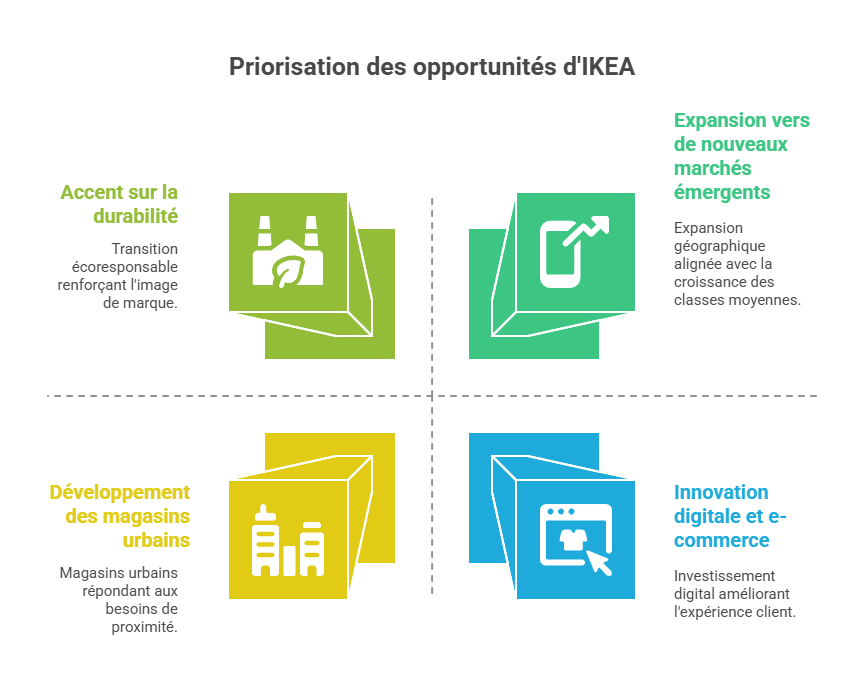
Promising opportunities for IKEA revealed by SWOT analysis in the furniture sector
Seizing opportunities allows for accelerated growth and increased competitiveness. Several avenues are opening up for IKEA in the near future.
- 🌱 Focus on sustainability: shifting toward more eco-friendly products will appeal to an increasingly environmentally conscious audience.
- 🤝 Expansion into emerging markets: the rise of middle classes in certain countries presents a significant opportunity.
- 📱 Digital innovation and e-commerce: continuing to invest in online sales and integrating new technologies enhances customer experience.
- 🏙️ Development of urban stores: IKEA City stores dedicated to city centers meet new consumption habits and bring the offer closer to customers.
- 🔄 Circular economy: developing furniture rentals, recycling, or buyback programs to meet modern expectations.
These opportunities enable IKEA to capitalize on its strengths while responding to global trends. The rising demand for sustainable products and seamless shopping experiences are particularly critical.
| Opportunity 🚀 | Description | Impact Potential |
|---|---|---|
| Sustainability | Transition to eco-friendly materials | Build customer loyalty and access new markets |
| Emerging markets | Geographic expansion in rapidly growing countries | Increase revenue |
| E-commerce | Enhance digital sales channels | Broaden accessibility and gain market share |
| Urban stores | Expand IKEA City format | Closer proximity to customers |
| Circular economy | Furniture rental and recycling programs | Support eco-friendly image and foster loyalty |
For more in-depth analysis, insights from Business Model Analyst and Pharrell provide very useful perspectives.

Threats identified in IKEA’s SWOT analysis and their impact on strategy
No company is immune to external or internal dangers that can slow down its progress. For IKEA, the analysis clearly highlights certain threats to monitor and address.
- ⚔️ Growing competition: even though there is no direct rival offering such a wide range at low prices, several brands attempt to gain market share.
- 🌍 Impact of health and economic crises: COVID-19 revealed vulnerabilities linked to closures and restrictions.
- 🛠️ Reputational problems: food scandals and criticisms of certain practices can tarnish the brand image.
- 🔄 Rapid industry changes: remaining agile and adaptable to new trends and consumption modes is essential.
- 🛃 Logistics and supply risks: dependence on specific suppliers or countries can cause disruptions in case of international tensions.
Understanding and anticipating these threats is crucial for the company to maintain its leadership position in the global furniture market. Monitoring competition and adjusting digital strategies in real time will be particularly important.
| Threat ⚠️ | Origin | Likely Consequence |
|---|---|---|
| Competition | Specialist and generalist players | Market share loss |
| Health crisis | COVID-19 and other pandemics | Restricted customer access |
| Reputational issues | Food scandals, product criticisms | Decline in trust |
| Rapid industry changes | Behavioral and technological shifts | Obsolescence of offerings |
| Logistical risks | Dependence on international suppliers | Availability disruptions |
Further information and additional insights can be found by consulting Aide BTS Assurance or Le Blog du Dirigeant.
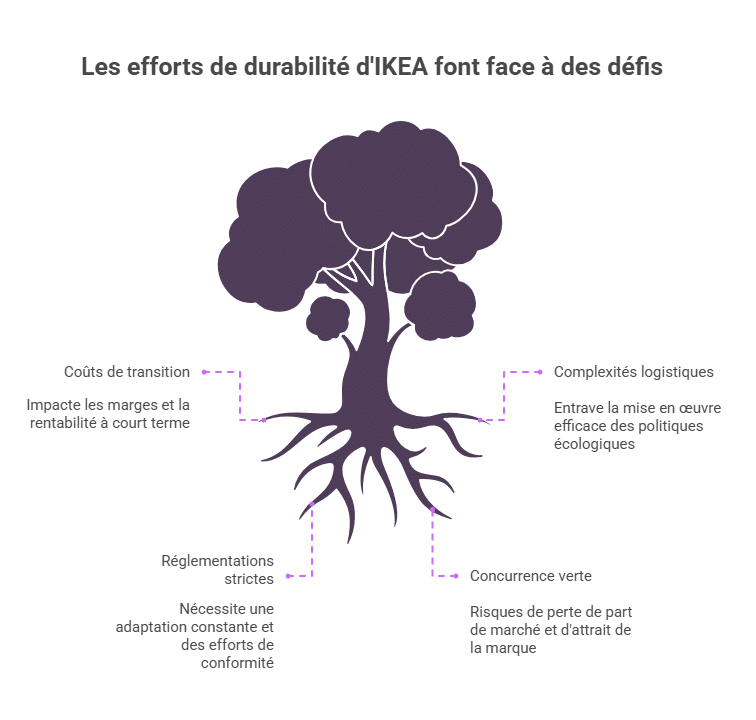
The central role of sustainability in IKEA’s strategic SWOT analysis
Sustainability has become a pillar of global companies’ strategic thinking, and IKEA is no exception. This dimension profoundly impacts each category of the SWOT analysis.
In its strengths, we find a clear commitment to sustainable development, with recycled or renewable materials and a goal to achieve circularity. Regarding weaknesses, criticisms sometimes persist about the delays and costs associated with this transition.
Opportunities are significant due to increasing consumer demand for eco-friendly products, while threats can arise from increasingly strict regulations or ecological competition that accelerates in this domain as well.
- 🌳 Strengths related to sustainability: integration into the manufacturing chain, product innovation, ecological certification.
- 🕳️ Weaknesses to address: additional costs, logistical complexities, implementation delays.
- ✨ Opportunities to exploit: growing market for green consumption, customer loyalty through environmental commitment.
- 💥 Threats to monitor: ecological competition, strict regulation, resource volatility.
| Aspect of sustainability 🌎 | Impact on SWOT | Consequences |
|---|---|---|
| Environmental commitment | Strength | Positive brand image and increased attractiveness |
| Transition costs | Weakness | Impact on margins in the short term |
| Growing green demand | Opportunity | Increased sales and customer loyalty |
| Stricter regulations | Threat | Constant adaptation required |
This analysis shows that IKEA must continue investing to avoid being left behind in this area. The repercussions are major for the sustainability of its business model and its ability to attract new generations. Several additional analyses are available on MindOnMap or Edraw Software.

Comparative analysis: IKEA versus competitors through SWOT perspective
Facing numerous local and international competitors, IKEA’s SWOT analysis can be contextualized to better understand its uniqueness. Few brands offer such an extensive range with such low prices, which remains a significant strategic advantage.
However, high-end furniture specialists or purely digital players target a different demanding audience, limiting direct confrontation. Indirect competition especially pushes IKEA to stay innovative and flexible. The comparison highlights several points:
- 👑 Unique positioning: a mix of competitive prices + accessible design, hard to replicate.
- 📦 Volume and logistics chain: the advantage of a giant capable of optimizing costs and distribution.
- 🌐 Global presence versus local: while some competitors are highly regional, IKEA covers the entire world.
- 🧩 Digital adaptability: an ongoing challenge facing purely digital players.
- 🔄 Support for sustainability: a difficult balance between cost and environmental ambition.
| Comparison ⚖️ | IKEA | Main competitors | Advantage |
|---|---|---|---|
| Competitive prices | Yes | Rare | ✓ |
| Extensive range | Very broad | Often specialized | ✓ |
| International presence | Yes, strong | Less extensive | ✓ |
| Supply chain | Optimized | Variable | ✓ |
| Committed sustainability | In progress | Progressing | Equality |
It clearly emerges that in the competitive landscape, IKEA maintains a comfortable margin. Competition stimulates continuous improvement and innovation. For those interested in understanding these dynamics, tools like Aide BTS Assurance provide cross-sector elements on SWOT comparisons.




Strategic perspectives for IKEA based on its SWOT analysis
Developing an assessment based on SWOT analysis helps IKEA define priority areas for its future. Leveraging strengths like cost and design mastery, while addressing key weaknesses, forms the basis of a robust strategy.
For example, integrating more simplicity into assembly, strengthening digital sales, and continuing investments in sustainable solutions are priorities to enable sustainable growth. Addressing threats through active monitoring and exploiting market opportunities like the circular economy can help stay aligned with expectations.
- 🎯 Simplify customer experience (assembly, purchases)
- 🌍 Accelerate toward an ecological and circular model
- 💻 Strengthen digital and omnichannel innovation
- 📊 Proactive competitive intelligence and rapid adaptation
- 🤝 Reinforce internal communication to prevent tensions
A summarized table encapsulates these directions:
| Strategic Priorities 🚀 | Objective | Key Actions |
|---|---|---|
| Simplify assembly | Improve customer satisfaction | Video tutorials, augmented reality |
| Increase sustainability | Reduce ecological footprint | Renewable materials, circular economy |
| Digitalization | Enhance accessibility and sales | Website and app improvements |
| Competitive monitoring | Active responsiveness and innovation | Regular analysis and strategic adjustments |
| Internal communication | Motivate and unify staff | Employee recognition programs |
These recommendations are based on numerous studies, available on Aide BTS Assurance and Le Blog du Dirigeant.
Useful FAQ about IKEA’s SWOT analysis for better understanding
SWOT (Strengths, Weaknesses, Opportunities, Threats) is an analytical method that helps IKEA identify its strengths, weaknesses, opportunities, and threats for better strategic decision-making.
The complex assembly process can confuse customers. IKEA is working on digital solutions to make this key step easier.
It invests heavily in renewable materials, waste reduction, and aims for total circularity of its products.
Expansion into emerging markets, circular economy initiatives, and digital innovations are promising avenues.
If competition is strong, few can challenge on all the combined criteria IKEA offers. Vigilance remains essential.
📊 Analyses SWOT similaires
📊 Voir aussi : notre hub centralisé de toutes les analyses SWOT & PESTEL (206 études) classées par secteur — Tech, Auto, Mode, Distribution, Finance.
Tu prépares le BTS Assurance ?
Cette analyse SWOT fait partie des thèmes abordés dans les épreuves. Notre E-book de révision couvre l'intégralité du programme en fiches claires et synthétiques.
- 100 % du programme BTS Assurance
- Fiches 1ère et 2ème année
- Créé par un diplômé
- Téléchargement immédiat

Entraîne-toi avec nos Quiz de révision
Fini les lectures passives. Pour retenir les notions clés du BTS Assurance, teste-toi ! Inscris-toi pour recevoir 1 quiz par jour directement dans ta boîte mail.


