📜 Collective insurance agreement: everything you need to know about your rights


In Summary
| 📌 Section | 📄 Description |
|---|---|
| 📜 What is a collective agreement? | Defines specific rules for insurance companies, ensuring enhanced rights for employees. |
| 🏢 Concerned companies | Applicable to insurance, reinsurance companies, specialized GIEs, and professional organizations in the sector. |
| ⚖️ Differences with the Labor Code | Offers superior benefits in terms of leave, bonuses, social protection, and allowances. |
| 📌 Checking the convention | Employees can verify their payslips, consult their contract, or inquire with their HR department. |
| ⏳ Trial period duration | Depends on the contract type: 2 to 4 months renewable in CDI, from 2 weeks to 1 month for CDD. |
| 💰 Salaries and bonuses | Includes a 13th month, a vacation bonus (50% of a month’s salary), and an experience bonus based on seniority. |
| 🏖️ Leave and rest days | States exceptional leaves (marriage, birth, death) and RTT days according to company agreements. |
| 🏥 Social protection and insurance | Mandatory company health insurance with at least 50% coverage and salary continuation during sick leave. |
| ⏳ Working hours and overtime | 35 hours per week with a 25% increase for hours between 36h and 43h, and 50% beyond that. |
| ⚖️ Dismissal and departure allowances | Indemnity of 20% of monthly salary per year of service and notice periods from 1 to 3 months. |
| 📑 Employer obligations | Respect of minimum wages, payment of bonuses, implementation of health insurance, and funding training. |
| 🎓 Training and career development | Right to training (DIF, CPF, VAE), possibility of skills assessments, and internal promotions. |
| 🚨 Rights and appeals in case of dispute | Possibility to contact staff representatives, the Labor Inspectorate, or Labor Courts in case of non-compliance. |
| 🏛️ Recent developments | Salary revaluations, strengthened health guarantees, and improved parental leave provisions. |
| 📢 Conclusion | The insurance collective agreement provides a secure working framework with solid financial and social advantages. |
The insurance collective agreement (IDCC 1672) defines the rights and obligations of employees and employers in the sector. It guarantees social benefits, bonuses, enhanced protection, as well as specific rules regarding salary, leave, and dismissal. Discover in this article the main provisions applicable to your employment contract.
🏛️ History and Role of Social Partners
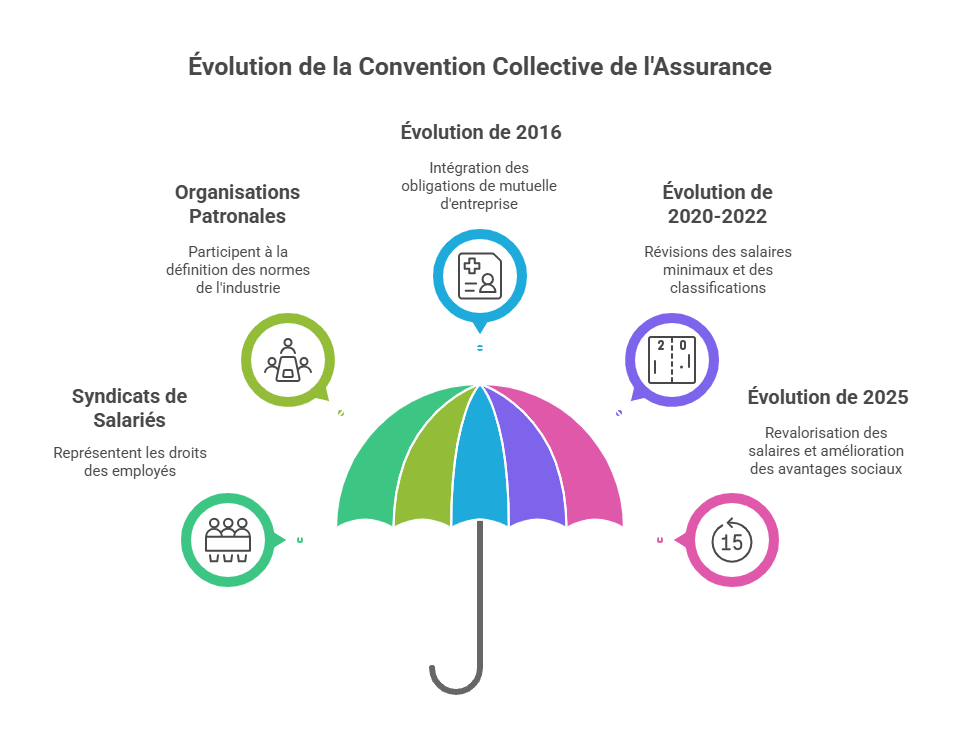
The insurance collective agreement was signed on May 27, 1992, after several years of negotiations between employee unions (notably CFDT, CFE-CGC, and UNSA) and representative employer organizations of insurance companies. It has been registered under number IDCC 1672 and since then serves as the reference framework for labor relations within the insurance branch.
Over the years, this convention has been enriched by numerous amendments, adapted to market evolutions and legislative reforms. Major updates include:
-
📅 2016: integration of obligations related to company health insurance, in connection with the National Interprofessional Agreement (ANI).
-
📅 2020-2022: significant revisions to minimum wages and classifications.
-
📅 2025: salary revaluation, extension of parental leaves, and improvement of health protection.
This collective effort results from a structured social dialogue, where unions defend employee rights and employers actively participate in defining a stable professional framework.
📜 What is the insurance collective agreement?
The insurance collective agreement is a written agreement concluded between employers’ professional organizations and employee unions in the sector. Its goal is to define and adapt the rules of the Labor Code to the specificities of insurance professions.
It applies mandatorily to all insurance and reinsurance companies, thereby guaranteeing enhanced rights for employees and a structured working framework for employers.
✅ Why is this agreement essential?
The insurance sector is regulated and includes several professions with specific characteristics (risk management, client relations, policy underwriting, claims processing, etc.). The purpose of the collective agreement is to:
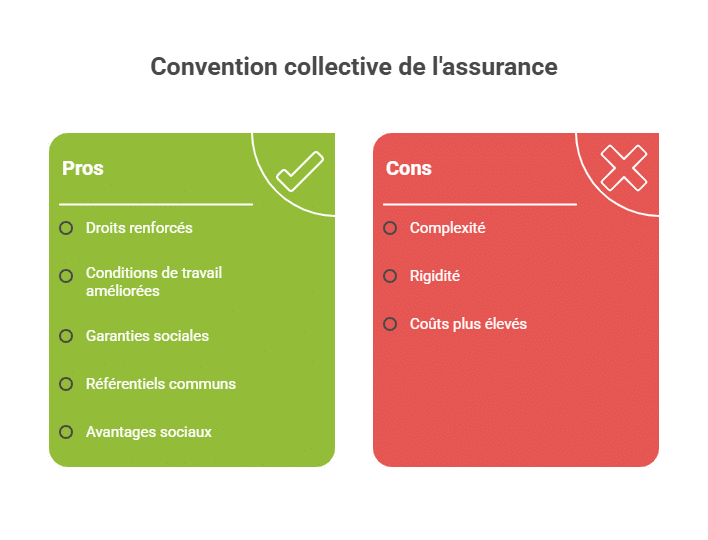
🔹 Frame working conditions for employees, especially regarding wages, bonuses, and working hours.
🔹 Harmonize rights of sector employees by ensuring minimum mandatory provisions.
🔹 Provide superior social benefits compared to the Labor Code, especially in terms of mutual health, insurance, and indemnities.
🔹 Avoid inequalities and abuses by establishing common benchmarks for all concerned companies.
🏢 Which companies does this agreement apply to?
The IDCC 1672 collective agreement applies to various types of companies operating in the insurance sector:
✔️ French and foreign insurance companies mentioned in the Insurance Code.
✔️ Reinsurance companies, specialized in covering insurers’ risks.
✔️ Economic interest groups (GIEs) made up of insurance or reinsurance companies.
✔️ Professional organizations in the insurance sector, which participate in studying or managing the branch’s activities.
💡 Note: This agreement does not apply to insurance brokers, who are subject to a specific brokerage agreement.
⚖️ What are the differences with the Labor Code?
Unlike the Labor Code, which sets general rules, the insurance collective agreement considers the sector’s specificities and guarantees more advantageous provisions for employees.
| 📌 Criteria | ⚖️ Labour Code | 📜 Insurance collective agreement |
|---|---|---|
| Working hours | 35h/week | Possibility of RTT based on company agreement |
| Paid leave | 25 days/year | 30 days/year + additional leave |
| Trial period | 2 months (employees) / 4 months (executives) | Renewable based on employee categories |
| Health insurance and insurance | Not mandatory | Mandatory company health insurance with employer coverage |
| Seniority bonus | No obligation | Experience bonus paid after 3 years seniority |
| Severance pay | 1/4 month’s salary per year of seniority | 20% of monthly salary per year of seniority |
🔎 Useful to know: When a legal dispute arises between the Labor Code and the collective agreement, the most favorable provision to the employee always applies.
📊 Comparison with other collective agreements
The insurance sector is not the only one with a specific collective agreement. To better understand its advantages, it’s interesting to compare it with other similar agreements, such as those for banks or brokers.
| Criteria 📌 | Insurance (IDCC 1672) 🏢 | Bank 🏦 | Brokerage 🤝 |
|---|---|---|---|
| Paid leave | 30 working days | 30 working days | 25 working days |
| 13th month | Mandatory | Mandatory | Variable by company |
| Seniority bonus | Experience bonus from 3 years | Often at 5 years | Rare |
| Mandatory health insurance | Yes (minimum 50% coverage) | Yes | Yes |
| RTT | Common in large companies | Variable | Rare |
| Severance pay | 20% of monthly salary per year | Usually 1/4 month | Usually limited to legal |
📌 Key takeaways:
👉 The insurance collective agreement stands out for better social coverage, a structured experience bonus, and more advantages than most similar sectors.
📄 How to verify if your company applies this agreement?
If you work in an insurance company, you should verify that your company applies the IDCC 1672 collective agreement. Here are three simple ways to find out:
1️⃣ Check on your payslip: The title of the applied collective agreement must appear on your payslip.
2️⃣ Ask your HR department: HR can provide you with a copy of the current collective agreement.
3️⃣ Consult the Legifrance website: By entering the IDCC number 1672, you can access the official text and view current articles.
⚖️ Who is affected by this collective agreement?
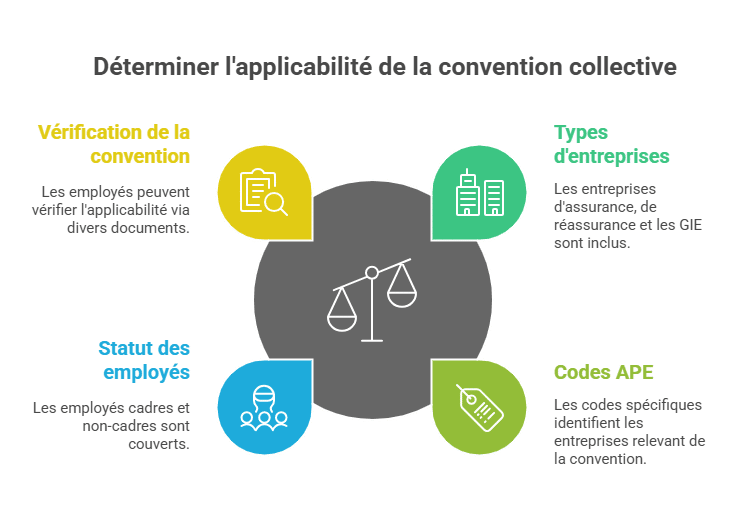
The insurance collective agreement (IDCC 1672) applies to several categories of companies and employees within the sector. It imposes obligations on employers and grants specific rights to employees, whether they are managers or non-managers.
🏢 Concerned companies
This agreement covers all companies whose main activity is related to insurance. This includes:
✅ Insurance companies, whether French or foreign, offering contracts to individuals and professionals.
✅ Reinsurance firms, specializing in covering insurer risks.
✅ Economic interest groups (GIEs) composed exclusively of insurance or reinsurance companies.
✅ Professional organizations linked to insurance companies, involved in research or branch management activities.
⚠️ Note: Insurance brokers are not covered by this agreement and fall under a separate brokerage agreement.
📌 APE codes of affected companies
Companies subject to this collective agreement generally have a specific APE/NAF code, reflecting their main activity.
| 📌 APE Code | 🏢 Type of company |
|---|---|
| 6512Z | Other insurance |
| 6511Z | Life insurance |
| 6520Z | Reinsurance |
| 6630Z | Fund management |
| 6622Z | Insurance agents and brokers |
💡 Why are these codes important?
The APE code is assigned by INSEE upon company registration. It helps to identify the applicable collective agreement.
📌 How to verify your collective agreement?
To confirm if your employer applies the IDCC 1672 collective agreement, you can:
1️⃣ Check your payslip: The name and IDCC number should be listed.
2️⃣ Ask your HR: HR can provide a copy of the current collective agreement.
3️⃣ Consult the Legifrance website: By entering the SIRET number or APE code, you can access official texts and current articles.
🔎 Good to know: If your company is in the insurance sector but no collective agreement applies, the Labor Code rules default.
⏳ Duration of the probation period
The probation period allows the employer and the employee to test their collaboration before the official contract formation. During this period, both parties can terminate the contract more easily, without needing to justify their decision.
🔎 Good to know: The length of the probation period depends on the contract type and the employee’s status.
📌 Proposed durations in the insurance collective agreement
| 📄 Contract type | ⏳ Duration of the probation period |
|---|---|
| CDI – Employees & technicians | 2 months renewable |
| CDI – Managers | 4 months renewable |
| Fixed-term > 6 months | Maximum 2 weeks |
| Fixed-term < 6 months | Maximum 1 month |
| Indefinite fixed-term without precise end | At company’s discretion |
💡 Renewal possible?
In a CDI, the probation period can be renewed only once, if provided for in the employment contract and if the employee consents in writing.
⚠️ Attention: Even if the collective agreement allows renewal, it must never exceed:
✔️ 4 months total for employees and technicians
✔️ 8 months total for managers
📢 What are the employee’s rights during the probation period?
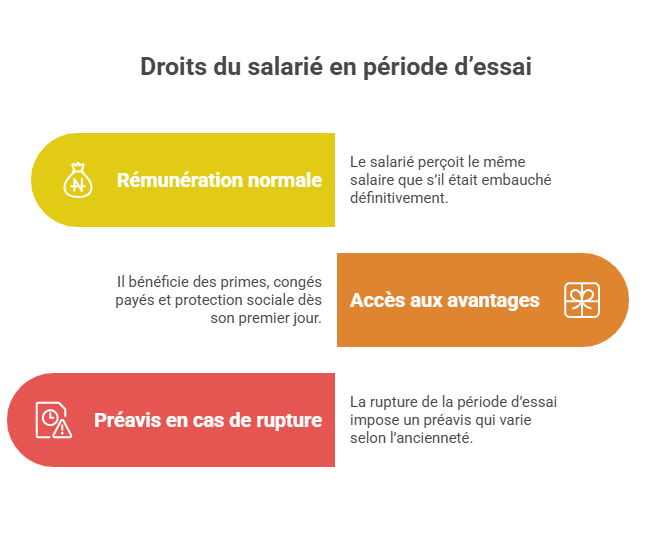
✅ Normal salary: The employee receives the same salary as if fully hired.
✅ Access to benefits: They benefit from bonuses, paid leave, and social protection from day one.
✅ Pre-notice in case of termination: Termination of the probation period requires a notice period that varies with seniority :
| ⏳ Seniority | ⚖️ Notice period to respect |
|---|---|
| Less than 8 days | 24 hours |
| Between 8 days and 1 month | 48 hours |
| More than 1 month | 2 weeks |
| After 3 months | 1 month (if employer terminates during trial) |
🔎 Good to know: If the employee resigns during their probation, they must also respect a notice period of at least 24 hours.

💰 Salaries and bonuses provided by the agreement
The insurance collective agreement sets a salary grid that defines minimum wages based on employee categories. In addition to the basic salary, it includes several bonuses and benefits that enable employees to enjoy a better remuneration.
🎁 Mandatory bonuses in the insurance sector
Employees benefit from specific bonuses, which supplement their monthly salary.
| 🎁 Bonus | 💶 Amount | 🔍 Conditions |
|---|---|---|
| Vacation bonus | 50% of one month’s salary | Paid annually to employees |
| 13th month | 1 month’s salary | Paid at year-end, sometimes split into two (June/December) |
| Experience bonus | Variable based on seniority | Replaces the seniority bonus, evolves with years of service |
✅ Why are these bonuses important?
They help improve employees’ purchasing power and reward their loyalty to the company.
📌 The salary grid in insurance
The collective agreement also defines minimum salaries, which vary depending on the job classification.
| 🏢 Employee class | 💶 Minimum annual remuneration |
|---|---|
| Class 1 (Entry-level employees) | 21,900 € |
| Class 2 | 23,290 € |
| Class 3 | 24,820 € |
| Class 4 | 29,430 € |
| Class 5 (Mid-level managers) | 34,790 € |
| Class 6 | 44,490 € |
| Class 7 (Senior managers) | 60,450 € |
💡 Good to know:
✔️ These are legal minimums, employers can offer higher salaries.
✔️ Salaries may be supplemented with bonuses and benefits (meal vouchers, profit sharing, etc.).
✔️ Salaries are reassessed annually through negotiations between unions and sector employers.
📢 Additional salary benefits
Besides the mandatory salary and bonuses, some employers offer additional perks to attract and retain talent:
🏥 Enhanced corporate health insurance: The employer covers more than 50% of the contributions.
🚗 Travel bonuses: For employees who travel frequently.
📈 Profit sharing and participation: Some companies distribute a share of profits to employees.
🎓 Training and career growth: Opportunities to increase salary by obtaining recognized diplomas (e.g., BTS, insurance degree…).

🧠 Classifications and Career Prospects in Insurance
The collective agreement is based on a classification into 7 classes, corresponding to different levels of responsibility and skills. This classification sets the minimum salary grid, but also helps to organize professional progression within companies.
📊 Example of classification:
| Class | Typical profile 🧑💼 | Job examples | Minimum annual salary 💶 |
|---|---|---|---|
| 1 | Beginner Employee | Administrative Assistant | 21,900 € |
| 2 | Confirmed Employee | Claims Handler, Reception Officer | 23,290 € |
| 3 | Experienced Technician | Production Manager, Indemnification Advisor | 24,820 € |
| 4 | Supervisor | Claims Team Leader | 29,430 € |
| 5 | Intermediate Manager | Underwriter, Project Manager | 34,790 € |
| 6 | Senior Manager | Confirmed Actuary, Regional Manager | 44,490 € |
| 7 | Executive | Technical Director, Deputy General Manager | 60,450 € |
📌 Career development:
-
Employees can climb the ladder based on seniority, continuous training (CPF, VAE) or internal mobility.
-
Paths between classes are common in the sector, especially for managers wishing to move towards underwriters or managerial roles.
-
Company agreements can provide accelerated career paths for high-demand profiles (actuarial work, data, technical management).

🏖️ Leave and rest days
The insurance collective agreement grants employees additional leave in case of family events and also allows benefiting from RTT days depending on the actual working time.
📆 Exceptional leave provided by the collective agreement
In addition to the standard paid leave (30 days per year), the agreement provides for extra leave days for significant life events.
| 📆 Reason | ⏳ Leave duration |
|---|---|
| Employee’s marriage/PACS | 4 to 5 days depending on seniority |
| Birth/adoption | 3 days |
| Child’s marriage | 1 day |
| Death of a child (-25) | 14 days + 8 days of mourning leave |
| Leave for sick child | 3 to 5 days/year (unpaid) |
✅ Why are these leaves important?
They allow employees to manage personal situations without impacting their compensation or their length of service in the company.
⏳ RTT days in the insurance sector
📌 The RTT days (Reduction of Working Time) are implemented to compensate hours worked beyond 35h/week.
🔹 Employees working 39h/week: They can benefit from RTT days depending on company agreements.
🔹 Part-time and day-rate employees: Specific rest days are scheduled for managers depending on their workload.
💡 Good to know: Managing RTT days depends on internal agreements of each company, but the collective agreement encourages their implementation.
🏝️ Other specific leave types
The agreement also provides for additional days for certain special situations:
✔️ Additional leave for seniority: Some employees get extra days off after several years of service.
✔️ Secondment leave: Possible for certain employees on overseas assignments.
✔️ Training leave: Available for employees seeking to advance professionally.

🏥 Social protection and insurance
The insurance collective agreement requires companies to implement a mandatory mutual health insurance and a insurance scheme to offer better social protection to employees and their families.
✅ Social guarantees provided by the collective agreement
| 🏥 Benefit | ✅ Advantage |
|---|---|
| Company mutual health insurance | Minimum coverage of 50% by the employer |
| Collective insurance | Employer contribution of 1.50% of gross salary |
| Salary continuation during sick leave | 100% of salary during 3 months |
🔎 Why is this coverage advantageous?
These guarantees allow employees to benefit from enhanced protection, especially in case of illness, accident, or death, without significant financial impact on them or their family.
🏥 Company mutual insurance: an employer obligation
🔹 Since 2016, all companies must offer a group health insurance to their employees.
🔹 The insurance collective agreement requires at least 50% coverage of contributions by the employer.
🔹 This insurance must cover a minimum set of benefits, including:
✅ General medical care (doctor visits, pharmacy, tests)
✅ Hospitalization (hospital stay costs, hospital package)
✅ Optical and dental care (reimbursements above basic scheme)
💡 Good to know: Some employers offer enhanced insurance plans, with better coverage and higher contribution than minimum.
⚖️ Group insurance: security in tough times
The agreement provides for mandatory insurance coverage for:
✔️ Employee death: payout of a benefit to beneficiaries.
✔️ Disability or work incapacity: continued income support for the employee.
✔️ Coverage of sick leave: Guarantee of salary continuation.
Employer contribution: 1.50% of gross salary to fund these guarantees.
📌 Why is this important?
A worker unable to work receives a supplementary benefit on top of social security daily allowances.
In case of death, the family receives a death benefit to cover expenses.
🤒 Illness leave: salary maintenance guaranteed
In case of sick leave, the collective agreement provides enhanced protection:
✔️ Salary maintained at 100% for 3 months for employees with at least 1 year of seniority.
✔️ Continued benefit through company insurance after this period.
✔️ Specific sick leave for certain conditions or prolonged hospitalizations.
🔎 Good to know: Some employers offer more favorable guarantees, such as extended benefits or salary supplements for up to 6 months.

⏳ Working hours and overtime
The insurance collective agreement sets the legal working time at 35 hours per week. However, it provides for overtime premiums and specific compensations for night work or holidays.
💼 Working hours regulations
📌 Weekly duration: 35 hours
📌 Maximum duration: 48 hours per week or 44 hours on average over 12 weeks
📌 Mandatory rest period: 11 consecutive hours per day and 35 consecutive hours per week
🔎 Good to know: Employers can organize working hours with internal agreements, such as the day-work plan for certain managers.
💶 Overtime premium
If an employee works overtime hours, they are paid at a premium rate depending on the volume.
| ⏳ Type of hours | 💶 Premium rate |
|---|---|
| Overtime (36h – 43h) | +25% |
| Overtime (+44h) | +50% |
| Night work and holidays | +50% |
🔎 Definition of night work:
Night work is defined as any period worked between 9 pm and 6 am. It entitles workers to a 50% salary increase.
🏖️ Compensatory rest instead of payment
Instead of paying overtime, the employer can offer a compensatory rest.
✔️ Starting from 36 hours/week, the employee can convert overtime hours into rest days.
✔️ Rest duration:
🔹 1 hour 15 minutes of rest for each hour with 25% premium
🔹 1 hour 30 minutes of rest for each hour with 50% premium
✔️ The employee must be informed in advance and give their consent for this arrangement.
📌 Why choose compensatory rest?
👉 Enables employees to gain additional days off.
👉 Reduces the cost of overtime for the employer.

⚖️ Severance pay or departure indemnities
The insurance collective agreement regulates the indemnities and notice periods in cases of dismissal, resignation, or retirement. These rules aim to ensure financial security for employees upon leaving the company.
📌 Dismissal severance
When an employee is dismissed without gross fault, they receive a compensatory indemnity that depends on their seniority.
💰 Calculation: 20% of the monthly salary per year of seniority.
📌 Conditions:
✔️ Having at least one year of seniority.
✔️ Cumulable indemnity with other benefits (unused paid leaves, bonuses…).
🔎 Example calculation:
An employee with 10 years of seniority and a monthly salary of €3,000 will receive:
📌 10 x (20% of €3,000) = €6,000 in dismissal indemnity.
⚠️ Special cases:
👉 Gross or serious misconduct: No dismissal indemnity.
👉 Dismissal due to incapacity: Indemnity increased if incapacity is of professional origin.
👴 Retirement severance indemnity
If the employer puts an employee into retirement, they are entitled to a specific indemnity based on their seniority.
📌 Conditions:
✔️ Being retired by the employer (not voluntary departure).
✔️ Proving at least 10 years of seniority.
💰 Calculation of indemnity:
✔️ 10% of the last twelve months’ salaries per year present.
✔️ Additional increase for employees with over 10 years seniority.
⏳ Notice period upon departure
The notice period depends on the reason for departure and the employee’s status.
| 🏢 Situation | ⏳ Notice period |
|---|---|
| Resignation – Employees & technicians | 1 month |
| Resignation – Managers | 3 months |
| Dismissal – Employees & technicians | 1 month (2 months after 2 years of seniority) |
| Dismissal – Managers | 3 months |
📌 Special cases:
✔️ Notice period can be shortened if the employee finds new employment.
✔️ Possible exemption in case of agreement between employer and employee.
✔️ Employees dismissed are entitled to job search hours during their notice period.
📌 Concrete example
👉 Sophie, a claims manager with 10 years in an insurance company, earns a gross monthly salary of €3,000.
In case of dismissal without gross misconduct, her indemnity is calculated as follows:
💰 10 years × (20% × €3,000) = €6,000 in dismissal indemnity, plus remaining paid leave and due bonuses.
🧍 Employee testimonial
“When I started as an assistant in 2013, I didn’t really know my rights. Thanks to the collective agreement, I was able to benefit from a experience bonus in my third year, then a training funded for becoming a manager. Today, I am a mid-level manager (class 5) with real salary recognition.”
— Sophie L., 37 years old, Lyon

📌 How to consult the insurance collective agreement?
Employees in the insurance sector can review their collective agreement to understand their rights and obligations. Several options are available for easy access.
🖥️ 1️⃣ Check the collective agreement on Legifrance
📌 The official Legifrance site provides free access to the full text of the national collective agreement of insurance companies (IDCC 1672).
✅ Advantages:
✔️ Free access and regular updates.
✔️ Easy search using the internal search engine.
✔️ Downloadable in PDF.
💡 Tip: Use CTRL + F on Legifrance to search for a specific article (e.g., “bonuses”, “dismissal”, “leave”).
📌 Direct link: Legifrance – Insurance collective agreement (IDCC 1672)
🏢 2️⃣ Request access from HR
📌 The HR department at each company must provide access to the collective agreement for employees.
✅ Why review with HR?
✔️ They can give you a printed version of the text.
✔️ They explain company-specific rights.
✔️ They answer questions about leave, bonuses, or work hours.
💡 Advice: Ask if company agreements supplement the collective agreement.
🤝 3️⃣ Contact unions and staff representatives
📌 Unions and staff representatives have an in-depth knowledge of the agreement and its potential updates.
✅ Why contact them?
✔️ They defend employee rights and clarify rules.
✔️ They can assist in case of disputes with employers.
✔️ They inform about updates to collective agreements.
💡 Good to know: Some professional branches publish guides explaining main articles of the collective agreement.

📑 What are the employer’s obligations?
The insurance collective agreement imposes specific obligations on employers to ensure favorable working conditions for employees. These rules apply to all companies in the sector and must be respected to avoid sanctions.
📌 Main employer obligations:
✔️ Respect wage grids: Employers must ensure that wages paid are at least equal to the minimums set by the collective agreement. Any lower remuneration is illegal.
✔️ Pay mandatory bonuses: Employees must receive the bonuses provided (13th month, vacation bonus, experience bonus, etc.). These salary supplements are mandatory and cannot be removed without a collective agreement.
✔️ Implement mutual health insurance and insurance scheme: The agreement requires a collective health insurance with at least 50% coverage of contributions by the employer. The insurance scheme guarantees compensation in case of illness or accident.
✔️ Apply overtime premiums: Any exceeding 35 hours per week must be compensated with either a salary premium or a rest day.
✔️ Provide access to professional training: Employers should promote skill development through internal or external training funded by the company.
✔️ Respect labor law and notice periods: In case of dismissal, resignation, or retirement, legal deadlines must be followed and corresponding indemnities paid.
💡 Good to know: An employer not respecting these obligations risks financial penalties and can be prosecuted before the Labor Courts by employees.

🎓 Training and professional development
The insurance collective agreement promotes skills development and encourages career advancement. Companies are obliged to offer appropriate training programs based on employee needs.
📚 Available training options:
✔️ Right to Individual Training (DIF), Personal Training Account (CPF): Each employee accrues training rights for skills development or requalification.
✔️ Validation of Skills Acquired (VAE): Employees with several years of experience can earn a diploma without completing full training.
✔️ Company training plan: Some companies offer fully funded internal training to support internal progression.
✔️ Skills assessment: Possible after 20 years of experience or starting at 45 years old, to evaluate skills and consider career change.
📌 Why are these training programs essential?
✅ They help employees increase their salary and benefit from career opportunities.
✅ They ensure companies have qualified and competitive teams to adapt to market changes.
💡 Good to know: Employers have a legal duty to inform employees about their training rights and facilitate access to these programs.

🚨 Rights and remedies in case of disputes
In case of conflict between an employee and their employer, several options are available to assert your rights.
⚖️ Possible steps for employees:
✔️ Contact staff representatives (works councils, union delegates): They can intervene to resolve conflicts amicably and ensure compliance with the collective agreement.
✔️ Contact the Labor Inspectorate: This agency can inspect companies and impose sanctions if obligations are not met.
✔️ Initiate proceedings before the Labor Courts: If no agreement is reached, an employee can bring a case to the Labor Court for compensation (indemnities, reinstatement, damages).
📌 Examples of common disputes:
🔹 Non-payment of overtime hours.
🔹 Breach of salary grids and mandatory bonuses.
🔹 Unlawful termination of employment.
🔹 Harassment or discrimination at work.
💡 Advice: An employee should keep all written documents (contracts, payslips, email exchanges) to substantiate their claim.

🏛️ Recent developments of the collective agreement
The collective agreement is regularly updated to adapt to sector evolutions and negotiations between unions and employers.
📆 Recent changes in 2025:
✔️ Wage revaluation: Salary scales have been increased to follow inflation and ensure higher purchasing power for employees.
✔️ Improved health benefits: The company health scheme now covers more medical expenses, especially in optical and dental.
✔️ Increase in experience bonus: Employees with years of seniority receive better financial recognition.
✔️ Better support for parental leave: Maternity, adoption, and child sick leave has been extended.
📌 Why are these changes important?
✅ They improve working conditions and employee remuneration.
✅ They help employers better retain their staff with competitive benefits.
💡 Tip: Regularly check Legifrance or union communications for updates.
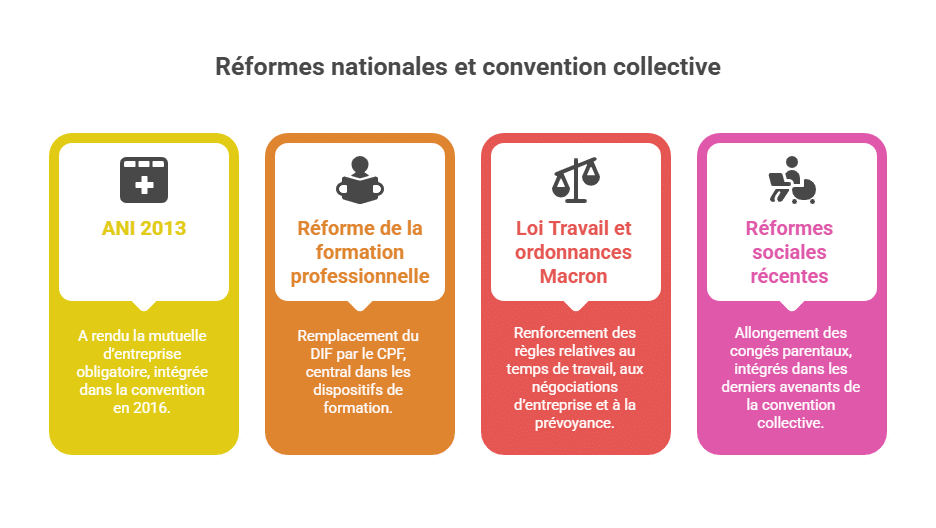
📝 Link to national reforms
The collective agreement fits within a constantly evolving French legislative framework. Major reforms have directly impacted its content:
-
📅 ANI 2013 → made company health insurance mandatory for all employees, integrated into the agreement from 2016.
-
📅 Reform of professional training (2015 – 2018) → replaced DIF with CPF, now central to training schemes mentioned in the agreement.
-
⚖️ Labor Law and Macron ordinances (2017) → strengthened rules on working time, company negotiations, and insurance schemes.
-
👶 Recent social reforms (2022-2025) → extended parental leaves, incorporated into the latest amendments of the collective agreement.
📌 In summary: the collective agreement constantly adapts to stay aligned with major legislative directions while offering benefits exceeding the legal minimum.
📢 Conclusion
The Insurance Collective Agreement (IDCC 1672) is a vital tool for employees and employers in the sector. It guarantees:
✅ Clear salary framework with 13th month and bonuses
✅ 30 days of annual leave and special days off
✅ Mandatory mutual health insurance and enhanced insurance scheme
✅ Overtime premiums
✅ Preferential dismissal indemnities
💡 For employees and employers, knowing this agreement well helps to claim rights and ensure a balanced work environment.
❓ FAQ – Common questions about the insurance collective agreement
📌 Does the insurance collective agreement apply to apprentices?
Yes ✅. Apprentices have the same rights as regular employees: 13th month, mandatory health insurance, bonuses, and leave, subject to the company’s adherence to the agreement.
📌 Can I combine the experience bonus with other bonuses?
Yes ✅. The experience bonus can stack with the vacation bonus and the 13th month. It is automatically paid after 3 years of seniority.
📌 What if my employer does not apply the agreement?
You can first discuss this with your HR department. If no change occurs, you may contact employee representatives or the Labor Inspectorate. As a last resort, legal action at the Labor Court is possible.
📌 How to access the latest version of the agreement?
The most reliable method is to download it for free from Legifrance, searching for “IDCC 1672”. HR should also be able to provide a printed copy.


For further information

Entraîne-toi avec nos Quiz de révision
Fini les lectures passives. Pour retenir les notions clés du BTS Assurance, teste-toi ! Inscris-toi pour recevoir 1 quiz par jour directement dans ta boîte mail.