- What is Adidas’ primary strength?
Its constant innovation capacity and widely recognized global reputation. - What are the challenges related to Adidas’ production?
Offshoring raises ethical questions and influences image, combined with pressure to reduce environmental footprint. - How does Adidas position itself vis-à-vis Nike?
Nike remains the global leader, but Adidas differentiates itself through cultural collaborations and a fashion-sport offer that is carefully curated. - What opportunities should be prioritized in 2025?
Emerging markets and digital channels offer major growth levers for Adidas. - What strategies will help counter threats?
Investing in sustainability, adjusting the pricing range, and strengthening transparent communication are key options.
In summary
| Section 📌 | Summary |
|---|---|
| Global presentation | Global brand (shoes, clothing, accessories); founded in 1949; presence in Europe/Asia/Americas; ~20% market share; competitors include Nike, Puma, Under Armour, Skechers. |
| History & evolution | From Dassler workshops to the 1954 Olympics (clip-in studs); diversification into multiple sports; partnerships with FIFA/UEFA/clubs; shift towards sport-lifestyle (Originals, Yeezy, Pharrell, Beyoncé). |
| Strengths | Worldwide reputation; innovation pipeline (over 60 new products per year); partnerships with athletes & celebrities; geographically diverse; extensive ranges covering performance & lifestyle. |
| Marketing & communication | “Impossible is Nothing”; strong social/digital presence; storytelling around sport + lifestyle; CSR supporting brand image; influencers (Messi, Salah, Pogba, Beyoncé). |
| Weaknesses | Perceived high prices; criticisms over offshoring; risk of “fast fashion” (image/durability); variable perceived quality; responsiveness to trends can be improved. |
| CSR & sustainability | Parley (ocean plastics), zero virgin plastic goal, circular economy, supplier audits; challenge: volume & long-term credibility. |
| Opportunities | Emerging markets (Asia/Africa); e-commerce & social media; collaborations/influence; sustainable products; wearables & “smart” tech. |
| Threats | Intense competition; rising raw material costs; ecological & regulatory pressure; geopolitical & supply chain risks; volatile trends. |
| PESTEL | Political (trade), Economic (inflation/FX), Socio-cultural (fitness/lifestyle), Tech (3D printing/e-com), Environmental (carbon), Legal (EU standards). |
| Innovation & R&D | Boost (cushioning), recycled materials, 3D printing & automation, wearables, tech-art collaborations; differentiation and time-to-market. |
| Competitors | Nike leading (marketing/finance power); Adidas strong in crossover fashion-sport; Puma/Reebok in niches; New Balance/Asics strong in running; casual brands: Converse/Skechers/Fila. |
| Segments | Football (FIFA/UEFA/clubs), Running (Ultraboost/Boost), Lifestyle (Originals/Yeezy), Fitness/Training, Basketball (less strong than Jordan). |
| Finance | Revenue ~24 billion € (2025); Net income ~1.6 billion €; market share ~20%; high R&D investment; Nike >50 billion $ revenue but Adidas remains profitable & resilient. |
| Recommended strategies | Accelerate sustainability; expand pricing range without sacrificing quality; boost digital & influence; strengthen partnerships; supply transparency. |
| Perspectives 2030 | Become the leading responsible & innovative brand through ESG as a competitive advantage; AI/personalization/AR-metaverse as growth drivers. |
| FAQ | Key strength: innovation + reputation; issues: production/ethics/footprint; priorities: emerging markets + digital; response: sustainability + pricing + transparency. |
Summary
- Global overview of Adidas within its sector
- Analysis of Adidas‘ strengths: main assets and competitive advantages
- Exploration of Adidas‘ weaknesses: internal limitations and challenges to address
- Growth and expansion opportunities in the global market
- External threats and risks impacting Adidas’ trajectory
- The impact of technological innovations and R&D on competitiveness
- Comparison with competitors: Nike, Puma, Reebok, and others
- Recommended strategies following Adidas’ SWOT analysis
- Global presentation of Adidas in its sector: a major player in sports and sports fashion

In the current landscape of sports equipment giants, Adidas stands out as an unavoidable force. Founded in 1949 by Adolf Dassler in Germany, the company has gradually expanded beyond simple shoe manufacturing to encompass a much broader universe including clothing, accessories, and assorted sports equipment. This diversification allows the brand to target a wide audience, from occasional amateurs to professional athletes.
The challenges posed by the dynamic sports and fashion industries require continuous adaptation. Competition is fierce and comes from both historic companies like Nike or Puma and emerging brands such as Under Armour or Skechers. In this context, Adidas’ ability to propose frequent innovations and high-performing products is crucial to maintaining its position.
Adidas’s global revenue in 2025 demonstrates remarkable strength in a market that continues to grow driven by the popularity of sports and well-being. Increased awareness of an active lifestyle is contributing to a steady rise in sales, a trend that benefits the three-stripe brand.
To better understand Adidas’ dynamics, an in-depth SWOT analysis offers a comprehensive overview of its internal and external environment, highlighting its strengths, weaknesses, opportunities, and threats. This method helps to better grasp the levers on which the company can capitalize and those it must watch carefully.
The table below summarizes the overall profile of Adidas in its market:
| Element 🔍 | Description |
|---|---|
| Origin | German company founded in 1949 |
| Product segments | Shoes, clothing, sports accessories |
| Main geographical zone | Global – Europe, Asia, Americas |
| Main competitors | Nike, Puma, Reebok, New Balance, Under Armour… |
| Market share value | About 20% of the global sports market |
Adidas has built a solid network over several decades, and this capital now fuels its development strategy and positioning among consumers. The following sections detail the inherent strengths and weaknesses of this company, as well as the external factors influencing its future.

History and evolution of Adidas
Adidas, founded in 1949 by Adolf Dassler, has roots much earlier, as in the 1920s Dassler was already producing sports shoes in the family workshop in Germany. The name Adidas comes from the contraction of his first and last name: Adi Dassler. The company quickly gained international prominence, notably through its technical innovations and its presence in major sporting competitions.
A major turning point occurs during the 1954 Olympic Games, where the German football team, equipped with Adidas screw-in studs, defeats Hungary in the final. This event, known as the “Bern Miracle,” thrust Adidas onto the international scene.
In the following decades, the brand diversified: running shoes, sports clothing, and then expanded through prestigious partnerships with FIFA, UEFA, and iconic clubs (Real Madrid, Bayern Munich, Manchester United).
Starting in the 2000s, Adidas adopted an M&A strategy, notably with Reebok (2006), and multiplied collaborations in fashion and culture. The launches of Adidas Originals, Yeezy (in partnership with Kanye West), and collaborations with Pharrell Williams or Beyoncé exemplify this evolution towards sport-lifestyle.
Today, Adidas is perceived not only as a sports brand but also as a symbol of urban fashion, skillfully navigating between performance and style.

Analysis of Adidas‘ strengths: key assets and competitive advantages to highlight
Any successful analysis of Adidas’s success must focus on its numerous strengths. Firstly, the brand benefits from an exceptional global reputation. This brand capital is strongly supported by powerful branding and communication focused both on performance and lifestyle. While Nike often dominates the scene, Adidas remains a giant with worldwide influence.
The second major strength lies in its constant innovation. The company invests massively in research and development, with over 60 new products released each year. These innovations often incorporate advanced technologies to enhance comfort, durability, or performance, thus standing out in a highly competitive market.
Furthermore, Adidas’ ability to establish strong strategic partnerships plays a key role. Whether with professional sports clubs, Olympic disciplines, or influential celebrities, the brand continuously expands collaboration efforts, boosting its visibility and credibility.
Another notable strength is its well-controlled geographical diversification. Europe remains a key market, but growth in Asia, especially in China and India, is an important driver. The emergence of middle classes in these markets and their interest in sports fashion fuel this growth.
Table of Adidas’ main strengths:
| Strength 🔥 | Description | Strategic impact |
|---|---|---|
| Worldwide reputation | Recognized brand in over 160 countries | Customer loyalty and strong attractiveness |
| Product innovation | Launching over 60 new items annually | Competitive advantage and differentiation |
| Strategic partnerships | Collaborations with renowned athletes and teams | Enhanced credibility and visibility |
| Geographical diversification | Strong presence in Europe, Asia, and the Americas | Risk mitigation across markets |
| Wide product ranges | Products for all sports and uses | Extensive market coverage |
By capitalizing on these assets, Adidas manages to hold its own against giants like Nike and Puma, while building a loyal and diverse customer base. Supply chain mastery and agile communication further complete this positive picture.

Adidas’ marketing and communication strategy
Adidas’s marketing is one of its main strengths in competing with Nike. The brand has always created memorable and unifying campaigns. Its iconic slogan “Impossible is Nothing” perfectly illustrates its ability to combine sports performance with universal inspiration.
Adidas focuses on:
-
Brand ambassadors: Lionel Messi, Mohamed Salah, Paul Pogba, Beyoncé, Kanye West. These figures embody the diversity and universality of sport and lifestyle.
-
Sports partnerships: Adidas is the official kit supplier for many federations (football, rugby, basketball) and renowned clubs. This ensures global visibility at major international events.
-
Digital and social media: The brand uses Instagram, TikTok, and YouTube to engage a young audience with creative content, often based on exclusive collaborations and storytelling.
-
Streetwear and urban culture: The Originals range, as well as iconic sneakers (Stan Smith, Superstar, Yeezy), have become fashion icons worn daily.
Adidas has also invested in CSR campaigns (corporate social responsibility) to respond to sustainability criticisms. These initiatives help reinforce its brand image in a context where ecological awareness is increasing.
In summary, Adidas’ communication combines sport, lifestyle, and social engagement, creating an aura that extends well beyond mere sports performance.

Analysis of Adidas‘ weaknesses: internal limitations and challenges to address to maintain its position
Despite its strengths, Adidas is not immune to dark areas. Continuous innovation has a significant cost that affects the final price of its products, which are sometimes seen as too high by some consumers. This pricing policy can restrict access to certain market segments, especially compared to competitors like Reebok or New Balance that often target more affordable niches.
Moreover, Adidas faces criticism related to its manufacturing choices. The gradual offshoring to cut costs has led to job losses in Europe, creating tensions with consumers sensitive to ethical practices. This has sometimes hurt the perception of the brand’s social responsibility.
In terms of quality, although generally recognized, some consumers have expressed reservations after certain campaigns that leaned towards “fast fashion.” While lucrative, this trend raises environmental questions and can negatively impact Adidas’ image at a time when sustainability is a crucial criterion for many.
Major weaknesses of Adidas in 2025:
- 💸 High prices limiting access to some markets
- 🌍 Offshoring and associated ethical criticisms
- ⚠ Variable perceived quality in certain segments
- ♻ Environmental concerns tied to fast fashion
- 🕒 Sometimes insufficient responsiveness to emerging trends
These weaknesses must not be overlooked, as they can hinder growth and diminish customer loyalty, particularly against rivals capable of offering more accessible or more responsible alternatives. Managing these challenges will require Adidas to remain agile.
| Weakness ⚠ | Origin | Consequences |
|---|---|---|
| High production costs | Investments in R&D and innovation | Relatively high sales price |
| Offshoring | Cost reduction | Ethical image affected, social tensions |
| Fast fashion | Commercial strategy | Loss of sustainable image |
| Perceived variable quality | Product segmentation | Consumer doubts |
| Limited adaptation | Responsiveness to trends | Risk of losing competitive momentum |
These aspects show that the brand must vigilantly monitor its internal environment and adjust its strategy to continue appealing to an increasingly demanding audience, especially in the wake of players like Asics or Fila.

Social responsibility and sustainable commitments
Sustainability is a key challenge for Adidas. The company is often criticized for offshoring and involvement in fast fashion, but it has undertaken real efforts in eco-responsibility.
Among its flagship actions:
-
Partnership with Parley for the Oceans: Adidas manufactures shoes and clothing from recycled plastics collected from oceans. Over 30 million pairs have already been produced as part of this initiative.
-
Zero virgin plastic goal: Adidas aims to gradually eliminate the use of non-recycled plastics in its products.
-
Circular economy: Developing recycling and reuse programs for used products to reduce waste.
-
More ethical supply chain: Adidas has increased transparency regarding its suppliers and factories, with regular audits.
However, there are still limits: mass production volumes continue to fuel fast fashion, and some consumers consider these efforts insufficient given the ecological urgency.
This section emphasizes the importance for Adidas to transform these commitments into competitive advantages in a market where sustainability has become a major purchasing criterion.

Growth and expansion opportunities for Adidas in a dynamic market
Despite challenges, Adidas has a foundation of opportunities that can fuel its expansion. The sports shoe and apparel market is experiencing sustained annual growth, driven by increasing global awareness of the benefits of physical activity. This trend generates growing demand, paving the way for new segments.
A particularly promising area is the rise of emerging markets like Asia, where economic growth boosts the middle class. These populations, increasingly concerned with well-being and appearance, seek well-known brands like Adidas, which embody both trendiness and performance.
The development of e-commerce is another significant lever. By leveraging well-designed digital platforms and targeted marketing campaigns, Adidas can reach a broader customer base, especially young social media users, a field where the brand stands out through original collaborations and viral communication.
Here are key opportunities for Adidas:
- 🌐 Expansion into emerging markets (Asia, Africa)
- 💻 Growth of digital channels and e-commerce
- 🤝 Strengthening partnerships with influencers and athletes
- ♻ Sustainable development: eco-friendly products
- 🆕 Diversification into wearables and “smart” technologies
The table below illustrates these growth axes:
| Opportunity 🚀 | Domain | Potential |
|---|---|---|
| Emerging markets | Geographical expansion | Strong, especially in Asia and Africa |
| Digital and e-commerce | Distribution | Significant, evolving consumption habits |
| Influencers and collaborations | Marketing | Enhanced visibility |
| Sustainable products | Product innovation | Meeting growing consumer expectations |
| Wearable technologies | Product incident | Innovative potential in the medium term |
Adidas’s ability to capitalize on these opportunities will depend on its strategic agility, particularly regarding its capacity to adapt to changing tastes and consumer expectations. These levers could even help it turn some threats into opportunities and strengthen its position.

External threats and risks impacting Adidas’s trajectory in a competitive environment
The sports equipment market is riddled with potential obstacles. Intense competition does not only come from Nike or Puma but also from players like Converse, Fila or Under Armour, which seek to gain market share through their agility.
Furthermore, rising production costs in various regions due to increased wages or raw material prices can impact profit margins. This trend forces the company to adjust its prices or find new efficiency sources.
Another delicate factor is the increased consumer sensitivity to ethics and sustainability. Adidas must balance rapid innovation with environmental impact, or risk losing customer segments, especially among younger consumers.
Lastly, geopolitical instability and evolving trade regulations pose external threats that should not be underestimated. Disruptions in the supply chain or tariff barriers could slow down growth.
Key threats facing Adidas:
- ⚔ Intensity of overall competition
- 📈 Rising raw material and production costs
- 🌿 Ecological pressures and consumer expectations
- 🛑 Geopolitical and trade risks
- 🎯 Rapid shifts in consumer trends
| Threat ⚡ | Origin | Impact |
|---|---|---|
| Increased competition | Multiplication of sports brands | Risk of losing market share |
| Rising costs | Global economic instability | Reduced profit margins |
| Environmental requirements | Social and regulatory pressure | Need for strategic adaptation |
| Political and commercial risks | International tensions | Slower trade flows |
| Changing consumer expectations | Rapid changes | Need for continuous innovation |
In such a fluid environment, Adidas must increase its efforts to stay agile and adaptable, especially in light of rivals who sometimes adopt bolder or more disruptive approaches. Mastering external risks is thus as important as optimizing internal strengths.

PESTEL analysis applied to Adidas
The PESTEL model helps understand external factors influencing Adidas’s strategy:
| Factor | Influence on Adidas | Concrete example |
|---|---|---|
| Political | Stability of countries where factories are located, trade regulations | Risks related to tensions between the EU, China, and the US |
| Economic | Inflation, purchasing power, exchange rates | Rising raw material prices impacting margins |
| Sociocultural | Active lifestyle, enthusiasm for sports and well-being | Popularity of fitness and sports-lifestyle among youth |
| Technological | Innovations (3D printing, wearables, e-commerce) | Adidas Futurecraft 3D and digital platforms |
| Environmental | Pressures to reduce carbon footprint | Use of recycled plastics and zero plastic goal |
| Legal | Safety standards, environmental laws | EU regulations on sustainability |
This analysis complements the SWOT by providing a macro view of the overall environment in which Adidas evolves.

Impact of technological innovations and R&D on Adidas’s competitiveness
Innovation, a true driver for Adidas, is notably reflected in its massive investments in research and development. These efforts are aimed at designing shoes that are increasingly high-performing, comfortable, and tailored to athletes’ specific needs. More than 60 new products are introduced annually, enriching an already diverse range.
The Boost technology is an iconic example that marked a turning point in shoe design, offering revolutionary cushioning. These technical advances are central to Adidas’ differentiation strategy, which also emphasizes ecological materials, blending performance with environmental respect.
Apart from products, Adidas is also incorporating innovations in its processes, such as advanced automation and 3D printing in certain production lines. This helps speed up manufacturing and reduce waste.
Some notable innovations include:
- 👟 Boost technology for high-quality cushioning
- ♻ Use of recycled and sustainable materials
- 🤖 Automation and 3D printing in production
- 📱 Development of connected wearables
- 🎨 Artistic collaborations incorporating technology
| Innovation 💡 | Description | Competitive advantage |
|---|---|---|
| Boost | High-resilience foam for cushioning | Increased comfort and performance |
| Recycled materials | Recycled textiles and plastics | Eco-responsible image and sustainability |
| 3D printing | Rapid and custom manufacturing | Flexibility and shorter lead times |
| Connected wearables | Smartwatches and sensors integrated | Digital sports integration |
| Tech-art collaborations | Innovative and unique designs | Diversification of customer base |
The investments in these technologies are essential for Adidas to stay competitive against rivals like Under Armour, which also innovate, creating an ongoing industry challenge.

Strategic comparison between Adidas and its main industry competitors
In this highly competitive sector, comparing Adidas with rivals like Nike, Puma, Reebok, and New Balance sheds light on approaches and positioning differences.
Nike remains the uncontested leader in marketing and product innovation, with financial power that often surpasses its rivals. However, Adidas has successfully established its identity through fashion and cultural collaborations, such as those with Kanye West or Pharrell Williams, which give it strong visibility among youth.
Puma and Reebok target narrower segments, but Adidas maintains an advantage through its broader offer. New Balance and Asics are more specialized, particularly in running, giving Adidas a wider scope to reach various audiences.
To summarize:
- 🏋️♂️ Nike dominates globally, but Adidas excels in crossover fashion-sport
- ⚽ Puma and Reebok are closing in with niche segments
- 👟 New Balance and Asics lead in certain sports segments, especially running
- 🌟 Adidas combines a broad range and trendy image to appeal
- 🆚 Converse, Skechers, and Fila compete mainly in casual and lifestyle segments
In essence, the competition also depends on strategic flexibility, where Adidas plays the card of diversity and modernity, allowing it to remain competitive against market predators.
| Brand 📊 | Specialty | Positioning | Key strength |
|---|---|---|---|
| Adidas | Multi-sport, fashion, lifestyle | Innovative, fashionable, and performance-oriented | Wide range and cultural collaborations |
| Nike | Sports performance and marketing | Global leader | Financial strength and technology |
| Puma | Sports and urban fashion | Niche segmentation | Style and celebrities |
| Reebok | Fitness and leisure | Affordable positioning | Attractive prices |
| New Balance | Running, comfort | Specialist in sports | Shoe technicality |
Adidas must continue innovating while defending its market share. Customer experience, supply chain management, and social trend adaptation are crucial factors.

Market segment focus
Adidas is not limited to one sport: its strength lies in covering several key segments.
-
Football ⚽: Adidas remains one of the global leaders, with partnerships with FIFA, UEFA, the Champions League, and iconic clubs (Real Madrid, Bayern Munich). Predator and Copa shoes are icons.
-
Running 👟: With the Ultraboost range and innovations like Boost technology, Adidas is a player in the high-end running market.
-
Lifestyle and streetwear 👕: Stan Smith, Superstar, Yeezy… many products have become worldwide fashion symbols. This segment is close to Adidas’ youth appeal.
-
Fitness and training 💪: Less dominant than Nike, but the brand is progressing with dedicated clothing and accessories ranges.
-
Basketball 🏀: Less strong than Nike (Jordan), but Adidas sponsors NBA players and remains active in this demanding market.
This segmentation illustrates the versatility of Adidas, which helps to limit risks in case of decline in a particular segment.
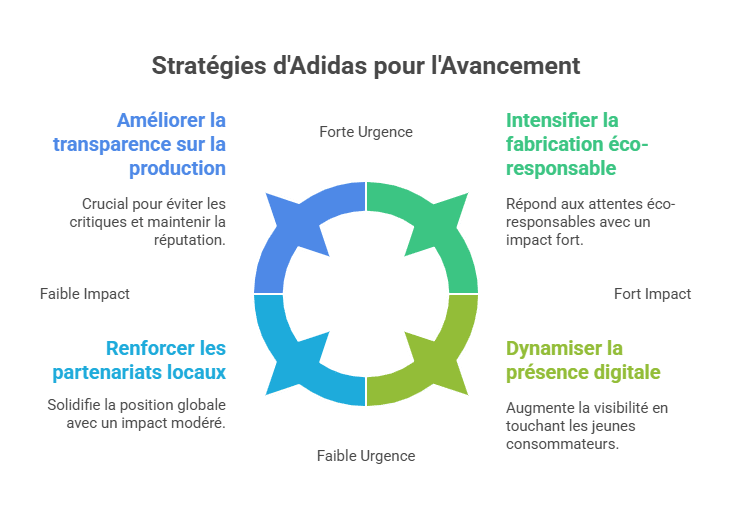
Recommended strategies to strengthen Adidas’s position based on its SWOT analysis
Based on this strategic insight, several paths emerge for Adidas to continue advancing.
First, the company must leverage its strengths by reinforcing its commitments to sustainable development. Eco-friendly production and circular economy are increasingly decisive factors among consumers, especially youth.
Second, it is crucial to balance the price range to reach a wider audience without damaging the overall premium image. Affordable but quality collections can broaden the customer base and effectively compete with brands like Skechers or Fila.
The digital channel also needs continuous optimization through more personalized marketing strategies, leveraging the power of social media, as this analysis clearly integrates.
Finally, improving transparency and communication about production conditions is essential to avoid criticisms related to offshoring and to protect the brand’s reputation.
A list of recommendations:
- ♻ Intensify eco-responsible manufacturing
- 💳 Offer a broader accessible range without compromising quality
- 📈 Boost digital presence and influencer marketing
- 🤝 Strengthen local and international partnerships
- 🔍 Improve transparency on social conditions and impacts
| Recommendation 📌 | Objective | Expected effect |
|---|---|---|
| Sustainable production | Meet eco-responsible expectations | Enhanced brand image, loyalty |
| Balanced pricing range | Broaden the customer base | Increased market share |
| Digital marketing | Reach young consumers | Increased visibility |
| Strategic partnerships | Consolidate overall positioning | Increased credibility |
| Social transparency | Improve reputation | Reduced criticisms |
By adopting these axes, Adidas will be better positioned to manage weaknesses and counter threats while fully exploiting its potential. The challenge is also to remain flexible in a highly dynamic environment, with players like Nike always lurking.

Financial analysis of Adidas
Financial analysis offers a numerical overview of the company’s health.
-
Revenue (2025): approximately 24 billion euros.
-
Net profit: about 1.6 billion euros, despite inflationary pressures.
-
Global market share: around 20%, versus nearly 27% for Nike.
-
R&D investment: multiple hundreds of millions of euros annually, reflecting the importance of innovation.
Compared to this, Nike remains more financially powerful with revenues exceeding 50 billion euros. However, Adidas maintains a solid profitability and a loyal global base, allowing it to compete strategically.


Future prospects for Adidas
Adidas approaches the future with clear challenges and opportunities:
-
Strengthening sustainability: Consumers expect greater transparency and concrete environmental commitments.
-
Leveraging artificial intelligence and digital technology: Customization of purchases, improved online customer experience, integration of the metaverse and augmented reality.
-
Diversifying cultural collaborations: Continuing to appeal to youth through fashion, music, and gaming partnerships.
-
Balancing the price range: Offering more accessible products without damaging its premium image.
-
Maintaining rivalry with Nike: Staying agile to counter the global leader’s dominance.
By 2030, Adidas could position itself as the most responsible and innovative brand in the sector, if it manages to turn its ecological initiatives into sustainable competitive advantages.
FAQ: Frequently asked questions about Adidas’ SWOT analysis
Its constant innovation capacity and widely recognized global reputation.
Offshoring raises ethical questions and influences image, combined with pressure to reduce environmental footprint.
Nike remains the global leader, but Adidas differentiates itself through cultural collaborations and a fashion-sport offer that is carefully curated.
Emerging markets and digital channels offer major growth levers for Adidas.
Investing in sustainability, adjusting the pricing range, and strengthening transparent communication are key options.
📊 Analyses SWOT similaires
📊 Voir aussi : notre hub centralisé de toutes les analyses SWOT & PESTEL (206 études) classées par secteur — Tech, Auto, Mode, Distribution, Finance.
Tu prépares le BTS Assurance ?
Cette analyse SWOT fait partie des thèmes abordés dans les épreuves. Notre E-book de révision couvre l'intégralité du programme en fiches claires et synthétiques.
- 100 % du programme BTS Assurance
- Fiches 1ère et 2ème année
- Créé par un diplômé
- Téléchargement immédiat

Entraîne-toi avec nos Quiz de révision
Fini les lectures passives. Pour retenir les notions clés du BTS Assurance, teste-toi ! Inscris-toi pour recevoir 1 quiz par jour directement dans ta boîte mail.