


Summary
| Category | Key Elements |
|---|---|
| Strengths 💪 | Global reputation and prestige, strong financial capacity via LVMH, expertise in leather goods, global network (1700+ boutiques), product innovation and diversification (ready-to-wear, jewelry, perfumes). |
| Weaknesses ⚠️ | Limited presence in China, dependence on leather goods, complex management of international HR, very high prices limiting certain customer segments. |
| Opportunities 🚀 | Growth of the luxury market in Asia, rise of eco-responsibility, surge of luxury e-commerce, artistic collaborations, diversification into jewelry, perfumes, connected accessories. |
| Threats 🔥 | Increased competition (Gucci, Dior, Chanel, Balenciaga), economic and geopolitical volatility, counterfeiting, environmental criticisms, rapid evolution of millennial and Gen Z expectations. |
- In-depth analysis of Louis Vuitton’s strengths in the global luxury market
- Exploration of internal weaknesses and encountered challenges
- Review of strategic opportunities for Louis Vuitton in Asia and beyond
- Identification of competitive and economic threats to manage
- Focus on innovation strategies and product diversification
- Role of internationalization and geographic positioning
- The importance of brand image in a constantly evolving sector
- Comparison with major competing houses such as Chanel, Dior, and Gucci
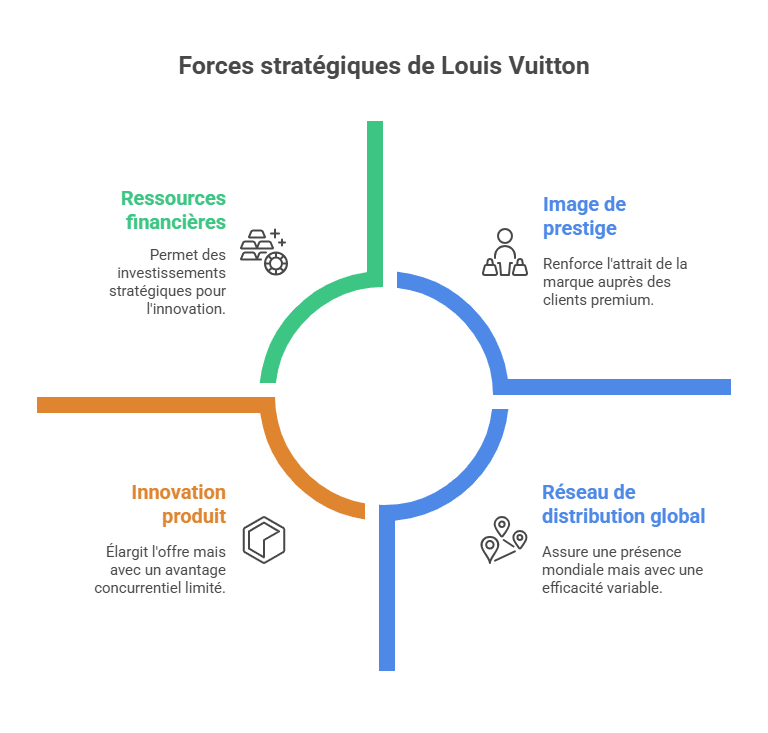
The major strengths in Louis Vuitton’s SWOT analysis in 2025
In the highly dynamic competitive landscape of luxury, Louis Vuitton has held a prominent position for over 15 years. With a heritage dating back to 1834, the company is today a strategic pillar of the LVMH group, the world leader in luxury products. Its turnover has increased fivefold over about fifteen years, illustrating solid growth and remarkable market mastery.
Among its most outstanding assets are:
- 🌟 Unmatched international reputation, placing Louis Vuitton at the top of luxury brands alongside Chanel, Dior, and Hermès.
- 💰 Financial strength conferred by the power of the LVMH group, whose profits in 2004 already exceeded 2.3 billion euros. This strong foundation allows for significant investments in research, innovation, and advertising.
- 👜 Historic expertise in leather goods, where Louis Vuitton is considered a pioneer and an undisputed master.
- 🌍 Strong global presence, with over 1,700 stores across several continents, notably in Asia, where the luxury market growth is highly promising.
- 🔝 Ability to innovate, launching diverse ranges such as ready-to-wear, footwear, watches, and jewelry, which have enriched the offering while maintaining the brand’s exclusivity.
This overall overview demonstrates that Louis Vuitton benefits from a balanced combination of heritage and modernity, thereby reinforcing its high-end positioning.
| Strength 🔥 | Description | Strategic Impact |
|---|---|---|
| Prestigious image | Brand associated with exclusivity and quality, recognized worldwide. | Attracts and retains premium clientele. |
| Financial resources | Part of LVMH with strong investment capacity. | Enables innovation, advertising, and expansion. |
| Global distribution network | Over 1700 stores worldwide, strong presence in Asia. | Access to key markets and high visibility. |
| Product innovation | Expansion into ready-to-wear and accessories. | Broadens the offer and meets modern customer expectations. |

In summary, financial robustness, a prestigious brand image, and a constant capacity for innovation are the key drivers of Louis Vuitton’s sustainable success on the international stage. To deepen this analysis, it is also relevant to compare these strengths with the strategies adopted by houses such as Chanel, Dior, or Hermès.
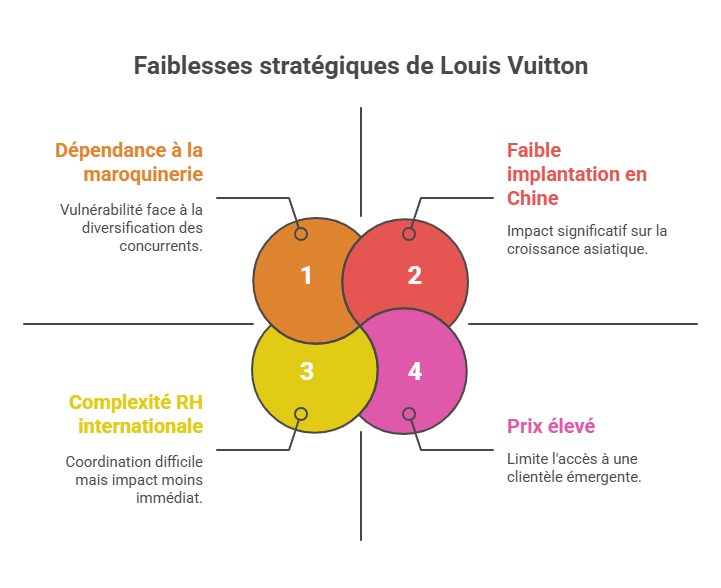
Detailed examination of internal weaknesses in Louis Vuitton’s strategy
Despite its many strengths, Louis Vuitton faces internal challenges that could limit its growth if they are not anticipated and addressed. A comprehensive SWOT analysis would not be complete without an honest evaluation of weaknesses that are often less visible to the general public.
Key weaknesses include:
- ⚠️ Difficulties in establishing a definitive foothold in certain Asian markets, particularly in China, where the brand has only about a dozen stores compared to around fifty in Japan. Problems related to location choices and store size hinder expansion.
- 📊 Heavy dependence on leather goods, which, although a historic segment, could hinder diversification necessary to confront rising competitors like Gucci and Balenciaga.
- 👥 Organizational challenges in managing international human resources, with over 60% of employees based outside France, complicating global coordination at times.
- 💸 Very high prices of products, which, while reinforcing exclusivity, limit access for younger or emerging customers, especially compared to brands like Prada or Fendi that sometimes better adapt their offerings.
The insufficient local presence in China highlights a strategic weakness that directly impacts growth potential in the Asian market, which is crucial for any luxury brand (source: Louis Vuitton presentation on Scribd). Addressing this requires a thorough reflection, such as forming local partnerships or revising concept stores.
| Weakness ❗ | Consequence | Recommended Action |
|---|---|---|
| Weak presence in China | Lack of presence in a lucrative market. | Strengthen partnerships, develop tailored stores. |
| Dependence on leather goods | Vulnerability to market changes. | Increase product diversification quickly. |
| International HR complexity | Risk of disorganization. | Optimize coordination, train local managers. |
| High prices | Limits access to certain customer segments. | Introduce accessible ranges without sacrificing prestige. |
Louis Vuitton’s ability to evolve in these areas will be decisive in maintaining its position amid rising competitors like Givenchy, Versace, and other innovative players (additional references on Marketing91).
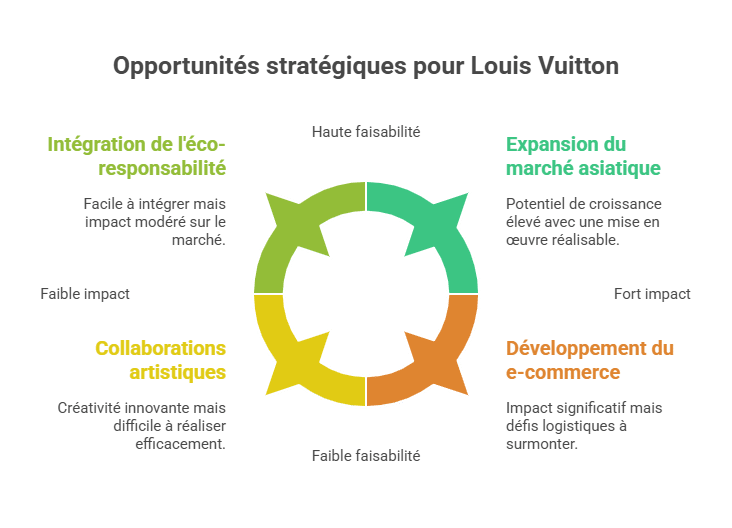
Analysis of strategic opportunities for Louis Vuitton in global markets
Louis Vuitton is well-positioned to seize numerous opportunities related to current economic, technological, and sociocultural developments. The SWOT analysis highlights several levers that could further boost growth and strengthen competitiveness.
The most promising opportunities for Louis Vuitton include:
- 🚀 The booming luxury market in Asia, especially in China where the middle-to-upper class is expanding rapidly, even though presence remains modest, offering enormous long-term potential.
- 🌿 The rising importance of eco-responsibility, which can be integrated into production and communication to reach increasingly conscious consumers.
- 🛍️ Development of high-end e-commerce, enabling the conquest of digital and global customers without physical store constraints.
- 🤝 Cross collaborations with artists, designers, or cutting-edge brands (such as fashion tech), injecting innovation and freshness into the range.
- 📈 Expansion into new product segments, such as jewelry, niche fragrances, or connected accessories, to diversify income sources.
The success of these initiatives has already been demonstrated through diversification initiated in the late 1990s, when Louis Vuitton added ready-to-wear lines, watches, and jewelry, following a reasoned expansion logic that seems sustainable against competitors like Chanel and Dior.
| Opportunity 💡 | Reason | Benefit for Vuitton |
|---|---|---|
| Growing Asian market | Expansion of wealthy classes. | Increased sales and recognition. |
| Eco-responsibility | Growing global trend. | Strengthening brand image and appeal. |
| E-commerce | Increased digitalization. | Global accessibility and new customers. |
| Artistic collaborations | Seeking innovation and exclusivity. | Creating buzz and fostering creativity. |
Fully leveraging these opportunities will allow Louis Vuitton to capitalize on its strengths while adapting to major environmental changes, as also detailed in a strategic management study available on this site.
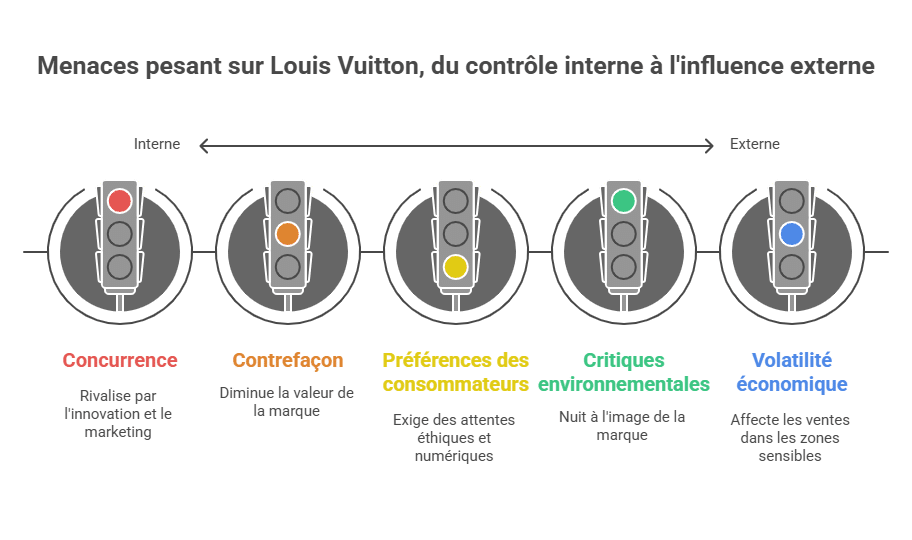
Precise identification of threats facing Louis Vuitton by 2025
In such a highly competitive luxury sector, constant vigilance regarding external threats is crucial to maintain a leadership position. Louis Vuitton must analyze and anticipate key risks that could hinder its future development.
The main threats facing the brand include:
- ⚔️ Increased competition from maisons such as Gucci, Prada, Fendi, and Balenciaga, which compete through innovation, impactful marketing campaigns, and constant renewal of their offers.
- 🌐 Volatility in international markets, often caused by geopolitical tensions or economic fluctuations impacting key areas like Asia or Europe.
- ♻️ Environmental and social criticisms increasingly directed at the luxury fashion industry, which can harm brand image if no responsible measures are taken.
- 📉 Piracy and counterfeiting that afflict the luxury sector, undermining the rarity and perceived value of Louis Vuitton products.
- 💬 Rapid changes in consumer preferences, notably with the rise of millennials and Gen Z, who have expectations related to ethics, trends, and digital engagement.
These threats call for very agile response strategies, where Louis Vuitton will need to combine innovation, proactive communication, and effective CSR policies, a theme also explored in several specialized articles (see for example ManagerOcean).
| Threat ⚠️ | Potential Impact | Strategic Response |
|---|---|---|
| Fierce competition | Loss of market share. | Strengthen innovation and product exclusivity. |
| Economic volatility | Drop in sales in sensitive zones. | Diversify geographically and financially. |
| Counterfeiting | Decrease in brand value. | Enhanced monitoring and legal actions. |
| Environmental criticisms | Damage to image. | Reinforced communication and genuine actions in CSR. |
Faced with these challenges, the company must closely monitor its environment and adapt quickly to maintain its leadership. This vigilance is especially important in a sector where brand image is as vital as product quality.
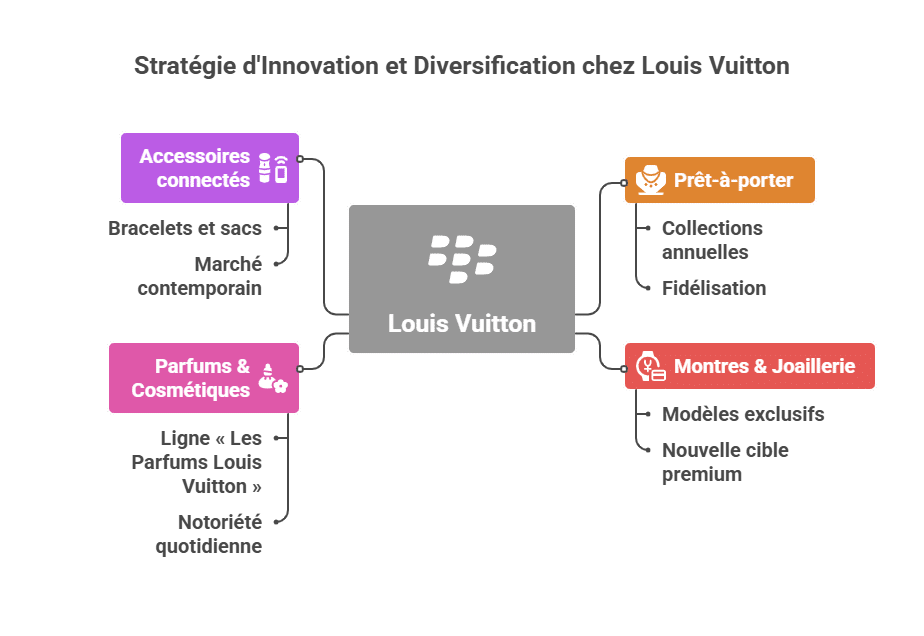
Louis Vuitton’s innovation and diversification strategy
The expansion of product lines has been a key strategy in Louis Vuitton’s recent history. Initially focused on leather goods, the brand has evolved into new segments, reflecting a commendable agility in the luxury universe.
The main axes of diversification include:
- 👠 Haute couture ready-to-wear, complementing luggage and bag offerings, targeting a loyal and discerning clientele.
- ⌚ Watches and jewelry, entry points for a segment seeking access to the brand through less imposing products.
- 💄 Fragrances and cosmetics, which provide excellent leverage to strengthen the image of accessible luxury used daily.
- 🛠️ Technology integration into certain products, especially via connected accessories, a promising niche only a powerful group like LVMH can manage.
This innovative approach is also reflected in artistic collaborations and capsule collections, energizing the brand while preserving its elitist character. For example, occasional partnerships with contemporary designers allow capturing the attention of a younger clientele, while recalling tradition through the exceptional quality of products.
| Type of diversification 🚀 | Concrete example | Strategic goal |
|---|---|---|
| Ready-to-wear | Annual clothing collections | Enhance loyalty and attractiveness |
| Watches & Jewelry | Exclusive mechanical watch models | Reach a new premium target |
| Fragrances & Cosmetics | “Les Parfums Louis Vuitton” line | Increase daily recognition |
| Connected accessories | Technology-integrated bracelets and bags | Innovate in the contemporary market |
For further details, the IIDE site also offers an interesting analysis of this diversification aspect within their SWOT analysis.

The challenges of internationalization and positioning of Louis Vuitton
One of Louis Vuitton’s key success pillars is undoubtedly its broad internationalization. More than 60% of employees are based abroad, and its extensive presence on multiple continents provides a clear competitive advantage. The differentiated expansion according to markets relies on detailed knowledge of local cultures and expectations, a vital element for a luxury brand.
Some key facts about this presence include:
- 🌏 Over 1,700 boutiques worldwide, concentrated in major capitals and economic hubs.
- 🏯 In Asia, Japan remains the most developed region, with about fifty stores, compared to only twelve in China, highlighting significant growth potential.
- 🇪🇺 In Europe and the U.S., presence is strong but highly competitive against historic rivals.
- 💼 The strategy also relies on points of sale in luxury hotels and popular tourist destinations, including less well-served areas.
This internationalization has a dual aspect: it allows Louis Vuitton to be at the heart of essential markets while managing logistical and cultural complexities. To better understand this dynamic, detailed studies like those available on Études et Analyses can be consulted.
| Geographical area 🌍 | Approximate number of boutiques | Main feature |
|---|---|---|
| Asia (Japan) | 50+ | Mature and well-established market |
| Asia (China) | 12 | Limited presence, significant potential to exploit |
| Europe | Several hundred | Historical and highly competitive market |
| The Americas (USA, Canada) | Hundreds | Strong tourist and local presence |

The brand image and its strategic importance at Louis Vuitton
The brand image is a crucial asset in the luxury industry, and for a house like Louis Vuitton, maintaining a strong symbolic capital is a central challenge. This positioning relies on several pillars:
- 🎨 Artisanal excellence and uncompromising quality of materials and finishes.
- 📸 Controlled communication that highlights the exclusive universe and historical storytelling.
- 🏆 Partnerships with celebrities and influencers that enhance visibility and desirability.
- 🌟 Consistency between collections, boutiques, and services offered.
- 💡 Original advertising campaigns based on striking visuals and well-crafted narratives.
This brand image is also tested by market issues, where the risk of luxury erosion by the “mass market” remains a constant concern. The house must therefore continuously balance belonging to an ultra-exclusive segment with subtle democratization, especially through digital channels.
| Brand Attribute 🌟 | Key Element | Positioning Effect |
|---|---|---|
| Artisanal quality | Historical craftsmanship | Maintains customer loyalty |
| Storytelling | Heritage and tradition | Diversifies brand capital |
| Communication | Advertising and influencers | Increases global visibility |
| Store experience | Luxurious ambiance and service | Enhances desirability |
It is useful to consult comparative analyses for a better understanding of this key dimension, especially on platforms such as SWOT and PESTLE Analysis.
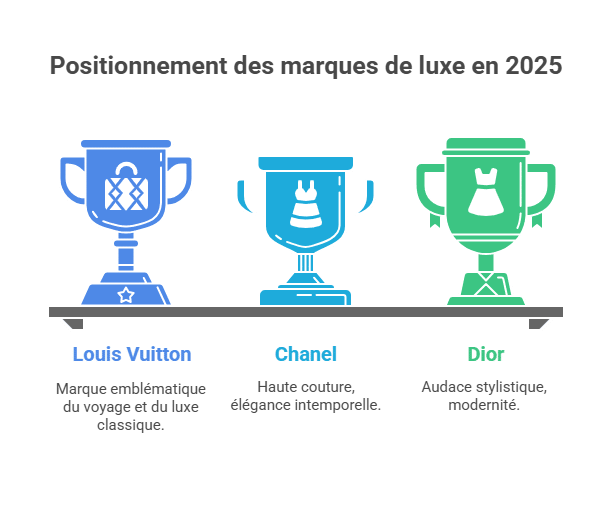
Competitive positioning of Louis Vuitton compared to other luxury brands in 2025
In a universe shared with giants such as Chanel, Dior, Gucci, and Versace, Louis Vuitton must continuously refine its strategy to stay ahead. Each house has its specificities: Chanel is renowned for its couture expertise, Dior for its stylistic daring, Gucci for its trendy contemporary style, while Louis Vuitton plays on its classicism, updated with modernity.
This delicate balance between tradition and innovation is the strength of the house. It manages to capitalize on a prestigious history while offering new products that meet current consumer expectations. This positioning is also expressed through precise market segmentation to adapt offerings to the different needs of clients worldwide.
| Luxury House | Key Positioning | Main Strategy |
|---|---|---|
| Louis Vuitton | Iconic brand of travel and classic luxury | Cautious innovation and diversification |
| Chanel | Haute couture, timeless elegance | Strong artistic presence and fashion innovations |
| Dior | Stylistic boldness, modernity | Constant collection renewal |
| Gucci | Luxe and avant-garde | Young and digital marketing |
For those interested in a comprehensive analysis, SWOT Wizard offers detailed insights that enrich this competitive overview.



Frequently Asked Questions about Louis Vuitton’s SWOT analysis
- ❓ What are Louis Vuitton’s main strengths in its sector?
Its worldwide reputation, strong investment capacity via LVMH, historical expertise in leather goods, and significant international presence. - ❓ What internal challenges hinder Louis Vuitton?
Limited presence in China, heavy dependence on leather goods, and complexities in managing international human resources. - ❓ What opportunity segments can be exploited?
The expanding Asian market, the development of eco-luxury, digitalization, and launching new lines such as jewelry and connected accessories. - ❓ How does Louis Vuitton face competition?
By combining tradition and innovation, through collaborations and cautious diversification to meet the diverse market expectations. - ❓ What is the importance of brand image for the house?
It is crucial, based on artisanal excellence, powerful storytelling, and controlled communication to ensure desirability and loyalty.
📊 Analyses SWOT similaires
📊 Voir aussi : notre hub centralisé de toutes les analyses SWOT & PESTEL (206 études) classées par secteur — Tech, Auto, Mode, Distribution, Finance.
Tu prépares le BTS Assurance ?
Cette analyse SWOT fait partie des thèmes abordés dans les épreuves. Notre E-book de révision couvre l'intégralité du programme en fiches claires et synthétiques.
- 100 % du programme BTS Assurance
- Fiches 1ère et 2ème année
- Créé par un diplômé
- Téléchargement immédiat

Entraîne-toi avec nos Quiz de révision
Fini les lectures passives. Pour retenir les notions clés du BTS Assurance, teste-toi ! Inscris-toi pour recevoir 1 quiz par jour directement dans ta boîte mail.


