


Summary
| Section Title | Description |
|---|---|
| 📜 Introduction: What is fire communication responsibility? | Describes the insured’s duty to promptly inform their insurer of any fire incident affecting covered property. This duty is crucial to activate coverage and obtain compensation for damages. Failure to comply may result in denial of coverage. |
| ❓ Importance of complying with fire communication obligations | Highlights the necessity of adhering to fire communication obligations to fulfill contractual terms, enable accurate damage assessments by insurers, and avoid financial losses and legal disputes. |
| 🚨 Main obligations regarding fire communication | Discusses the installation and maintenance of fire alarm systems, mandatory training for building occupants on using these systems, routine checks to ensure system functionality, and developing emergency evacuation plans. |
| 🔥 Consequences of non-compliance with obligations | Details severe consequences of failing to meet fire communication obligations, including risks to occupant safety and potential legal actions against responsible parties. |
| ⚖️ Civil and criminal liability in case of fire damages | Explains legal repercussions for damages or injuries caused by fires, including civil responsibility for compensation and potential criminal penalties for negligence. |
| 📏 Regulations and technical standards | Provides an overview of specific French standards (NF EN ISO 7010, NF S 61-933, NF S 61-970) governing fire safety signage and the installation and maintenance of fire detection systems. |
| 📜 Laws related to fire communication | Lists key legislative texts such as Civil Code and Labor Code articles that define legal responsibilities concerning fire safety in various establishments. |
Within the framework of fire risk management in buildings, fire communication responsibility plays a crucial role. This article explores in detail this duty, which requires insured parties to promptly notify their insurer in case of a fire affecting covered property. It highlights legal obligations, related technical standards, and consequences of failing to meet these duties. The goal is to emphasize the importance of these practices not only for compliance with insurance contracts but also for the overall safety of building occupants.
What is fire communication responsibility?
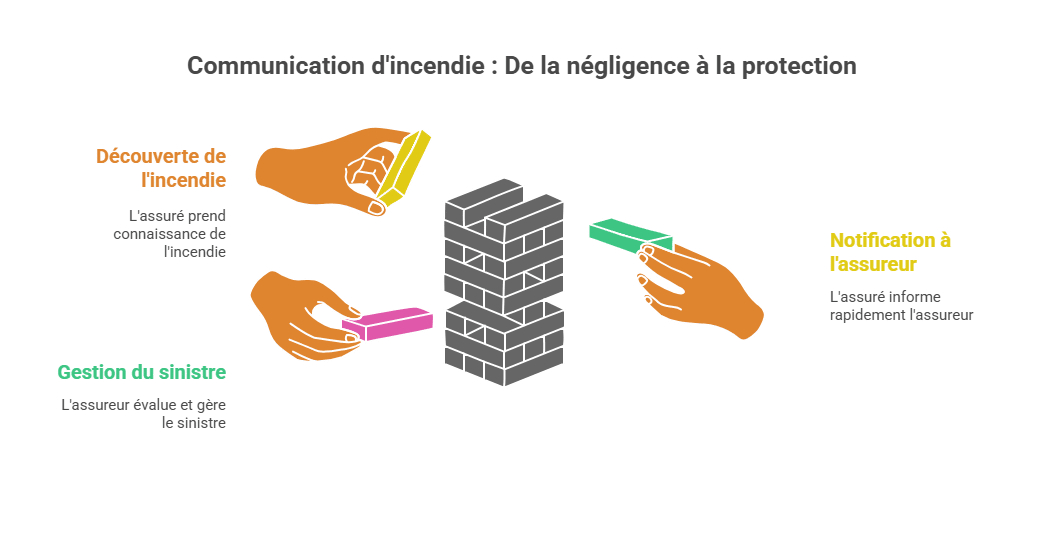
The Fire Communication Responsibility refers to the insured’s obligation to quickly inform their insurer of any fire damage occurring to insured property. Fire communication is an obligation specified in the fire insurance contract, and it is essential to enable the insurer to implement the coverage and protections provided by the contract. The fire communication responsibility requires that the insured notify their insurer as soon as they become aware of a fire on the insured property, so that the insurer can take necessary measures to handle the loss and compensate victims. If the insured does not communicate the fire within the prescribed deadlines, their right to compensation for fire-related damages may be denied.

Focus on declaration timelines
In insurance matters, declaration deadlines are non-negotiable:
-
Insurance Code – Article L.113-2: the insured must inform their insurer within 5 working days of becoming aware of the incident.
-
Specific contracts: some insurers impose even shorter deadlines for professionals, sometimes just 48 hours.
Consequences of missing deadlines:
-
Denial of compensation if the delay causes prejudice to the insurer (e.g., damage aggravation due to lack of rapid intervention).
-
Reduced indemnities proportionally to the severity of the delay.
-
Risk of contract termination for breach of contractual obligations.
➡️ That’s why every insured should know in advance the deadlines specified in their contract and set up an internal emergency communication plan in case of fire.
Why is it important to adhere to fire communication obligations?
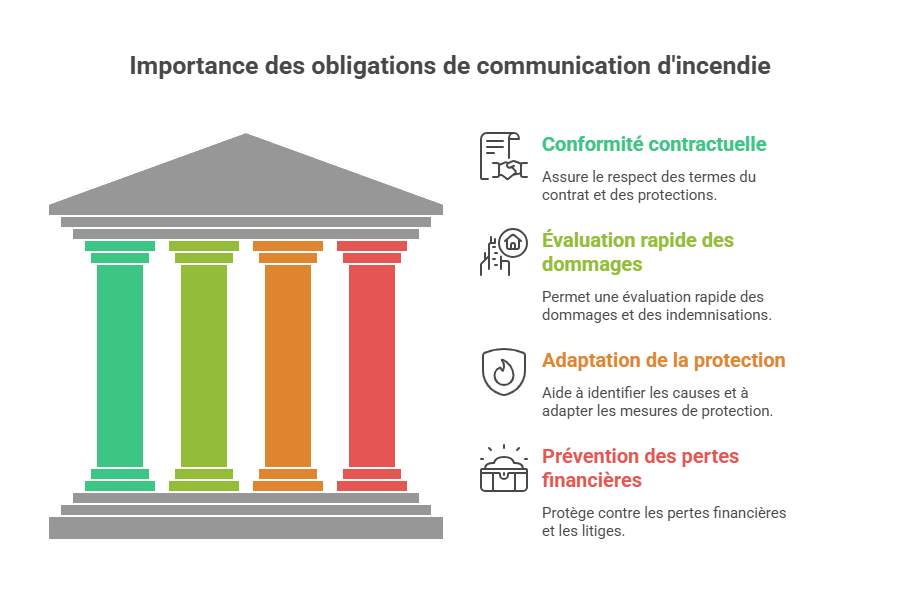
Respecting these fire communication obligations is crucial for several reasons. Firstly, it ensures compliance with the contract terms and allows beneficiaries to benefit from the protections and guarantees offered. In case of a claim, prompt notification enables the insurer to assess damages and process necessary indemnities. Additionally, it helps identify the causes of the fire and adjust protections accordingly. Finally, effective communication protects against significant financial losses and prevents disputes between the insured and the insurer.

Main obligations regarding fire communication
Installation of a fire alarm system
A fire alarm system must be installed in all buildings to ensure the safety of all present. The responsibility for fire communication lies with the entity managing the building, whether the owner, manager, or any other responsible person for fire safety.
When installing a fire alarm system, adhering to local standards and regulations is essential. It is also crucial to ensure that the system is correctly installed and maintained to guarantee its proper functioning in case of fire. Engaging a qualified professional for installation is recommended.
Training occupants to use the fire alarm system
Training those present in the building or establishment on how to operate the fire alarm system allows them to know how to react in case of fire and take the necessary measures to ensure their safety and that of others.
Training should include information about the different types of fire alarm systems, evacuation procedures in case of fire, and measures to prevent fires. Raising awareness among people about fire hazards and showing them how to use safety equipment such as extinguishers and fire blankets is also essential.
Planning regular evacuation drills helps ensure that occupants are well informed and prepared to respond in case of fire. These drills can also identify potential issues in evacuation procedures and allow improvements for everyone’s safety.
Regular verification of the proper functioning of the fire alarm system
Regularly checking the proper operation of the fire alarm system ensures it functions correctly during a fire. Conducting periodic tests, inspecting equipment condition, and taking measures to maintain the system in good condition are essential.
Engaging a qualified professional for these checks is advisable. The professional performs comprehensive tests to ensure proper operation and can advise on measures to keep the system in good working condition.
Keeping documentation related to the fire alarm system, such as manuals and maintenance records, allows maintenance personnel to know how to proceed in case of problems, ensuring proper system upkeep.
Modern tools and technologies
Technology is revolutionizing fire communication:
-
Connected detectors (IoT): linked to mobile applications, they alert the manager, insurer, and sometimes directly firefighters instantly.
-
Dedicated applications: some insurance companies offer apps that allow fire reporting in just a few clicks with photos.
-
Integrated systems in smart buildings: sensors connected to artificial intelligence capable of detecting electrical or thermal anomalies before a fire starts.
➡️ These tools modernize fire safety and speed up insurance procedures.
Implementation of an evacuation plan in case of fire
Setting up an evacuation plan in case of fire ensures the safety of people present in the building or establishment. The evacuation plan should include information on different evacuation routes, measures for evacuating people with disabilities or those unable to move on their own, and procedures to call emergency services.
Raising occupant awareness about the evacuation plan is vital. This can be achieved through regular evacuation drills, displaying the evacuation plan in highly visible locations, and providing clear instructions on the procedures to follow during a fire.
Regularly updating the evacuation plan helps account for changes in building or facility layout, procedural modifications, and new fire safety standards and regulations.

Consequences of non-compliance with fire communication obligations
Failure to meet fire communication obligations can have serious consequences, especially concerning the safety of people in the building or establishment. Non-compliance can lead to occupants not being informed quickly and efficiently in case of fire, which may cause delays in evacuation and endanger their lives.
Failure to adhere to fire communication obligations may also result in legal proceedings against the responsible entity managing the building or establishment. This can lead to fines and imprisonment for those responsible.
Practical insurance aspects
When a fire occurs, the insured must follow a specific procedure to ensure their compensation:
-
Claim notification
-
Sending a registered letter with acknowledgment of receipt or declaration via the online customer area.
-
The declaration must mention the date, location, circumstances, and estimated extent of damages.
-
-
Providing proof
-
Photos and videos of damages.
-
Firefighters’ report.
-
Invoices or proof of value for destroyed property.
-
Testimonials, if any.
-
-
Expert visit
-
The insurer appoints an expert to assess the cause and cost of damages.
-
The insured must cooperate: provide keys, explain circumstances, answer questions.
-
➡️ The more complete the file, the faster the compensation.
An incomplete file causes delays and even disputes.

Case studies and real-life examples
Practical cases are essential to illustrate fire communication obligations. They help understand how laws and insurance contracts apply concretely.
-
Negative case: delayed declaration
A shopkeeper experienced a fire in their store and waited over 15 days before notifying their insurer. Result: the insurer refused compensation because the legal deadline of 5 working days specified by the Insurance Code was not met. Not only did they lose their right to compensation, but they also faced the permanent closure of their business due to financial difficulties. -
Positive case: prompt response rewarded
An individual immediately reported a fire that destroyed their garage to their insurer. Within 24 hours, an expert was commissioned. Thanks to quick declaration and submission of photos, invoices, and the firefighter’s report, the compensation was approved in less than three weeks. This allowed the insured to rebuild quickly and avoid lasting damage.
➡️ These examples show that quick communication plays a decisive role in financial protection and reconstruction after a fire.

Civil liability in case of damages caused to persons by fire
In case of damages caused to persons by a fire, the responsible entity managing the building or establishment can be held liable under civil law. Civil liability is the obligation for a person or entity to repair damages caused to another, whether material or immaterial.
If a person sustains damages (physical, material, or immaterial) caused by a fire in a building or establishment, they can file a civil liability claim against the responsible entity. This action aims to obtain compensation for the damages suffered.
It is important to note that civil liability can be engaged not only for damages caused to persons but also for damages to property. If a fire damages belongings (furniture, equipment, etc.) owned by a person, they can also file a civil liability action to seek restitution.
Punitive liability in case of injuries or deaths resulting from fire
In case of injuries or deaths due to a fire, the responsible entity managing the building or establishment may face criminal liability. Criminal liability involves an obligation for a person or entity to answer for their acts before criminal justice, which can lead to fines or imprisonment.
If a person suffers injuries or dies due to a fire in a building or establishment, criminal liability action may be initiated against the responsible party. This can be brought by public authorities or by victims (or their relatives) in a civil liability action.
It is important to note that criminal liability can be engaged not only for injuries or deaths but also for damages to the environment or public property. If a fire causes damage to the environment or public assets, criminal proceedings may be initiated against the responsible entity.
Prevention/Proactive Insurance Approach
Fire communication is not only a legal obligation but also a proactive risk management approach.
-
For businesses: having a rapid communication plan helps reduce economic losses and ensures a quick recovery after an incident.
-
For insurers: an insured implementing safety procedures is perceived as less risky, which can lead to premium reductions.
-
For the community: effective communication prevents fire spread to neighboring buildings, protecting other people and property.
➡️ Insured parties gain credibility and trust with their insurer when adopting a preventative and transparent approach.

Administrative penalties in case of inspections by competent authorities
During inspections by relevant authorities, the responsible entity managing the building or establishment may face administrative penalties if fire safety standards and regulations are not met. Administrative penalties are sanctions imposed by public authorities to penalize violations of applicable rules.
Penalties can vary depending on the nature and severity of the breach. They may range from a simple fine to temporary or permanent bans on operation, including the closure of an establishment or a formal notice to implement corrective measures.
Adhering to fire safety standards and regulations helps avoid administrative penalties. This involves installing an adequate fire alarm system, training occupants on its use, and regularly checking that the system is operational.

How to ensure the fire safety of your building or establishment?
Choosing an appropriate fire alarm system suited to your needs and building or establishment configuration
Configure your building or establishment to ensure the safety of the people inside. Several types of fire alarm systems are available, which can be adapted to different situations and configurations.
When selecting an appropriate fire alarm system, several factors must be considered:
- The layout and size of your building or establishment: this will help determine the number and placement of smoke detectors and alarms needed to cover all areas.
- The equipment and materials used in the building or establishment: some equipment or materials can produce smoke or vapors that may interfere with smoke detectors operation. It’s important to consider this when choosing detectors suited to these conditions.
Training all occupants in the use of the fire alarm system
All individuals present in the building or establishment must be familiar with the fire alarm system and know how to operate it during an emergency. This includes understanding different alarm types and signals, as well as procedures to follow during a fire. Ensuring personnel receive adequate training on how to respond and use safety equipment like extinguishers and emergency exits is crucial. In a fire situation, every second counts, so everyone must be prepared to react quickly and efficiently.
Regularly inspecting your equipment
Routine inspections of fire prevention and suppression systems are essential. This includes checking smoke detectors, alarms, extinguishers and emergency exits. Confirming that these installations are in good working order and compliant with current standards is vital. Any anomalies or defects should be repaired immediately to ensure occupant safety. During a fire, these systems can mean the difference between life and death.
Regulations and Technical Standards
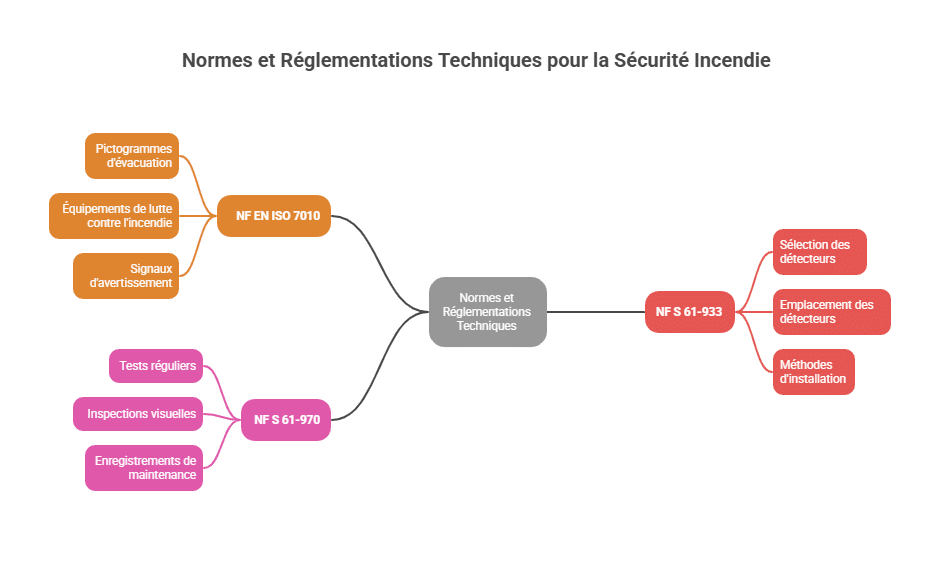
Technical standards and regulations play a key role in fire prevention and management within buildings. In France, two sets of standards are particularly relevant: NF EN ISO 7010 and NF S 61-933 and NF S 61-970.
NF EN ISO 7010 standard
The NF EN ISO 7010 standard specifies graphical symbols for safety instructions, including those related to fire, to be displayed in buildings. Its aim is to ensure universal understanding and immediate recognition of safety symbols regardless of language. Main symbols include:
- Evacuation pictograms (directional arrows, emergency exits)
- Fire fighting equipment signals (extinguishers, fire hoses)
- Warning signals (fire hazard, no smoking)
These symbols must be clearly visible and meet strict criteria for color, shape, and pictograms to ensure quick and effective identification during emergencies.
Standards NF S 61-933 and NF S 61-970
The standards NF S 61-933 and NF S 61-970 concern the installation and maintenance of fire detection systems in France:
- NF S 61-933: This standard covers requirements for designing and installing fire detection systems. It addresses technical aspects to ensure effectiveness and reliability, including detector selection, placement, and installation methods.
- NF S 61-970: Focuses on maintenance of fire detection systems. It defines procedures for checks and upkeep to ensure systems remain operational. Regular testing, visual inspections, and maintenance record keeping are governed by this standard.
International comparison
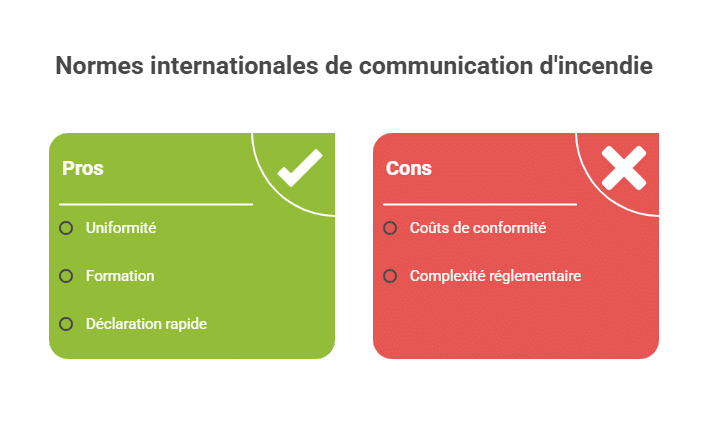
Fire communication is not limited to France: it is regulated worldwide.
-
European Union:
-
The EN 54 standards harmonize the design and installation of fire detection systems.
-
Goal: ensure uniformity of devices across member countries.
-
-
United States:
-
The NFPA (National Fire Protection Association) establishes strict standards, including NFPA 72 on fire alarm systems.
-
Companies are required to train their personnel and report any incidents immediately to insurers and local authorities.
-
-
Canada:
-
The National Fire Prevention Code (NFPC) mandates standardized evacuation plans and quick reporting to insurers.
-
➡️ This comparison shows that France aligns with an international logic where quick response and prevention are shared standards.

Legal texts related to fire communication
Civil Code
- Article 1242 paragraph 2: This article states that liability for things in one’s custody is engaged in case of fire transmission between neighboring buildings. It is not necessary to prove fault; demonstrating that the property contributed to the fire’s spread is sufficient.
Labor Code
- Articles R. 4216-2 to R. 4216-2-3: These articles impose obligations on employers regarding fire safety, including implementing deferred evacuation devices for disabled persons.
- Articles R. 4227-37 to R. 4227-39: These articles define fire safety instructions, including the names of responsible persons for safety equipment and evacuation personnel.
- Article R. 4227-13: Requires employers to ensure employee safety concerning fire safety, including training.
Environmental Code
- Book V, Title I: Governs classified installations for environmental protection (ICPE), including specific preventive measures against fires in these facilities.
Regulations for Public Access Buildings (ERP)
- June 25, 1980 order: Approves general provisions of fire and panic safety regulations in ERP, including measures such as building layout, structural features, exits, and firefighting means.
High-Rise Buildings (IGH) Regulations
- December 30, 2011 order: Sets safety rules for constructing high-rise buildings and protecting them against fire and panic risks, with specific measures adapted to their characteristics.
Residential Buildings
- January 31, 1986 order: Concerns fire protection in residential buildings, defining measures to prevent and manage fires in residences.
Conclusion
Fire communication responsibility is not merely a formal obligation but an essential condition for ensuring people’s safety and guaranteeing coverage by insurance. Quickly reporting an incident, respecting legal deadlines, maintaining alert devices, and training occupants are actions that help limit fire consequences. Conversely, failure to do so can lead to civil, criminal, or administrative sanctions, as well as denial of compensation.
In summary, effective fire communication is key to protecting property, loved ones, and fulfilling one’s responsibilities.
Frequently Asked Questions:
-
How much time do you have to declare a fire?
→ Up to 5 working days, unless specified otherwise in the contract. -
Should I report a small fire with little damage?
→ Yes, even if damages seem minor, as they may reveal structural issues. -
What are the risks of late declaration?
→ Reduced or denied compensation, or even contract termination. -
Difference between civil and criminal liability?
→ Civil liability aims to compensate victims, while criminal liability punishes serious fault (fines, imprisonment). -
Can I report a claim online?
→ Yes, most insurers allow online declaration or via mobile apps.


For further information

Entraîne-toi avec nos Quiz de révision
Fini les lectures passives. Pour retenir les notions clés du BTS Assurance, teste-toi ! Inscris-toi pour recevoir 1 quiz par jour directement dans ta boîte mail.


