Summary
| 📌 Section | 📖 Main Content Summary |
|---|---|
| 💶 Introduction | Ink stains on banknotes can have various origins. Some are harmless, others related to security devices activated during theft. Understanding their nature helps prevent mistakes and payment refusals. |
| 🧾 The nature of ink stains on a banknote | Stains can come from a pen, an anti-theft device or an accident. Bright colors (violet, red, green) are typical of security inks used to signal stolen banknotes. |
| 🏛️ History and evolution of security ink devices | Since the 1990s, central banks have developed indelible and traceable inks to prevent reuse of stolen banknotes and enhance monetary security. |
| ⚖️ Impact of ink stains on banknote validity | A pen-stained banknote remains valid, but a banknote marked with security ink must be exchanged at a bank. The law protects the nominal value as long as more than 50% of the banknote is identifiable. |
| 🏦 Procedures for exchanging a stained or damaged banknote | The holder must go to their bank or the Bank of France. An expertise can be carried out before the exchange, particularly if the note appears suspicious or heavily stained. |
| 🧍♂️ What to do if you receive a banknote stained with ink? | You should avoid reusing it and inform the bank. If the note comes from a ATM, keep the receipt to facilitate analysis. In case of doubt, the Bank of France conducts verification. |
| 🧩 Difference between accidental ink stains and security ink | Accidental ink comes from everyday use; security ink results from theft or break-in. Knowing how to distinguish them helps avoid judgment errors or bank refusals. |
| 💡 Risks of using a banknote stained with security ink | Using a note marked with bright ink can be considered concealed theft. The note risks confiscation or an investigation. It should be handed to the Bank of France. |
| 🛒 Impact of ink stains on note acceptance by merchants | Merchants may refuse a stained banknote as a precaution. Large stores generally accept light stains, while vivid inks raise suspicion. |
| 🧺 Prevention measures to avoid stains | Protect banknotes in a billholder, avoid liquids and inked objects, and not write on them — these simple actions help preserve their validity. |
| 🏢 Role of large French banks | Banks (BNP, LCL, Société Générale…) assist clients in exchanging damaged banknotes and guarantee the quality of the monetary supply in cooperation with the Bank of France. |
| 🏦 Role of the Bank of France | The Bank of France is responsible for verifying, replacing and destroying damaged banknotes. It trains professionals and raises public awareness about suspect inks detection. |
| 🧼 Common misconceptions about banknote cleaning | Home methods like vinegar, water or ironing are dangerous. They can erase markings and invalidate the banknote. It’s better to avoid attempting anything yourself. |
| 🧴 Cleaning techniques and advice | Only a light alcohol wipe can reduce a pen stain. However, security inks are indelible and require an official exchange at a bank. |
| ❓ FAQs on stained banknotes | A pen-stained note remains usable, but a security ink marked note must be exchanged. French banks and the Bank of France offer this service бесплатно. |
Banknotes are an integral part of our daily lives, but their frequent handling exposes them to all kinds of incidents: tears, wear… and especially ink stains. These marks, often harmless, can still raise doubts about the note’s validity or its legitimate origin.
In some cases, these stains come from a pen or marker, with no particular consequence. But in others, they are the result of a security device activated during a theft or break-in, making the note suspect in the eyes of banks and merchants.
Understanding the difference between accidental stain and security ink is therefore essential to avoid surprises during payment or deposit. The Bank of France and major French banks strictly regulate these situations to maintain trust in physical currency.
This article explains everything you need to know about stained banknotes: their validity, exchange procedures, legal risks, prevention measures, and practical tips to identify usable banknotes.
Contents
- Can I pay with a pen-stained banknote?
Yes, a pen-stained banknote remains a valid payment method and retains its value. - What should I do if my banknote is marked with security ink?
It must be exchanged at the Bank of France as it is often linked to theft or break-in attempts. - Can I clean a stained banknote myself?
Some gentle methods exist, but they carry risks. It is advisable not to attempt cleaning to avoid damaging the note’s authenticity. - My merchant refuses a stained banknote, is this legal?
Merchants have the right to refuse a banknote, even if it is legal, but it is recommended to offer an exchange at a bank. - Which institutions exchange damaged banknotes?
The Bank of France and many French banks such as BNP Paribas, Crédit Agricole, Société Générale, LCL, CIC, or La Banque Postale provide this service.
- The nature of ink stains on a banknote
- Impact of ink stains on banknote validity: what the law says
- Procedures for exchanging a stained or damaged banknote with banks
- Difference between accidental ink stains and security ink
- Impact of ink stains on note acceptance by merchants
- Prevention measures to avoid stained banknotes
- The role of major French banks in managing damaged banknotes
- Techniques and advice for treating or cleaning ink stains on banknotes
- FAQs about stained banknotes and their use

The nature of ink stains on a banknote
Circulating banknotes pass through many hands and undergo daily use that can sometimes be harsh. The ink stains that may appear on these banknotes have several origins: pen ink traces, security ink projections, or marks left by anti-theft devices. Understanding the exact nature of these stains is essential to know if the banknote remains usable.
Most of the time, stains occur during normal handling, for example when a banknote comes into contact with a pen or marker. In most cases, this does not question the validity of the note. However, some stains, called security ones, are explicitly used by financial institutions to deter fraud.
These specific inks often appear in bright colors such as violet, green, blue, red, or black. They are anti-theft systems that activate during robberies of ATMs or armored cash transport trucks. In this case, banknotes are deliberately marked to make them immediately recognizable as stolen or suspected of theft.
Here are some common examples of ink stains you may encounter:
- Pen ink traces after signing a check or taking notes on the banknote
- Smudges from foam or colored liquid projected during break-ins (security ink)
- Accidental stains from contact with ink cartridges or mechanical printers
It is crucial to distinguish these causes to avoid unnecessarily discarding a banknote that may still be legally valid. Institutions like the Bank of France or major establishments such as Crédit Agricole and Société Générale provide detailed information for identification and possible replacement.

| Type of ink stain | Origin | Effect on note validity |
|---|---|---|
| Pen ink | Manual contact with a pen or marker | Note still valid |
| Security ink (bright color) | Anti-theft devices (ATMs, armored trucks) | Suspect note, exchange only possible at a bank |
| Accidental stains or dirt | Liquids, greases, or other substances | Can be used, exchange if too dirty |

History and evolution of security ink devices on banknotes
For several decades, monetary institutions have enhanced banknote security to combat fraud and theft. The emergence of security ink devices aligns with this effort to protect the monetary system. These special inks, used since the 1990s, are automatically projected onto banknotes during attempted thefts involving ATMs or cash transport trucks.
These inks are indelible, fluorescent, and highly detectable. They aim to render the banknote unusable and immediately signal that it comes from illegal activity. Over time, technology has evolved toward forms that are even more sophisticated, resistant to water, heat, and chemicals.
Today, the European Central Bank (ECB) and the Bank of France collaborate to ensure that each banknote marked with a security device is traceable, protecting consumers and the economic circuit.
| Period | Evolution of devices | Main goal |
|---|---|---|
| 1990s | Introduction of security inks in ATMs | Fight against theft |
| 2000s | Widespread use of indelible inks | Prevent reuse of stolen banknotes |
| 2010s | Chemical improvement and traceability | Quick identification of suspect notes |
| Today | Smart inks linked to detection systems | Enhance the security of the monetary circuit |
👉 In summary: these devices are not aimed at individuals but at criminals. A banknote marked with bright security ink is potentially a stolen item and must be submitted to the Bank of France for verification.

Impact of ink stains on banknote validity: what the law says
In theory, a banknote stained with ink remains monetary. It retains its face value even if it shows signs of wear or unintentional ink marks. The law does not automatically cancel a banknote simply because it is stained or partially damaged, unlike heavily torn or burned notes.
However, some businesses or merchants may decide not to accept a banknote that is stained as a precaution. This attitude, though contestable, is permitted by the merchant’s freedom of choice. The note remains a legal means of payment, but its acceptance may vary in practice depending on circumstances.
The regulations specify several fundamental points:
- A damaged, crumpled, ink-stained banknote retains its value.
- A banknote marked with security ink, related to theft or break-in attempts, must be reported and cannot be used normally.
- The holder of a damaged note can present it for exchange at a bank branch or directly at the Bank of France.
The main condition for obtaining an exchange is that the note must still be identifiable. More than half of the note must be intact to claim a replacement. In some cases, if less than half is available, a specific expertise is required, and the exchange can be partial.
Banks such as BNP Paribas, La Banque Postale, CIC, LCL or HSBC strictly follow these rules to guarantee monetary reliability while protecting the consumer who is sent to the Bank of France in case of more serious issues.
| Condition of the note | Validity for payment | Recommended actions |
|---|---|---|
| A torn note with more than 50% intact | Yes, payment possible | Use or exchange if possible |
| Pen ink stained note | Yes, payment possible | No special precautions necessary |
| Security ink marked note | No, payment refused | Exchange mandatory at the Bank of France |

Procedures for exchanging a stained or damaged banknote at banks
When a banknote is seriously damaged, stained, or marked with security inks, it is not advised to try to use it in everyday life. The proper procedure is to visit a bank branch or directly go to the Bank of France to exchange it for a new banknote.
The process is simple but regulated:
- Present yourself with the banknote at a bank branch (Crédit Agricole, Société Générale, LCL, etc.) or at the Bank of France.
- The staff verifies the authenticity of the note and its overall condition (more than 50% visible, no counterfeiting).
- An honor declaration is sometimes required, certifying that the deterioration was not intentional.
- A note judged authentic and sufficiently intact on the surface is exchanged for a new note.
- If there is doubt, the request is forwarded to the Bank of France for a thorough expertise, which may take several weeks.
This service is free and accessible to everyone. Traditional banks such as BNP Paribas, Banque Populaire, or ING often facilitate this operation for their clients, avoiding long procedures.
However, if the banknote is marked with security ink, it often indicates theft or potential fraud, which requires a special procedure where the Bank of France examines the case before any exchange.
| Step | Details | Approximate duration |
|---|---|---|
| Banknote submission | Initial check by the bank | A few minutes |
| Declaration of honor | Certifies the good faith of the holder | Immediate |
| Thorough examination | Possibly performed by the Bank of France | 2 to 3 weeks |
| Exchange | Replacement with a new banknote | Immediate or delayed depending on the case |

🧍♂️What to do if you receive a banknote stained with ink as payment?
Receiving a marked banknote can be distressing, especially if you are unaware of its origin. Fortunately, the procedure is simple and regulated.
-
Do not attempt to reuse it. The note could be confiscated.
-
Note the circumstances of obtainment. (commerce, ATM, private transaction, etc.)
-
Immediately notify your bank. They will conduct a verification without charge.
-
If the stain is suspicious (violet, green, red), contact the Bank of France or the nearest police station.
Banks have specific tools to analyze ink compositions and determine if they come from security devices.
👉 Example:
If an ATM gives you a banknote stained with ink, keep the withdrawal receipt. Banks can then verify the exact origin and proceed with the exchange without incident.
| Situation | Response to adopt | Reason |
|---|---|---|
| Banknote received from an individual | Inform the bank | Avoid the risk of concealed theft |
| Banknote from an ATM | Keep the receipt and contact the bank | Quick verification |
| Banknote received from a business | Notify the merchant and note the date | Easier traceability |

Difference between accidental ink stains and security ink
A key point to understanding the validity of a stained banknote is to distinguish between accidental ink and security ink. The former is often related to everyday use, while the latter is a voluntary measure to protect dispensers and transporters.
Security ink is a special dye projected in case of break-in or theft attempt. Its bright color and chemical composition prevent the note from re-entering the legal circuit without precise control. Thus, even if the banknote appears intact, its marking makes it suspicious.
Conversely, a pen trace, a pencil line, or even a non-security industrial ink mark do not invalidate the note. This usage is very common daily and does not prevent normal use of banknotes.
- Accidental ink: pen, marker, felt-tip pen, etc.
- Security ink: bright color (violet, red, green), associated with anti-theft devices
Banknotes marked with security ink are often located at the periphery or have a visible mark indicating to merchants and institutions that these banknotes are questionable or stolen. Hence, the importance of being vigilant not to confuse the types of stains.
For further information, you can consult official online resources such as the European Commission on damaged banknotes, which details these distinctions.

💡What are the legal risks of using a banknote stained with security ink?
Even if it is tempting to use a “similar” stained banknote, such a decision can have significant legal consequences.
Banknotes marked with security ink are considered stolen or compromised. Using them knowingly or unknowingly can be interpreted as an attempt at concealed theft or money laundering of stolen funds.
In practice:
-
Merchants or banks can refuse the note and alert authorities.
-
The holder must justify its origin (receipt from an individual, ATM, transaction, etc.).
-
The note will be transmitted to the Bank of France for expertise.
If the note is authentic but accidentally stained, it will be replaced. If it derives from theft, it will be confiscated without compensation.
| Type of stain | Risk incurred | Action to take |
|---|---|---|
| Pen ink | No risk | Useable banknote |
| Bright violet or red ink | Suspicion of theft | Notify the bank |
| Entirely stained banknote | Confiscation and investigation | Mandatory reporting |
💬 Good to Know: The Bank of France works closely with judicial police to identify trafficking circuits. If in doubt, never attempt to use the banknote and contact your bank.
Impact of ink stains on note acceptance by merchants
In practice, some merchants refuse a banknote with a stain even if it is legally valid. This refusal may stem from ignorance of the rules or fear of concealment theft.
A banknote marked with security ink is automatically suspected of theft, increasing merchant vigilance. But even a pen-ink stained banknote can sometimes be refused, especially in small shops or when the note’s aesthetic is compromised.
Here are some points explaining this phenomenon:
- The merchant has the right to accept or refuse cash as a payment method.
- Some prefer to avoid handling damaged notes due to perceived future risks.
- Large stores with modern systems (supermarkets, hypermarkets) accept affected notes without difficulty.
- Trust in the note’s authenticity may be questioned due to suspicious or colored stains.
In any case, if you face refusal, do not throw away the banknote. The proper move is to go to your usual bank, whether Banque Populaire, ING, or others, to proceed with an exchange if necessary.
Understanding issues and clearly communicating the legal status of banknotes often helps resolve conflicts.

Prevention measures to avoid stained banknotes
To minimize problems related to ink stains on banknotes, it is useful to adopt some simple rules to protect paper currency quality:
- Avoid signing or writing directly on banknotes unless necessary.
- Store banknotes carefully in a wallet or billholder designed to limit rubbing.
- Never place a damp or ink-stained banknote in your pockets.
- Be cautious of objects likely to project ink, especially around ATMs.
Institutions like Crédit Agricole or BNP Paribas also offer advice to preserve banknote integrity and thus reduce the frequency of notes needing exchange or destruction.
Public awareness is also key to reducing costs associated with withdrawing and replacing worn or stained banknotes.
| Advice | Benefit |
|---|---|
| Do not write on the banknote | Preserves value and acceptance |
| Use a billholder | Avoid rubbing and tears |
| Wipe your hands before handling | Reduces transfer of greasy or liquid substances |
| Avoid handling banknotes near colored inks | Prevents contamination |
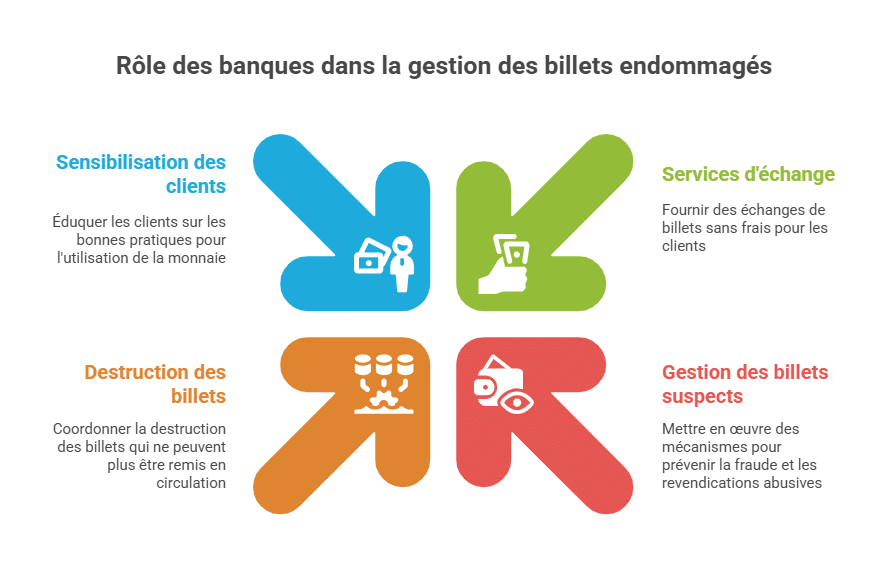
The role of major French banks in managing damaged banknotes
Each player in the French banking sector has a role in managing damaged or stained banknotes. Institutions such as the Bank of France, Crédit Agricole, Société Générale, or CIC implement procedures to ensure the renewal of banknotes in the economic circuit.
They offer exchange services sometimes free of charge, assisting clients on-site or via mail. Their efforts also extend to holders of suspect banknotes, with mechanisms to prevent fraud or abusive claims.
Furthermore, the Bank of France coordinates the destruction of banknotes that can no longer be circulated, ensuring the quality of the national monetary supply. Millions of damaged banknotes are exchanged or replaced annually to maintain confidence in physical currency.
Clients of major banks—HSBC, La Banque Postale, LCL, or ING—are encouraged to visit their nearest branch when holding suspicious or stained banknotes.
An important role of these actors is raising customer awareness of best practices, thus facilitating the secure and optimized use of physical money daily.

🏦 The role of the Bank of France in combating counterfeit banknotes
The Bank of France plays a central role in preserving monetary confidence. Every questionable or damaged banknote is transmitted for expertise, identification, and processing.
Its specialized service, located in Chamalières (Puy-de-Dôme), has cutting-edge technologies: chemical analysis of inks, UV and infrared detection, electron microscopy.
Each year, several million damaged banknotes are withdrawn from circulation, then shredded and recycled.
This system ensures:
-
Guaranteeing full traceability of damaged banknotes,
-
Preventing the circulation of stolen banknotes,
-
Maintaining citizens’ confidence in physical currency.
The Bank of France also acts preventively:
-
It trains merchants and bank agents to spot suspicious inks,
-
It publishes verification guides accessible to the general public,
-
It collaborates with the ECB to adapt security measures to new threats.
| Action by the Bank of France | Objective |
|---|---|
| Suspect banknote expertise | Determine ink composition |
| Valid banknote exchange | Ensure monetary fairness |
| Confiscation of stolen notes | Secure the financial system |
| Public awareness | Reduce fraud risks |

🧼 Common misconceptions about cleaning stained banknotes
The internet is filled with “miracle recipes” to remove ink stains from banknotes: alcohol, white vinegar, ironing, or even warm water baths. These methods are dangerous and ineffective.
Banknotes are printed with a special polymerized ink, sensitive to heat and solvents. Any cleaning attempt can damage the fibers of the paper, erase security micro-markings, and permanently invalidate the banknote.
Experts at the Bank of France advise against any chemical or mechanical manipulation. If the note is lightly stained (pen or marker), it’s better to do nothing and present it directly to the bank.
| Cleaning method | Expected result | Actual risk |
|---|---|---|
| Alcohol or vinegar | Partial removal of stain | Discoloration of banknote |
| Hot water + soap | Temporary visual cleaning | Leaning paper, fibers destroyed |
| Ironing | Visible smoothing | Mark erasure |
| No intervention | Unchanged appearance | Banknote preserved and valid |
🧠 Tip: Store stained banknotes flat, in a transparent sleeve, before handing them over to your bank.



Techniques and advice for treating or cleaning ink stains on banknotes
It may be tempting to try cleaning a stained banknote to restore its original appearance. However, this operation is delicate and poorly controlled, and could damage the banknote more or render it non-compliant.
Nevertheless, when the stain is caused by pen ink, some gentle methods exist:
- Dampen a cotton swab with 90° alcohol and gently dab the affected area, without vigorous scrubbing.
- Avoid using water or abrasive products that could alter the printed ink on the banknote.
- Test first on a small area to avoid visible risks
It is important to note that major banks such as La Banque Postale generally advise against attempting to clean banknotes oneself to avoid compromising their authenticity.
In the case of a banknote marked with security ink, no homemade technique will remove the stain without making the note suspicious or unusable. In such cases, the best solution is to proceed with an exchange.
| Method | Benefits | Risks |
|---|---|---|
| Dab with 90° alcohol | Can remove some light stains | May damage the banknote if applied improperly |
| Washing with water | Simple but ineffective | Risk of deterioration and discoloration |
| No intervention | Preserves the banknote intact | The note remains usable unless in extreme cases |
FAQs: Common questions about ink-stained banknotes
Yes, a pen-stained banknote remains a valid payment method and retains its value.
It must be exchanged at the Bank of France as it is often linked to theft or break-in attempts.
Some gentle methods exist, but they carry risks. It is advisable not to attempt cleaning to avoid damaging the note’s authenticity.
Merchants have the right to refuse a banknote, even if it is legal, but it is recommended to offer an exchange at a bank.
The Bank of France and many French banks such as BNP Paribas, Crédit Agricole, Société Générale, LCL, CIC, or La Banque Postale provide this service.

Entraîne-toi avec nos Quiz de révision
Fini les lectures passives. Pour retenir les notions clés du BTS Assurance, teste-toi ! Inscris-toi pour recevoir 1 quiz par jour directement dans ta boîte mail.