What is a false medical certificate?
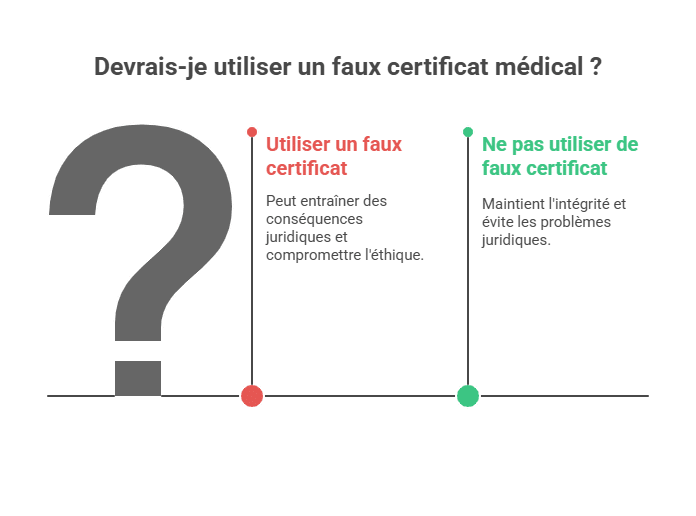
A false medical certificate is a document that imitates or alters an authentic attestation issued by a healthcare professional, such as a doctor, dentist, or any other accredited practitioner. This type of certificate is designed to simulate a medical situation, often to bypass obligations or obtain benefits to which the individual is not entitled. While it may seem harmless at first glance, producing or using a false medical certificate constitutes a illegal act with serious legal consequences.
Common forms of false medical certificates
False medical certificates can take various forms, including:
- Alteration of an authentic document: Changing details on a legitimate medical certificate, such as dates or information provided.
- Complete fabrication of a fake document: Creating a false certificate using image editing software or reproducing doctor’s stamps and signatures.
- Certificate of convenience: Issued by a doctor but not reflecting a real medical situation, often under pressure or at the patient’s request.
These practices are not only unethical; they also compromise the reliability of medical institutions and the rights of other individuals.
Most frequent uses
A false medical certificate is often used to:
- Justify an absence from work or school.
- Escape obligations in sports, such as avoiding mandatory medical examinations.
- Obtain compensation or social benefits.
- Falsify health status to access certain rights or avoid administrative constraints.
Why is it considered a serious offense?
The production or use of a false medical certificate counts as falsification and use of false, as defined by Article 441-1 of the Penal Code. This offense is taken very seriously because it:
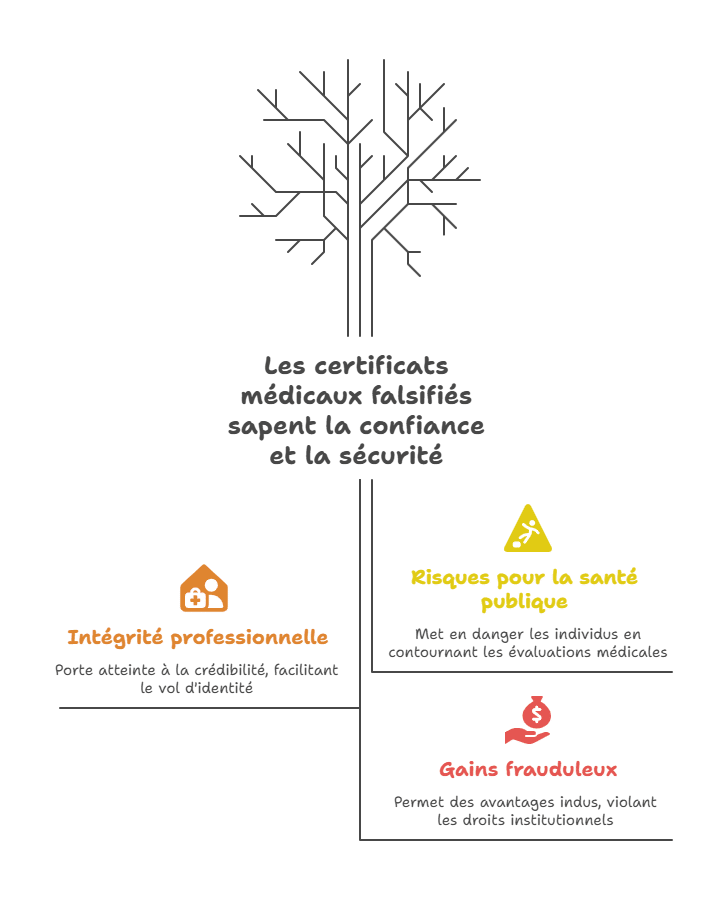
- Distorts the truth of facts presented to an official or private entity.
- Can pose risks to health and safety in case of accidents or lack of proper medical follow-up.
- Undermines the integrity of healthcare professionals, whose identity or seal may be usurped.
Ethical and social issues
Beyond legality, the use of a fake medical certificate raises major ethical questions. In deceiving institutions or employers, it can:
- Harm trust in healthcare professionals and honest patients.
- Create inequalities by benefiting from undue resources or advantages.
- Increase the workload of agencies responsible for verifying document authenticity.

Why is a medical certificate required?
The medical certificate plays a crucial role in many everyday life domains, ensuring individual safety and transparency in administrative procedures. Issued by a healthcare professional, it attests to a person’s health status and provides reliable information about their physical or mental capacities. Here are the main contexts in which a medical certificate is required, along with its specific role:
| Domain | Role of the medical certificate |
|---|---|
| Work life | Justify an illness absence or a work stoppage. |
| Sports practice | Verify physical fitness before a competition or risky activity. |
| Educational institutions | Report allergies, contagious diseases, or inability to participate in certain activities. |
A tool for transparency and responsibility
These certificates guarantee administrative transparency by providing legitimate medical proof that protects both the applicant and the relevant institutions. They particularly allow to:
- Avoid abuse: Ensuring that an absence or fitness is based on a real medical evaluation.
- Prevent risks: In sports or school settings, they assess potential contraindications and reduce dangers related to certain activities.
- Protect legal responsibilities: In case of an accident or dispute, the medical certificate is a key document to determine liabilities.
Some obligations related to the medical certificate
- In professional life:
- Employers may require a medical certificate to justify a prolonged sick leave.
- After a work-related accident, it helps define unfitness or resumption of activity under certain conditions.
- In sports:
- Sports federations require a certificate to ensure the practitioner has no medical contraindications.
- For some high-risk sports (diving, rugby, mountaineering), an in-depth medical exam is necessary each year.
- In schools:
- School institutions require a certificate to report contagious diseases, justify a sports exemption, or inform about an allergy requiring special vigilance.
An evolving requirement
The validity period and requirements for medical certificates have changed over the years to adapt to modern needs. For example:
- In sports, the validity of a medical certificate is now 3 years for licenses, subject to an annual health questionnaire.
- Certain certificates can be obtained via teleconsultations, simplifying procedures for situations not requiring a detailed physical examination.
History of the medical certificate in France
The medical certificate is not a recent invention. Its use in France dates back to the 19th century, when public authorities began requiring written proof of individuals’ health status, especially to fight epidemics. In the 1950s, it gradually became mandatory in the school and sports sectors to protect children and athletes. More recently, legislative reforms have relaxed certain rules, such as the three-year validity for sports licenses, subject to an annual health questionnaire. This historical evolution shows that the certificate has always been regarded as a tool for prevention, but also as a means of social organization.

Legal risks associated with a false medical certificate
Using or producing a false medical certificate constitutes a serious offense under French law. According to article 441-1 of the Penal Code, these acts fall under the offense of forgery and use of fake, with severe penal sanctions. Here is an overview of the types of offenses and legal penalties involved:
| Type of offense | Legal penalty |
|---|---|
| Manufacture of fake | Up to 3 years imprisonment and €45,000 fine. |
| Use of fake | Similar penalties to manufacturing. |
| Impersonation | Additional sanctions for medical fraud. |
These penalties clearly show the severity of consequences for anyone involved in forging or using medical certificates.
Why are these sanctions so strict?
The significant penalties laid out by law reflect several critical issues:
- Protection of public health:
- A false medical certificate can lead to dangerous situations, especially in sports or workplace contexts.
- It compromises individual safety by enabling risky activities without proper medical assessment.
- Maintaining integrity of healthcare professionals:
- Forgery damages the credibility of doctors and other practitioners.
- It can lead to impersonation, with serious consequences for the professionals involved.
- Fight against fraud:
- Fake certificates can be used to obtain undue benefits (compensation, prolonged absences, etc.).
- This infringes on the rights of employers, sports federations, and institutions.
Impacts on employers and institutions
Companies, sports federations, or schools are often the first victims of false medical certificates. Here are the possible impacts:
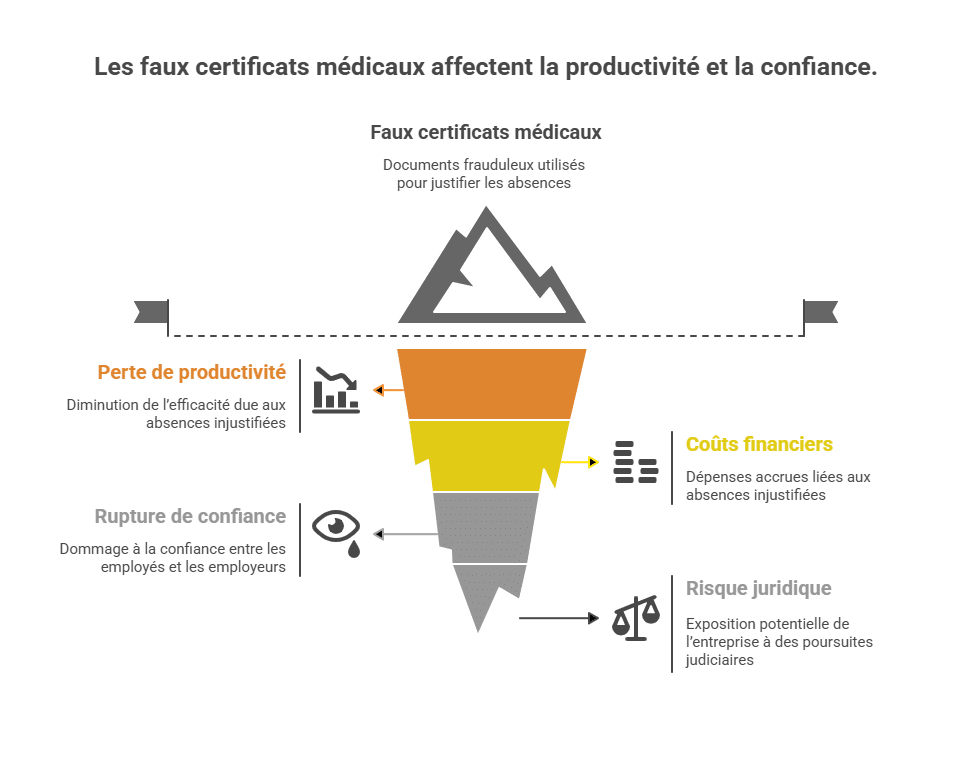
- Financial loss: Unjustified prolonged absences or incorrectly paid benefits constitute a significant cost.
- Loss of trust: Discovering a false certificate can harm the trust relationship between employer and employee.
- Increased verification obligations: Institutions must invest in control tools or processes, increasing administrative burden.
Personal implications for the user of the fake certificate
Besides penal sanctions, using a fake certificate can lead to:
- A disciplinary action within the company, possibly leading to termination for serious misconduct.
- Exclusion from sports competitions in the case of federations.
- A damage to personal reputation, which is difficult to repair.
Preventive message
Given these risks, it is essential to favor legal procedures and consult a doctor if needed. Resorting to a fake medical certificate is not only risky, but also unnecessary when legitimate solutions such as teleconsultations are available.
The significant sanctions provided by law highlight the importance of maintaining the integrity of medical certificates and respecting established rules.
Practical cases and real examples
Several high-profile cases illustrate the severity of using a fake medical certificate. In 2020, an employee was sentenced to several months in prison with suspension for providing a forged document to extend a sick leave. In the sports world, some federations excluded athletes after discovering false documents intended to hide medical contraindications. These examples remind us that the law does not hesitate to punish these practices severely and that they leave lasting marks on the reputation of those involved.
How to detect a false medical certificate?
With technological advances, false medical certificates are becoming increasingly sophisticated. However, effective methods exist to detect these forged documents, even when they appear credible at first glance. Here are the main approaches:
1. Manual verification
- Traditional validation remains a key tool for detecting fakes. It involves analyzing:
- The information provided, such as the doctor’s name, address, and contact details of the establishment.
- The medical signature, which should match the practitioner’s usual style.
- The presence of an official stamp, essential to validate the document’s authenticity.
This method requires meticulous attention, as gross errors (like inconsistencies in dates or mandatory mentions) can be easily spotted.
- Advanced technologies
- Technological advances allow strengthening the detection of fakes through intelligent algorithms. These tools analyze criteria such as:
- Visible inconsistencies, like scribbles or digital alterations on the document.
- Cross-referenced data with official databases to verify registered practitioners.
- Fakes generated by digital tools (Photoshop, image retouching), often detected via metadata analysis.
These automated systems are especially effective for processing large volumes of certificates, such as in sports federations or companies.
- Verification with the doctor
- In case of doubt, the most reliable method is to contact the doctor directly listed on the certificate. This helps to:
- Confirm that the practitioner indeed issued the document.
- Verify that the information matches the patient’s medical record.
This method is often used in critical cases, such as during disputes or in-depth investigations.
- Maintain integrity in administrative procedures.
- Protect the rights of healthcare professionals and institutions.
- Prevent abuses and ensure only eligible individuals benefit from benefits linked to a medical certificate.
- Loss of insurance coverage:
- In case of an accident or problem occurring in a context covered by a fake certificate (sports, work, etc.), insurers may deny any compensation.
- This forces the user to cover medical expenses or other costs related to the incident.
- Disciplinary sanctions:
- In a professional setting, an employer may consider the use of a fake certificate as a serious misconduct.
- This can lead to immediate dismissal without notice or compensation, with lasting career impact.
- Legal proceedings:
- The use of a fake certificate is punishable under article 441-1 of the Penal Code.
- In case of damage caused, the user may also be liable to pay damages, increasing financial consequences.
- Removal from the Medical Order:
- The professional can be struck off, which means permanent exclusion from the profession.
- This decision is often final and destroys the practitioner’s career.
- Temporary or permanent ban from practice:
- Depending on the severity of the facts, the doctor may be prohibited from practicing for a set period or for life.
- This ban includes all medical functions, whether in public or private practice.
- Criminal penalties:
- The healthcare professional may be sentenced to prison sentences and high fines, similar to those for the user.
- For the user: Their personal and professional reputation may be damaged, limiting future opportunities.
- For the healthcare professional: Involvement in such acts tarnishes the image of the entire profession and harms the trust relationship between doctors and patients.
- The practitioner can perform a comprehensive exam, ensuring the certificate’s relevance.
- The issued document includes all necessary elements (signature, stamp, date) to be valid for institutions.
- This method is especially recommended for situations requiring a thorough physical assessment, such as risky sports activities.
- 24/7 accessibility:
- Teleconsultation platforms like Feeli or Doctolib are available at any time, making them suitable for emergencies or busy schedules.
- They allow consulting a doctor with a few clicks, from home.
- Simplified procedures:
- A medical certificate can be issued after a medical questionnaire and a video or secure messaging consultation.
- The document is directly accessible in digital format within the user’s account.
- Limitations of telemedicine:
- Certiain certificates requiring a physical exam—such as those for extreme sports or specific disabilities—cannot be issued online.
- In these cases, a visit to a medical practice is mandatory.
- Legal sanctions related to a false certificate.
- Credibility issues in administrative or professional procedures.
- Loss of coverage in case of accident or dispute.
Common signs of a false medical certificate
| Indicators | Examples |
|---|---|
| Data inconsistencies | Errors in dates, names, or addresses. |
| Absence of stamp | A document without an official stamp is suspicious. |
| Scribbles or retouches | Visible modifications or clumsy erasures. |
| Impersonation | Doctor not registered with the medical order or unknown at the provided address. |
Importance of detecting false certificates
Detecting fakes is essential to:

Consequences of a false medical certificate
Using or applying a false medical certificate can have serious repercussions on legal, professional, and personal levels. These consequences vary depending on whether you are the user of the fake document or a healthcare professional involved.
Consequences for the user
The use of a fake medical certificate exposes the user to strict sanctions, which can impact their personal and professional situation:
Consequences for the healthcare professional
A doctor or any other healthcare professional involved in issuing a fake certificate is responsible for criminal and professional liability. Penalties are particularly severe to preserve the integrity of the medical sector:
Summary table of consequences
| Involved party | Potential consequences |
|---|---|
| User | Loss of insurance coverage, dismissal, legal proceedings. |
| Healthcare professional | Removal from register, ban from practice, criminal sentences. |
Lasting impact on reputation
Beyond legal sanctions, the use or issuance of a fake medical certificate can lead to a loss of credibility:
Preventive message
Resorting to a fake medical certificate is never a solution. The risks involved, for users and professionals alike, outweigh any potential benefits. It is better to use legal solutions such as consulting a doctor or telemedicine to meet your needs while respecting the law.
Role of insurance
A fake medical certificate can also have serious insurance consequences. Insurance companies may refuse to indemnify a policyholder who presented a falsified document during a claim. For example, in the case of a sports or work-related accident, fraud results in the nullification of coverage. This exclusion denies the insured any compensation and may expose them to significant medical or legal costs. Using an authentic certificate issued by an approved practitioner is therefore essential to maintain financial protection.
Dispute procedures
When an employer or institution suspects a false medical certificate, there are legal procedures for contestation. The employer can request a second medical examination performed by an approved physician. If doubt persists, they can involve the medical council or even the courts. These remedies protect both the company and the employee, preventing abuse. Transparency and adherence to rules thus reinforce mutual trust among employers, doctors, and employees.
Economic impact of false certificates
The use of fake medical certificates has a significant economic impact. In companies, fraudulent sick leaves cause productivity losses and additional costs, especially related to temporary replacements. For social security, each fraud costs thousands of euros in unjustified benefits paid out. Estimates suggest that unjustified absences amount to several hundred million euros annually in France. Beyond the figures, these practices weaken the national solidarity, as resources intended for genuine patients are diverted.

Legal alternatives to obtain a medical certificate
Instead of resorting to falsification, it is preferable to use legal and secure solutions to obtain a medical certificate. These methods prevent serious sanctions and comply with current regulations:
| Legal solution | Advantages |
|---|---|
| Medical consultation | Authentic and reliable certificate, validated by an approved doctor. |
| Telemedicine consultation | Time-saving and straightforward: no need to travel. |
Traditional medical consultation
In-person medical consultations remain the most common and reliable method of obtaining a medical certificate. They offer several advantages:
Telemedicine: a quick and convenient alternative
Telemedicine offers a legal and modern option to get a medical certificate without visiting a medical office. It is ideal in various cases:
Comparison table of legal alternatives
| Criteria | In-person consultation | Telemedicine consultation |
|---|---|---|
| Reliability | Authentic and complete certificate | Valid certificate for simple cases. |
| Speed | Depends on the doctor’s availability. | Time-saving, often immediate. |
| Physical exam | Performed on site. | Not possible. |
| Accessibility | Requires travel. | Accessible from anywhere. |
Why choose legal solutions?
These legal options allow obtaining a medical certificate while respecting the law. They prevent:



Conclusion
A false medical certificate may seem like a simple solution, but it carries major legal and personal risks. The best approach is to respect the law and obtain an authentic medical certificate through in-person or online consultations.
For Further Reading

Entraîne-toi avec nos Quiz de révision
Fini les lectures passives. Pour retenir les notions clés du BTS Assurance, teste-toi ! Inscris-toi pour recevoir 1 quiz par jour directement dans ta boîte mail.